IEC Standard X/R Ratio – Understanding Its Role in Fault Current and System Protection
The term IEC Standard X/R Ratio often comes up in electrical engineering studies and design standards. It represents one of the most critical factors in short circuit analysis, protective device coordination, and transformer fault calculations. Understanding this ratio helps engineers design safe and reliable power systems that comply with international standards such as IEC 60909. This article explains what the IEC standard X/R ratio is, why it is important, and how it is applied in real-world power systems.
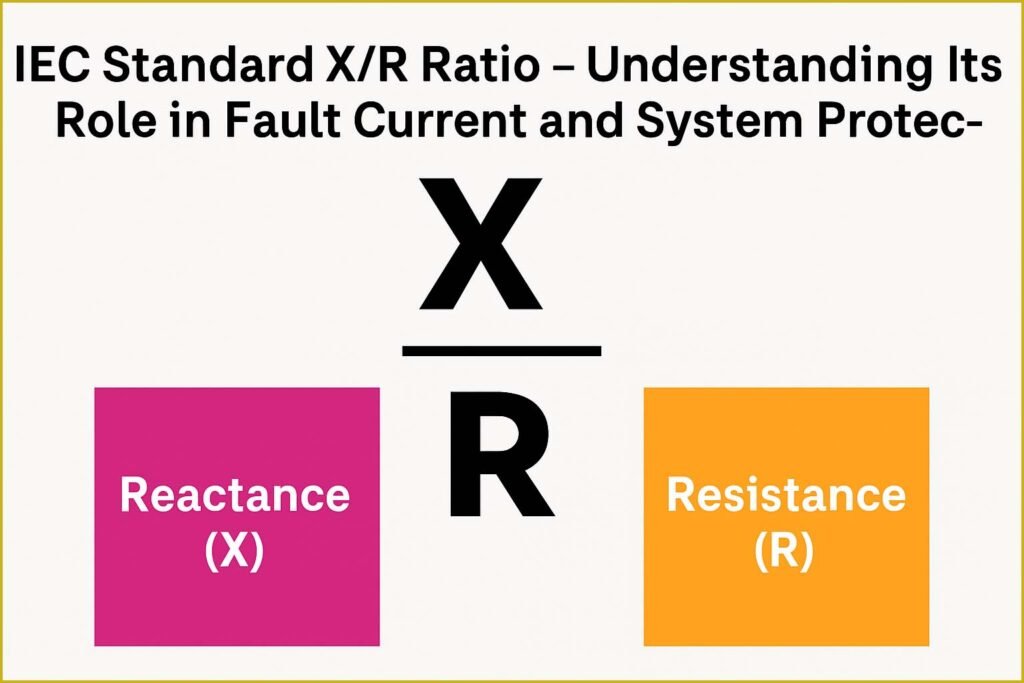
Table of Contents
What is the IEC Standard X/R Ratio
The IEC Standard X/R Ratio refers to the ratio of reactance (X) to resistance (R) in an electrical network. It indicates how inductive or resistive a circuit is under fault conditions. The higher the X/R ratio, the more inductive the system becomes, leading to a slower decay of DC offset currents during short circuits.
In simpler terms, this ratio shows how much of the total impedance is reactive (due to inductance) versus resistive. Power systems with long transmission lines or large transformers generally have higher X/R ratios because inductive reactance dominates over resistance.
The International Electrotechnical Commission (IEC) uses the X/R ratio in its standards for fault current calculations, particularly in IEC 60909 – Short Circuit Currents in Three-Phase AC Systems. This standard provides guidelines for determining short circuit levels, which are essential for sizing circuit breakers, fuses, and other protective equipment.
Know more about IEC Standards for Transformer Testing – Complete Guide to IEC 60076 and Testing Procedures
Formula for X/R Ratio
The formula is straightforward:
X/R
Where:
X = System reactance in ohms (Ω)
R = System resistance in ohms (Ω)
The result is a dimensionless number that shows the dominance of reactance or resistance in the system.
Importance of IEC Standard X/R Ratio
The IEC Standard X/R Ratio plays a major role in electrical system protection and equipment design. When a short circuit occurs, the initial current is not purely sinusoidal because of the DC offset caused by system inductance. This offset depends on the X/R ratio. A higher ratio means a slower decay of DC components, leading to a higher peak short circuit current.
This has direct consequences on:
- Circuit breaker selection – Breakers must handle the peak current caused by DC offset.
- Busbar design – Mechanical forces during faults depend on the peak fault current.
- Relay coordination – Time-current curves are influenced by the X/R value during transient faults.
- Transformer and generator protection – Accurate X/R ratios ensure proper relay settings and fault withstand capacity.
Ignoring the correct X/R ratio can result in underestimating short circuit currents, which can cause severe damage to switchgear, transformers, and other equipment.
IEC 60909 and X/R Ratio in Fault Calculations
The IEC 60909 standard provides methods to calculate short circuit currents, including the effects of DC components. It introduces the k factor, which depends on the system’s X/R ratio. This factor adjusts the RMS value of the short circuit current to include the DC offset for accurate peak current estimation.
The IEC method defines the peak short circuit current as:
Ipeak = k × √2 × Ik”
Where:
- Ipeak is the peak short circuit current
- Ik” is the initial symmetrical RMS short circuit current
- k is the correction factor based on the X/R ratio
Know more about IEC Standard for XLPE Cables – Complete Guide to IEC 60502 and Electrical Cable Specifications
Typical k Values for Different X/R Ratios
| X/R Ratio | k Factor | Nature of System |
|---|---|---|
| 1 | 1.02 | Low voltage, short cable |
| 5 | 1.10 | Typical industrial system |
| 10 | 1.15 | Medium voltage network |
| 20 | 1.25 | High voltage transmission |
| 40 | 1.35 | Very inductive system (EHV) |
This table shows that as the X/R ratio increases, the k factor rises, meaning a higher peak fault current. The IEC standard uses this relationship to ensure equipment ratings and clearances are sufficient.
Typical X/R Ratios in Electrical Systems
The X/R ratio varies depending on the type of network and equipment.
| System Type | Voltage Level | Typical X/R Ratio Range |
|---|---|---|
| Low Voltage Distribution | 230/400V | 1 to 5 |
| Industrial Networks | 415V to 11kV | 3 to 10 |
| Medium Voltage Substation | 11kV to 33kV | 10 to 20 |
| Transmission Network | 132kV to 400kV | 20 to 40 |
In low-voltage systems, resistance dominates, resulting in lower X/R ratios. In high-voltage systems, reactance dominates due to long transmission lines and transformers, leading to higher ratios.
Example of X/R Ratio Calculation
Consider a 11kV feeder with a total impedance of Z = 0.25 + j1.5 Ω.
Here,
R = 0.25 Ω
X = 1.5 Ω
Therefore,
X/R = 1.5 / 0.25 = 6
This means the system has an X/R ratio of 6, indicating it is moderately inductive. In short circuit studies, this value will be used to determine the DC offset and peak current.
Know more about IEC Standard for Relay Coordination – Complete Guide to Protection and Coordination Studies
Impact of X/R Ratio on Fault Currents
The IEC Standard X/R Ratio directly affects the following parameters:
- DC Component Decay – A high X/R ratio causes slow decay of DC current, increasing the initial fault asymmetry.
- Peak Current – The higher the ratio, the higher the peak fault current seen by circuit breakers and busbars.
- Thermal Stress – Equipment must withstand the energy released during fault conditions; high X/R ratios increase stress.
- Relay Coordination – Accurate X/R data ensures correct time settings for overcurrent relays, preventing false tripping or delayed isolation.
Example Comparison
| X/R Ratio | DC Offset Decay Time (ms) | Approx. Peak Fault Current (p.u.) |
|---|---|---|
| 2 | 10 | 1.1 |
| 10 | 50 | 1.3 |
| 20 | 100 | 1.4 |
This table shows that a system with X/R = 20 will have a much higher peak current and slower decay compared to X/R = 2.
IEC Guidelines for Short Circuit Testing
When manufacturers test circuit breakers or switchgear, the IEC Standard X/R Ratio must be considered to simulate realistic fault conditions. The test circuits are designed to match the expected X/R ratio of the system where the equipment will be used.
For example, IEC 62271 for high-voltage switchgear specifies that:
- For 11kV to 33kV systems, the test circuit should have X/R ≈ 10 to 14
- For transmission-level breakers (132kV and above), X/R ≈ 20 to 40
These ratios ensure that the breaker is tested for the correct degree of DC offset and mechanical stress.
Know more about IEC Standard for Vibration Testing – IEC 60068 Explained with Procedures and Requirements
Difference Between IEC and ANSI X/R Standards
Although both IEC and ANSI standards consider the X/R ratio, their approaches differ slightly. The IEC standard (IEC 60909) uses correction factors (k) to adjust for asymmetry, while ANSI (IEEE C37) directly includes X/R ratio in calculating the DC component.
| Parameter | IEC 60909 | ANSI C37 |
|---|---|---|
| Method | Uses correction factor (k) | Directly uses X/R ratio |
| Typical Range | 1 to 40 | 1 to 50 |
| Peak Current Calculation | Based on k × √2 × Ik” | Based on e^(–t/τ) with τ = L/R |
| Application | Europe, Asia, Africa | North America |
Both standards aim to ensure equipment safety, but IEC provides a more general and simplified approach suitable for various voltage levels and system types.
Applications of IEC Standard X/R Ratio
The concept of the IEC Standard X/R Ratio finds application across multiple engineering fields:
- Power System Design – Used to estimate short circuit levels and equipment withstand ratings.
- Protective Relaying – Critical in determining relay pickup settings and time-current coordination.
- Transformer Testing – Helps predict inrush currents and short circuit strength.
- Generator Protection – Ensures generators can withstand transient currents during system faults.
- Switchgear Rating – Used to define the making and breaking capacities of circuit breakers.
Every power system study or equipment design based on IEC standards requires an accurate X/R ratio to maintain compliance and reliability.
Key Takeaways
The IEC Standard X/R Ratio is not just a theoretical concept but a practical parameter with a direct impact on safety and equipment design. Understanding it helps engineers make informed decisions during short circuit analysis, relay coordination, and equipment testing.
Key points to remember:
- It defines the inductive to resistive balance of a system.
- Higher ratios lead to higher DC offsets and peak currents.
- IEC 60909 defines methods to include X/R ratio in fault calculations.
- Equipment design and testing must comply with the correct X/R ratios for realistic results.
Know more about IEC Standard for Vacuum Circuit Breaker – IEC 62271 Guidelines, Ratings & Testing Explained
Conclusion
The IEC Standard X/R Ratio serves as a foundation for accurate short circuit current calculations under the IEC 60909 standard. It represents how inductive or resistive a power system is, influencing peak current levels, equipment selection, and system protection schemes. Engineers must always consider the appropriate X/R ratio for their system voltage and configuration to ensure safety, compliance, and efficiency.
In every practical design—whether it’s a low-voltage plant or a high-voltage grid—the X/R ratio remains one of the most vital parameters to get right. A clear understanding of the IEC standard X/R ratio enables safer electrical networks and ensures every component performs within its design limits, avoiding unnecessary risks and failures.
Follow Us on Social:
Subscribe our Newsletter on Electrical Insights for latest updates from Electrical Engineering Hub
#IECStandard, #XRRatio, #PowerSystemAnalysis, #FaultCurrentCalculation, #ShortCircuitAnalysis, #ElectricalEngineering, #TransformerDesign, #IEEEStandards, #CircuitProtection, #ElectricalSafety, #PowerQuality, #HighVoltageTesting, #RelayProtection, #ElectricalFormulas, #EngineeringStandards