IEC Standard for Vibration Testing – IEC 60068 Explained with Procedures and Requirements
Vibration testing is one of the most important methods to ensure the durability and reliability of electrical and electronic equipment. It helps manufacturers understand how their products behave under real-world mechanical stresses such as transportation, operation, and environmental conditions. The IEC standard for vibration testing provides globally recognized procedures to conduct these tests accurately and consistently.
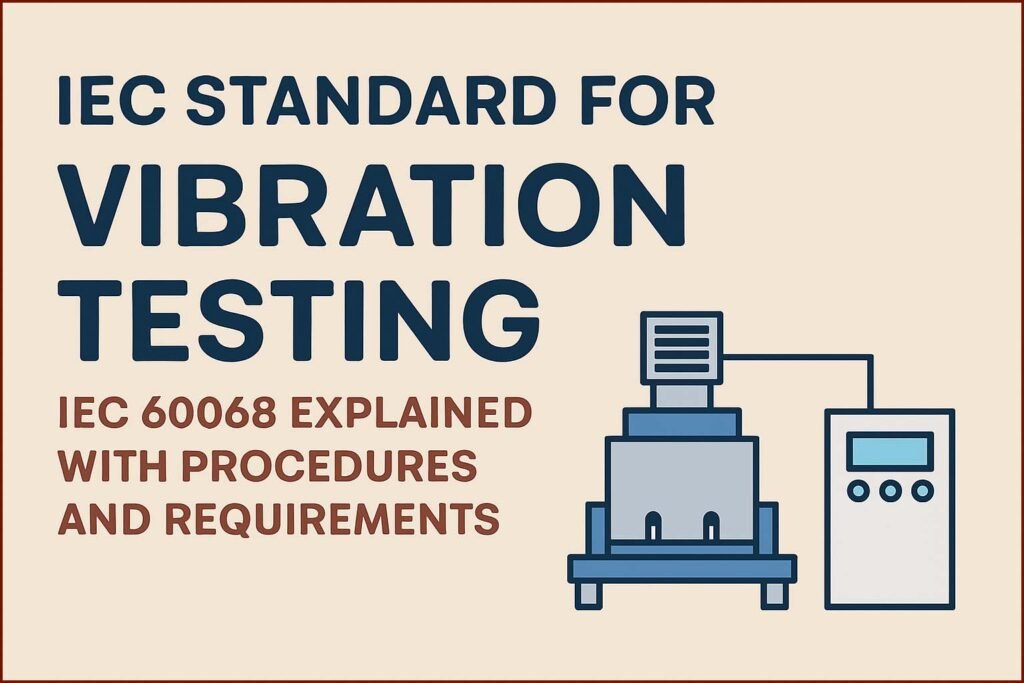
Table of Contents
This article explains what the IEC vibration testing standard is, why it is important, the testing procedures it defines, and how different industries apply it. We will also look at key parameters, test setups, and the major IEC standards that define vibration test requirements.
What is the IEC Standard for Vibration Testing
The IEC standard for vibration testing is a set of international guidelines developed by the International Electrotechnical Commission (IEC). These standards define how to perform vibration tests on electrical and electronic products to check their ability to withstand mechanical stresses.
The most common vibration standard used is IEC 60068-2-6, which describes the sinusoidal vibration test methods. The main purpose of this standard is to provide uniform testing methods for manufacturers and testing laboratories. It ensures that equipment is tested under consistent vibration conditions so that results are comparable across industries and regions.
The IEC standard is widely used in sectors such as power systems, automotive, aerospace, telecommunications, and consumer electronics. These industries rely on vibration tests to confirm that their devices can handle shocks and vibrations during shipping, installation, and operation.
Know more about IEC Standard for Vacuum Circuit Breaker – IEC 62271 Guidelines, Ratings & Testing Explained
Objectives of IEC Standard for Vibration Testing
The primary goals of the IEC vibration test standard are:
- To determine whether a product can withstand vibrations during its lifecycle
- To identify weak mechanical joints, solder cracks, and component fatigue
- To assess the performance stability under continuous vibration
- To verify compliance with reliability and quality requirements
By following IEC 60068-2-6 or related standards, manufacturers gain valuable data about structural integrity and product endurance.
Major IEC Standards Related to Vibration Testing
The IEC standard for vibration testing covers different vibration types and conditions. Below is a table summarizing key IEC standards relevant to vibration testing:
| IEC Standard | Description | Test Type | Application Area |
|---|---|---|---|
| IEC 60068-2-6 | Sinusoidal vibration test | Fixed frequency or swept vibration | General electrical equipment |
| IEC 60068-2-64 | Random vibration test | Broadband random vibration | Automotive, aerospace, and defense |
| IEC 60068-2-27 | Shock testing | Single or repetitive shocks | Transportation and packaging tests |
| IEC 60068-2-57 | Multiple shocks | Combination of shocks | High-reliability systems |
| IEC 60068-2-59 | Combined temperature and vibration | Environmental testing | Harsh environments |
Each of these standards defines the vibration profile, frequency range, acceleration levels, and test durations depending on the product category and its expected usage environment.
Know more about IEC Standard for Voltage Drop Calculation: Best Guide
Understanding IEC 60068-2-6 in Detail
The IEC 60068-2-6 is the most widely referenced IEC standard for vibration testing. It focuses on sinusoidal vibration, where the test equipment applies vibrations in a single frequency at a time or sweeps across a range of frequencies.
During this test, the specimen is mounted on a vibration table and subjected to controlled vibration along one or more axes. The test checks for any functional or mechanical failures, such as component displacement or broken connections.
Main Parameters in IEC 60068-2-6
The following parameters are defined under this standard:
| Parameter | Description | Typical Range |
|---|---|---|
| Frequency Range | The range of vibration frequencies applied during test | 10 Hz to 150 Hz or up to 2000 Hz |
| Acceleration | The force per unit mass (measured in g) | 0.5g to 10g or more |
| Displacement | Peak-to-peak motion amplitude | 0.075 mm to several mm |
| Duration | Total exposure time at each axis | 1 to 3 hours per axis |
The test can be performed either as a fixed-frequency test or as a frequency sweep test, where the vibration frequency changes gradually over time.
Test Procedure According to IEC Standard for Vibration Testing
The general test process involves several stages to ensure reliability and consistency.
1. Preparation Stage
The test specimen is cleaned, inspected, and mounted securely on the vibration table using appropriate fixtures. The orientation of the specimen is decided according to its normal operating position. Sensors such as accelerometers are attached to measure vibration levels accurately.
2. Test Execution
The vibration test is then started based on the parameters defined in the IEC standard. In sinusoidal testing, the frequency is either kept constant or swept across a defined range. The test is repeated along three perpendicular axes (X, Y, and Z) to simulate real-world conditions.
The test equipment records acceleration, displacement, and any functional failures during the test.
Know more about IEC Standard for VRLA Battery – Complete Guide to Design, Testing, and Performance
3. Post-Test Inspection
After completing the vibration exposure, the specimen is inspected for visible or hidden damage. Electrical continuity, insulation resistance, and functional performance tests are carried out.
If any defects appear, they are documented and analyzed to improve product design.
Importance of IEC Standard for Vibration Testing
Following the IEC standard for vibration testing provides several benefits:
- Reliability assurance: It ensures that products will function reliably under vibration stresses during operation and transport.
- Quality verification: It helps confirm mechanical robustness and adherence to international quality standards.
- Compliance: Many industries require IEC compliance before accepting products for use or further certification.
- Customer confidence: Compliance demonstrates that a product meets global reliability benchmarks.
- Design improvement: Vibration testing highlights weak points that can be corrected before mass production.
Industries Applying IEC Vibration Standards
The IEC standard for vibration testing is used across diverse industries:
- Automotive industry: Ensures vehicle components such as sensors, relays, and connectors withstand engine and road vibrations.
- Aerospace and defense: Tests avionics, control systems, and communication modules for vibration resilience during flight.
- Power and energy: Checks the mechanical strength of transformers, circuit breakers, and control panels.
- Electronics manufacturing: Verifies solder joints, PCB mounting, and enclosure strength.
- Telecommunications: Confirms the stability of antennas, base stations, and transmitters under vibration loads.
Know more about IEC Standard for Generator Protection – Key Guidelines and Compliance Requirements
Typical Equipment Used in Vibration Testing
A well-equipped vibration test system consists of:
| Equipment | Function |
|---|---|
| Electrodynamic shaker | Generates controlled vibrations |
| Power amplifier | Drives the shaker to desired frequency and amplitude |
| Control system | Monitors and adjusts vibration parameters |
| Accelerometers | Measure vibration levels on specimen |
| Fixture and table | Mount specimen securely during test |
Modern vibration systems are computer-controlled, allowing precise test setup, real-time data monitoring, and automated reporting.
Test Severity and Duration
The IEC standard for vibration testing defines test severity levels depending on product type and usage environment. For example, equipment used in transport vehicles experiences higher vibration intensity than static installations.
Severity is determined by combining parameters such as frequency range, acceleration level, and test duration. The duration can vary from a few minutes to several hours depending on reliability requirements.
Common Failure Modes Detected
Vibration tests often reveal mechanical and electrical weaknesses such as:
- Loosening of screws or connectors
- Cracked solder joints
- Wire breakage or insulation damage
- Deformation of enclosures
- Functional interruptions under vibration
Detecting these failures early helps prevent costly field failures and warranty claims.
IEC 60068-2-64 Random Vibration Test Overview
While IEC 60068-2-6 focuses on sinusoidal vibration, IEC 60068-2-64 addresses random vibration testing. This type of testing better represents real-world vibration profiles, such as those experienced in vehicles or aircraft.
Random vibration tests apply vibrations across a wide range of frequencies simultaneously, based on a defined Power Spectral Density (PSD) profile. This test is essential for products used in transport or mobile applications.
Know more about IEC Standard for Gas Insulated Switchgear – IEC 62271 Compliance, Design & Safety Guide
Comparison Between Sinusoidal and Random Vibration Tests
| Parameter | IEC 60068-2-6 (Sinusoidal) | IEC 60068-2-64 (Random) |
|---|---|---|
| Vibration Type | Single frequency or swept | Multiple frequencies simultaneously |
| Realism | Simulated | Realistic vibration conditions |
| Application | General electronics, power systems | Automotive, aerospace, defense |
Documentation and Reporting
The IEC standard also requires comprehensive documentation of test parameters, setup, and results. Reports should include:
- Equipment details and calibration data
- Vibration profile and frequency range
- Mounting orientation and test duration
- Observed failures or anomalies
- Post-test functional results
This ensures traceability and credibility of the test results.
Advantages of Following IEC Standard for Vibration Testing
Using the IEC vibration test framework gives manufacturers a competitive edge. It improves product reliability, reduces warranty claims, and ensures compliance with global requirements. Furthermore, it supports entry into international markets since IEC standards are widely recognized.
Products that pass IEC 60068-2-6 or IEC 60068-2-64 tests demonstrate mechanical strength and long-term durability, enhancing brand trust and reputation.
Conclusion
The IEC standard for vibration testing is a cornerstone of product reliability verification. It provides structured methods to test mechanical endurance under vibration and shock conditions. Among these standards, IEC 60068-2-6 and IEC 60068-2-64 are the most commonly used, defining procedures for sinusoidal and random vibration testing respectively.
By following these standards, manufacturers can ensure their products perform reliably in real-world environments, meet international compliance requirements, and maintain customer satisfaction. Whether for electronics, automotive components, or industrial systems, adherence to the IEC vibration testing standard remains a vital part of modern product development and quality assurance.
Follow Us on Social:
Subscribe our Newsletter on Electrical Insights for latest updates from Electrical Engineering Hub
#IECStandardForVibrationTesting, #VibrationTesting, #IECStandards, #MechanicalTesting, #ProductReliability, #EnvironmentalTesting, #ElectronicsTesting, #TestingStandards, #QualityAssurance, #VibrationTestLab, #IEC60068, #ProductCertification, #EngineeringStandards, #IndustrialTesting, #ComplianceTesting