
How to Calculate Voltage Drop Across a Resistor – Simple Formula, Examples & Tips
Understanding How to Calculate Voltage Drop Across a Resistor is a basic yet very important skill in electronics and electrical engineering. Whether you are a student, technician, hobbyist, or professional, this concept helps you design safe circuits, troubleshoot faults, and improve overall system efficiency. Voltage drop explains how electrical energy is used by components and why the voltage at one point in a circuit is different from another.
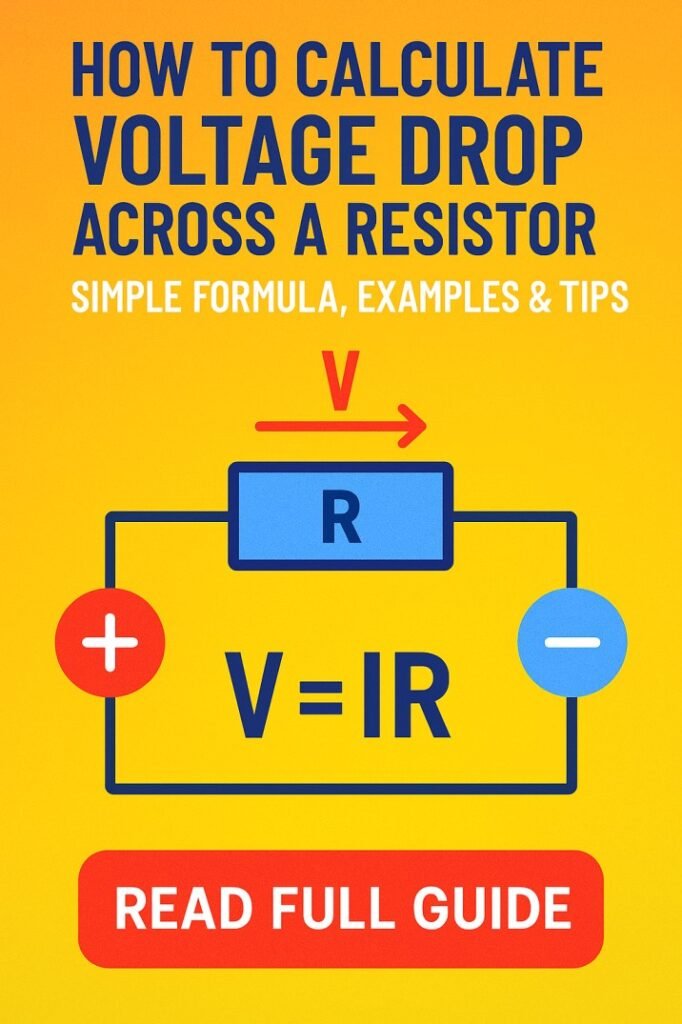
Table of Contents
In this guide, you will learn the theory behind voltage drop, the simple formula used worldwide, step-by-step examples, common mistakes, and practical tips used in real projects. The explanation stays simple, practical, and easy to follow from start to end.
What Is Voltage Drop Across a Resistor
Voltage drop is the reduction in electrical potential when current flows through a resistor. A resistor opposes the flow of current, and because of this opposition, some electrical energy is converted into heat. That energy conversion appears as a drop in voltage across the resistor.
In simple words, when current passes through a resistor, the voltage before the resistor is always higher than the voltage after it. The difference between these two values is called the voltage drop.
Try this tool out to save time and effort for easy conversions Amps to Wire Size Calculator – Choose the Right Cable for 10A, 20A, 40A Loads
Knowing How to Calculate Voltage Drop Across a Resistor allows you to predict circuit behavior, select proper components, and avoid under-voltage issues in sensitive devices.
Why Voltage Drop Matters in Circuits
Voltage drop is not just a theory topic. It has strong practical importance in real-world applications.
- It helps ensure electronic components receive the correct operating voltage
- It prevents overheating and component failure
- It improves power efficiency in circuits
- It helps diagnose wiring and connection problems
- It ensures accurate sensor and control system performance
Ignoring voltage drop can lead to malfunctioning devices, unstable circuits, and higher maintenance costs.
Basic Formula Used to Calculate Voltage Drop
The calculation of voltage drop across a resistor is based on Ohm’s Law. This law defines the relationship between voltage, current, and resistance.
The basic formula is:
Voltage Drop = Current × Resistance
Or in symbols:
V = I × R
Where:
- V is the voltage drop across the resistor (volts)
- I is the current flowing through the resistor (amperes)
- R is the resistance value (ohms)
This simple equation is the foundation of How to Calculate Voltage Drop Across a Resistor in both DC and AC circuits.
This tool is perfect for achieving better results in solar system design. Try here Wire Size Calculator for Solar Panels – Avoid Power Loss in Off-Grid and Hybrid Systems
Units Used in Voltage Drop Calculation
Before using the formula, it is important to understand the standard units involved.
| Quantity | Symbol | Unit |
|---|---|---|
| Voltage | V | Volt (V) |
| Current | I | Ampere (A) |
| Resistance | R | Ohm (Ω) |
Always make sure values are in correct units before applying the formula. Incorrect units are a common source of errors.
Step by Step Example of Voltage Drop Calculation
Let us understand the concept with a simple example.
Suppose you have a resistor of 10 ohms, and the current flowing through it is 2 amperes.
Step 1: Identify given values
- Resistance = 10 ohms
- Current = 2 amperes
Step 2: Apply the formula
Voltage Drop = Current × Resistance
Step 3: Substitute values
Voltage Drop = 2 × 10
Step 4: Calculate
Voltage Drop = 20 volts
This means the resistor causes a voltage drop of 20 volts. This clear process shows How to Calculate Voltage Drop Across a Resistor without confusion.
Use this tool if you are trying to calculate cable size for underground cables. Try here Underground Cable Size Calculator – Find Correct Wire Size for Long Distance Runs
Voltage Drop in Series Circuits
In a series circuit, resistors are connected end to end, and the same current flows through each resistor. The total voltage is divided among all resistors based on their resistance values.
| Resistor | Resistance (Ω) | Current (A) | Voltage Drop (V) |
|---|---|---|---|
| R1 | 5 | 2 | 10 |
| R2 | 10 | 2 | 20 |
| R3 | 15 | 2 | 30 |
Total Voltage = 10 + 20 + 30 = 60 volts
This method is widely used in voltage divider circuits. Understanding How to Calculate Voltage Drop Across a Resistor in series circuits helps in designing stable power supplies.
Voltage Drop in Parallel Circuits
In parallel circuits, the voltage across each resistor remains the same, while the current divides. Voltage drop across each branch equals the supply voltage.
Key points for parallel circuits:
- Voltage drop is equal across all resistors
- Current depends on resistance value
- Power dissipation varies for each branch
While the calculation focus changes, the core idea of How to Calculate Voltage Drop Across a Resistor remains linked to Ohm’s Law.
Use our online tool for free Voltage Drop on Resistor Calculator – Accurate Calculations for Electrical Circuits
Common Mistakes to Avoid
Many beginners make small mistakes that lead to incorrect results. Avoiding these improves accuracy and safety.
- Using resistance in kilo-ohms without converting to ohms
- Mixing milliampere and ampere values
- Forgetting that current is same only in series circuits
- Ignoring internal resistance of power sources
- Applying AC values directly without RMS consideration
Double-checking values ensures reliable results every time.
Practical Tips for Accurate Calculations
Applying theory in real projects requires attention to detail. These tips will help you get better results.
- Always measure actual resistance with a multimeter
- Account for temperature effects in high-power resistors
- Use proper wire size to avoid unwanted voltage drop
- Calculate power dissipation along with voltage drop
- Verify results with simulation tools when possible
These practices enhance your understanding of How to Calculate Voltage Drop Across a Resistor in practical environments.
Voltage Drop and Power Dissipation Relationship
Voltage drop is closely related to power dissipation in a resistor. Power can be calculated using:
Power = Voltage × Current
Or:
Power = I² × R
Higher voltage drop usually means higher heat generation. This is why resistor wattage rating must always be selected carefully.
| Voltage Drop (V) | Current (A) | Power Dissipation (W) |
|---|---|---|
| 5 | 1 | 5 |
| 10 | 1 | 10 |
| 20 | 2 | 40 |
Ignoring power ratings can damage components and reduce circuit life.
Know more about Voltage Drop Chart: A Comprehensive Overview
Applications Where Voltage Drop Calculation Is Essential
Voltage drop calculations are used in many real-world applications.
- Electronic circuit design
- LED resistor selection
- Battery-powered devices
- Automotive electrical systems
- Industrial control panels
In all these areas, engineers rely on How to Calculate Voltage Drop Across a Resistor to ensure performance and safety.
Final Thoughts
Learning How to Calculate Voltage Drop Across a Resistor is a fundamental step toward mastering electronics. The formula is simple, but its applications are vast and practical. By understanding voltage drop, you gain control over circuit behavior, prevent costly mistakes, and improve design quality.
Ue our online tool for free Resistor Voltage Drop Calculator: A Comprehensive Guide
With regular practice, careful measurements, and proper component selection, voltage drop calculations become second nature. This knowledge not only improves technical skills but also builds confidence when working with real electrical systems.
Follow Us on Social:
Subscribe our Newsletter on Electrical Insights for latest updates from Electrical Engineering Hub
#VoltageDrop, #ResistorCalculations, #OhmsLaw, #CircuitAnalysis, #ElectricalEngineering, #ElectronicsBasics, #EEStudy, #ElectricalFormulas, #EngineeringStudents, #LearnElectronics