High Voltage Circuit Breaker Testing: Important Guide to HV Breaker Inspection, Tests & Maintenance
High voltage circuit breaker testing is an essential part of maintaining reliable electrical power systems. High voltage circuit breakers operate as the primary protection devices in substations and power distribution networks. They interrupt fault currents, isolate damaged equipment, and prevent cascading failures across the grid.
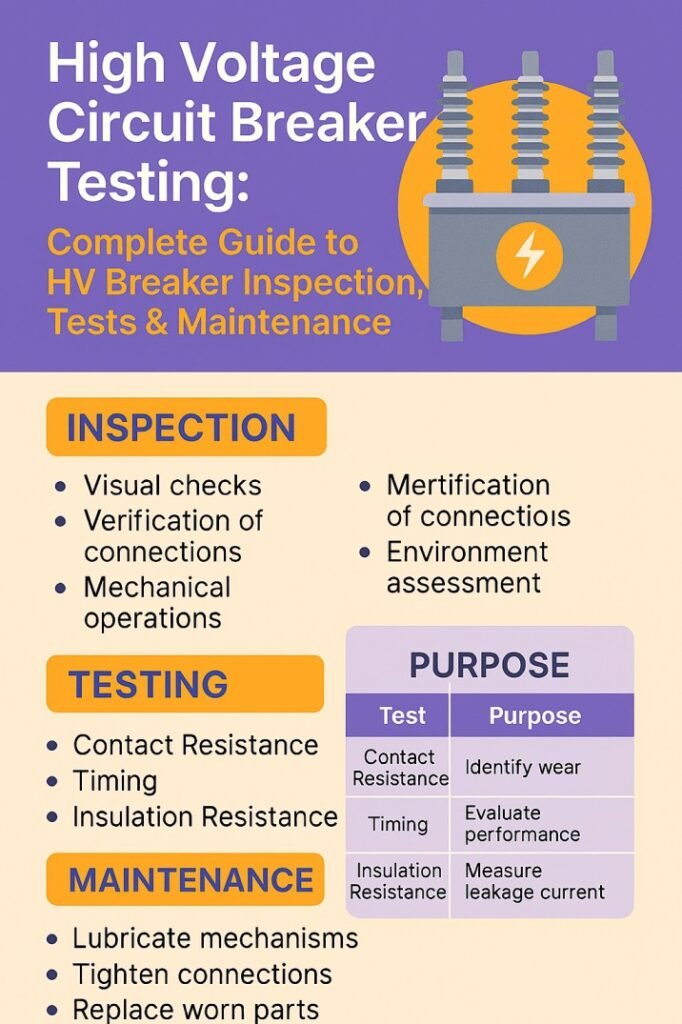
Table of Contents
Because these breakers operate under extreme electrical stress, regular testing and inspection are necessary to ensure proper operation. Without proper testing, a circuit breaker may fail to trip during a fault, which can result in equipment damage, power outages, and safety hazards.
This guide explains the practical aspects of high voltage circuit breaker testing, including inspection procedures, common testing methods, and recommended maintenance practices used in modern power systems.
Importance of High Voltage Circuit Breaker Testing
High voltage circuit breakers are critical switching devices in transmission and distribution networks. Their reliability directly affects the stability of the entire power system.
Learn more about circuit breaker contact resistance test
Routine high voltage circuit breaker testing helps engineers verify that the breaker can interrupt fault currents safely and within the specified time limits. It also allows maintenance teams to detect insulation problems, mechanical wear, or contact deterioration before failure occurs.
Some key benefits of periodic testing include:
- Ensuring safe interruption of fault currents
- Detecting mechanical and electrical defects early
- Extending breaker service life
- Reducing unexpected outages
- Maintaining compliance with power utility standards
Modern utilities typically follow maintenance standards such as IEC 62271, IEEE C37 series, and manufacturer recommendations when performing high voltage circuit breaker testing.
Types of High Voltage Circuit Breakers
Different technologies are used in high voltage breakers. Each type requires specific testing and maintenance methods.
| Breaker Type | Interrupting Medium | Typical Voltage Range | Maintenance Requirement |
|---|---|---|---|
| Oil Circuit Breaker | Mineral oil | Up to 220 kV | High maintenance |
| Air Blast Circuit Breaker | Compressed air | 132 kV – 400 kV | Moderate |
| SF6 Circuit Breaker | Sulfur hexafluoride gas | 66 kV – 800 kV | Low |
| Vacuum Circuit Breaker | Vacuum interrupter | Up to 72.5 kV | Very low |
Among these, SF6 circuit breakers and vacuum circuit breakers are most commonly used today because of their reliability and minimal maintenance requirements.
Get complete information about contact resistance test
Regardless of the technology, high voltage circuit breaker testing ensures the breaker continues to perform its protective function effectively.
Visual Inspection Before Testing
Before performing electrical tests, a detailed visual inspection should be carried out. This step often reveals many mechanical or environmental issues.
Inspectors should check the following components carefully:
- Condition of insulation and bushings
- Signs of oil leakage or gas pressure loss
- Mechanical linkage and operating mechanisms
- Contact wear indicators
- Corrosion on terminals and connectors
- Control wiring and auxiliary contacts
A simple inspection can prevent unnecessary testing delays and identify visible problems that require immediate attention. Learn more about circuit breaker contact resistance test
Major Tests Performed in High Voltage Circuit Breaker Testing
Several diagnostic tests are used during high voltage circuit breaker testing. These tests verify electrical integrity, mechanical performance, and insulation strength.
The most common tests are listed below.
Contact Resistance Test
Contact resistance testing measures the resistance across breaker contacts when the breaker is closed. High resistance may indicate worn contacts, contamination, or poor connections.
Find out more about Busbar Stability Test Procedure – Step-by-Step Method to Ensure Safe and Reliable Busbars
The test is usually performed using a micro-ohmmeter that injects high DC current through the contacts.
Typical acceptable resistance values depend on breaker type and manufacturer specifications.
| Breaker Rating | Typical Contact Resistance |
|---|---|
| 11 kV Breaker | 20 – 80 µΩ |
| 33 kV Breaker | 30 – 100 µΩ |
| 132 kV Breaker | 40 – 150 µΩ |
Consistent readings across all phases indicate healthy contacts.
Timing Test
Timing analysis is one of the most important procedures in high voltage circuit breaker testing. It measures the opening and closing time of breaker poles.
If the poles do not operate simultaneously, system faults may not clear properly.
Timing tests evaluate:
- Opening time
- Closing time
- Pole synchronization
- Contact bounce duration
Know more about Top 20 Electrical Testing Tools Which You Must Have
Digital breaker analyzers are commonly used for this purpose.
| Parameter | Typical Range |
|---|---|
| Opening Time | 30 – 60 ms |
| Closing Time | 50 – 100 ms |
| Pole Difference | < 2 ms |
Abnormal timing values may indicate mechanical wear, weak springs, or actuator problems.
Insulation Resistance Test
Insulation resistance testing verifies the integrity of breaker insulation using a megohmmeter.
The test is performed between:
- Phase to phase
- Phase to ground
- Across open contacts
A higher insulation resistance value indicates better insulation health.
| Voltage Level | Minimum IR Value |
|---|---|
| 11 kV | 100 MΩ |
| 33 kV | 200 MΩ |
| 132 kV | 500 MΩ |
Low insulation resistance may indicate moisture ingress, contamination, or insulation degradation.
Know more about Best Megger Testers for Industrial Use
High Voltage Withstand Test
The high voltage withstand test checks whether the breaker insulation can withstand operating voltage levels without breakdown.
This test applies a high voltage across breaker terminals for a specified duration.
Common test types include:
- Power frequency withstand test
- Lightning impulse test
- Switching impulse test
Successful completion of these tests confirms that insulation strength is adequate for system operation.
Dynamic Contact Resistance Measurement
Dynamic contact resistance measurement evaluates contact resistance while the breaker operates.
This test helps identify contact erosion or poor arcing contact engagement.
Explore all about How to Test a 3 Phase Motor With a Megger
Dynamic measurements provide valuable information about:
- Contact travel profile
- Arcing contact condition
- Mechanical linkage performance
Advanced circuit breaker analyzers are typically used for this test.
Mechanical Operation Testing
Mechanical reliability is as important as electrical performance in high voltage circuit breaker testing.
Technicians verify the operating mechanism by checking:
- Spring charging motor operation
- Trip and close coil functionality
- Mechanical interlocks
- Lubrication condition
- Operating force and travel distance
A breaker may pass electrical tests but still fail mechanically if the operating mechanism is weak or damaged.
Find more about Fluke 1507 Insulation Tester Megger Working
Gas and Oil Quality Tests
Certain breaker technologies require additional tests related to their interrupting medium.
For SF6 circuit breakers, technicians measure:
- SF6 gas pressure
- Gas purity
- Moisture content
- Dew point
For oil circuit breakers, the insulating oil must be tested for:
- Dielectric strength
- Moisture level
- Dissolved gas analysis
| Parameter | Acceptable Limit |
|---|---|
| SF6 Moisture Content | < 150 ppm |
| Oil Dielectric Strength | > 30 kV |
| Gas Purity | > 97% |
Poor gas or oil quality can significantly reduce breaker insulation capability.
Find more about Best Megger Insulation Tester for Industrial Motors
Recommended Maintenance Intervals
Utilities follow maintenance schedules based on operating cycles, system voltage, and manufacturer guidance.
Typical inspection intervals are shown below.
| Equipment | Inspection Interval |
|---|---|
| Visual Inspection | Every 6 – 12 months |
| Functional Operation Test | Every 2 – 3 years |
| Complete Electrical Testing | Every 5 years |
| Major Overhaul | 10 – 15 years |
However, breakers operating in harsh environments may require more frequent high voltage circuit breaker testing.
Common Problems Detected During Testing
Regular high voltage circuit breaker testing often reveals issues that could lead to failure if left unaddressed.
Some common problems include:
- Increased contact resistance
- Slow breaker operation
- Gas leakage in SF6 breakers
- Insulation deterioration
- Mechanical linkage wear
- Control circuit malfunction
Early detection allows maintenance teams to repair or replace components before major system failures occur.
Find all about Best Megger Insulation Testers 5000V
Best Practices for Reliable Breaker Performance
Following best maintenance practices improves the reliability and lifespan of high voltage circuit breakers.
Important recommendations include:
- Maintain detailed test records for trend analysis
- Follow manufacturer maintenance guidelines
- Use calibrated testing equipment
- Train maintenance personnel regularly
- Implement condition-based maintenance strategies
Utilities that follow systematic high voltage circuit breaker testing programs experience significantly fewer unplanned outages.
Know more about Top 12 Electrical Testing Equipment Suppliers in USA
Conclusion
High voltage circuit breaker testing plays a crucial role in ensuring safe and reliable power system operation. Circuit breakers protect expensive electrical equipment and maintain grid stability by interrupting dangerous fault currents.
Routine inspection, electrical testing, and preventive maintenance help identify potential issues long before they lead to equipment failure. Tests such as contact resistance measurement, timing analysis, insulation resistance testing, and mechanical operation checks provide valuable insights into breaker health.
By implementing a structured high voltage circuit breaker testing program, power utilities and industrial facilities can improve system reliability, reduce downtime, and extend the service life of critical switching equipment. Find all about High Voltage Cable Testing Standards: Complete Guide for Engineers
Follow Us on Social:
Subscribe our Newsletter on Electrical Insights for latest updates from Electrical Engineering Hub
#HighVoltageCircuitBreakerTesting, #HighVoltageTesting, #CircuitBreakerMaintenance, #SubstationTesting, #PowerSystemProtection, #ElectricalTesting, #SwitchgearTesting, #HVEquipment, #ElectricalEngineering, #PowerSystemMaintenance