
Energy Management System ROI Calculator – Instantly Measure Energy Savings & Payback
Rising electricity costs, tighter sustainability targets, and pressure to improve operational efficiency have pushed energy optimization to the top of the priority list for industries, commercial buildings, and large facilities. While many organizations understand the value of monitoring and controlling energy usage, decision-makers still ask one critical question before investing: What is the return on investment?
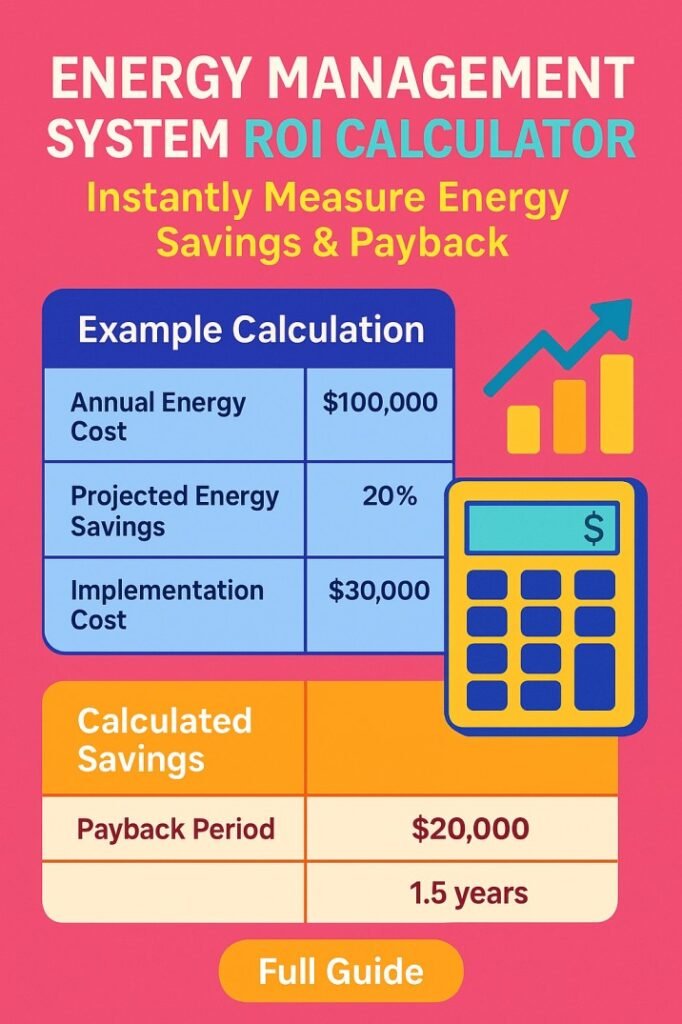
Table of Contents
This is where an energy management system ROI calculator becomes essential. It allows facility owners, energy managers, and financial planners to instantly estimate savings, payback period, and long-term financial benefits before implementing an Energy Management System. Instead of relying on assumptions, you can make data-driven decisions with clear financial visibility.
What Is an Energy Management System ROI Calculator
An energy management system ROI calculator is a practical evaluation tool used to quantify the financial impact of deploying an Energy Management System. It combines energy consumption data, utility tariffs, system costs, and efficiency improvement assumptions to calculate potential savings and investment recovery time.
Rather than presenting generic estimates, the calculator adapts to your specific facility profile. This makes it useful for factories, data centers, hospitals, shopping malls, universities, and office buildings where energy consumption patterns vary widely.
Test our online tool for free Transformer Full Load Current Calculator – Accurate Load & Current Calculation Tool for Transformers
At its core, the energy management system ROI calculator answers three fundamental questions:
- How much energy cost can be reduced annually
- How long it will take to recover the initial investment
- What financial benefit the system delivers over its lifecycle
Energy Management System ROI Calculator
Energy Management System ROI Calculator
Estimate savings, payback, ROI, NPV, and IRR for EMS projects—IEC efficiency practice and NEC installation cost context.
Inputs
How to use
- Baseline: Enter annual kWh and energy rate. If demand charges apply, add peak kW and monthly demand rate.
- Savings: Set EMS energy savings (%) and peak reduction (%). TOU mode weights savings toward peak hours.
- Costs: Enter capex, annual O&M, incentives, project life, and discount rate.
- Run: Click Calculate to see annual savings, payback, ROI, NPV, IRR, and peak demand savings.
- Interpretation: Positive NPV and IRR above your hurdle rate indicate a financially attractive EMS project.
Technical notes
- Energy savings: kWh_saved = baseline·(EMS%) adjusted by TOU peak share if selected.
- Demand savings: kW_saved = peak·(peak%) → annual demand savings = kW_saved·rate·12.
- Cash flow: Annual net = (energy + demand savings) − O&M. NPV uses discount rate; IRR solved numerically.
- Scope: This tool estimates financials; detailed M&V, tariff structures, and NEC installation specifics should be verified for your site.
Why ROI Calculation Matters Before EMS Implementation
Energy Management Systems are long-term investments. Hardware, software licenses, sensors, integration, and training all contribute to upfront cost. Without a clear ROI analysis, approval becomes difficult, especially when budgets are tight.
Using an energy management system ROI calculator helps align technical goals with financial expectations. It bridges the gap between engineers and management by translating kilowatt-hours into currency and savings into measurable value.
Key reasons ROI analysis is critical include:
- Budget justification for management and finance teams
- Comparison between multiple EMS vendors or system scopes
- Risk reduction by identifying realistic savings potential
- Alignment with corporate energy efficiency and ESG goals
Start using our online tool today — it’s free Transformer Short Circuit Calculator – Accurate Fault Current & Transformer Protection Tool
Key Inputs Used in an Energy Management System ROI Calculator
The accuracy of any energy management system ROI calculator depends on the quality of input data. While calculators vary in complexity, most rely on the following parameters.
| Input Parameter | Description |
|---|---|
| Annual Energy Consumption | Total electricity or energy usage in kWh or MWh |
| Energy Cost | Average utility tariff per unit |
| Expected Efficiency Gain | Percentage reduction from monitoring and optimization |
| EMS Implementation Cost | Hardware, software, installation, and training |
| Maintenance Cost | Annual operational or licensing expenses |
| Project Life | Evaluation period, typically 5 to 10 years |
These inputs help the calculator simulate realistic scenarios instead of optimistic assumptions.
Enjoy free access to our online tool Step-Down Transformer Calculator – Accurate Voltage & Power Conversion Tool
How the Energy Management System ROI Calculator Works
The logic behind an energy management system ROI calculator is straightforward but powerful. It converts operational improvements into financial metrics that are easy to interpret.
The typical calculation flow includes:
- Estimating annual energy savings based on efficiency improvement
- Converting saved energy units into monetary savings
- Subtracting annual EMS operating costs
- Calculating net annual benefit
- Dividing total investment by annual savings to determine payback period
This structured approach ensures transparency and credibility, which is essential when presenting results to stakeholders.
Sample ROI Calculation Table
To better understand how results are presented, consider the example below.
| Parameter | Value |
|---|---|
| Annual Energy Use | 5,000,000 kWh |
| Energy Cost | 0.14 per kWh |
| Expected Reduction | 10% |
| Annual Energy Savings | 500,000 kWh |
| Annual Cost Savings | 70,000 |
| EMS Investment | 180,000 |
| Simple Payback Period | 2.6 Years |
An energy management system ROI calculator produces similar outputs instantly, allowing quick comparison across facilities or projects.
Use our online tool without paying anything Transformer Impedance Calculation Tool – Accurate Transformer Impedance Calculator for Engineers
Benefits of Using an Energy Management System ROI Calculator
Beyond basic financial metrics, the calculator provides strategic insights that support smarter energy decisions.
Major benefits include:
- Clear visibility of cost-saving potential
- Faster investment approval cycles
- Improved confidence in EMS deployment
- Ability to scale EMS projects based on financial performance
- Better alignment between engineering and financial teams
By quantifying benefits, energy optimization becomes a business initiative rather than just a technical upgrade.
Typical Energy Savings Achieved with EMS
Actual savings vary by facility type, operational discipline, and energy profile. However, data from real-world implementations shows consistent improvement when Energy Management Systems are properly used.
| Facility Type | Typical Savings Range |
|---|---|
| Manufacturing Plants | 8% to 15% |
| Commercial Buildings | 5% to 12% |
| Data Centers | 10% to 20% |
| Hospitals | 6% to 14% |
| Universities | 7% to 13% |
An energy management system ROI calculator factors these realistic ranges to avoid overstated projections.
Access our online tool completely free Transformer Vector Group Calculation Tool | Easy & Accurate Vector Group Calculator
Beyond Payback: Long-Term Financial Impact
While payback period is often the first metric reviewed, it does not tell the whole story. A robust energy management system ROI calculator also highlights cumulative savings over the system’s life.
Over five to ten years, even moderate efficiency gains can translate into substantial cost reductions. Additionally, improved energy visibility reduces equipment stress, lowers maintenance costs, and supports predictive maintenance strategies. These indirect benefits further strengthen the financial case, even if they are not fully quantified in basic ROI models.
Who Should Use an Energy Management System ROI Calculator
This tool is not limited to energy engineers. It serves a wide range of professionals involved in planning and approving energy projects.
- Facility and plant managers
- Energy auditors and consultants
- Electrical and automation engineers
- Financial controllers and CFOs
- Sustainability and ESG managers
By speaking the language of finance and operations simultaneously, the energy management system ROI calculator becomes a common reference point for decision-making.
Use our tool online at no cost Transformer Losses Calculation Tool – Accurate & Easy Energy Loss Analysis
Common Mistakes to Avoid When Calculating ROI
Even with a calculator, errors can distort results if assumptions are unrealistic. Awareness of common pitfalls improves accuracy.
- Overestimating energy reduction percentages
- Ignoring recurring software or maintenance costs
- Using outdated or averaged energy tariffs
- Excluding future energy price escalation
- Assuming behavior change without accountability
A well-designed energy management system ROI calculator encourages conservative inputs to maintain credibility.
How to Use the Calculator for Maximum Accuracy
To get the most reliable results, always base inputs on real data. Use at least 12 months of energy bills, confirm tariff structures, and consult EMS vendors for realistic efficiency benchmarks. Recalculate ROI annually after implementation to track actual performance against projections.
When used correctly, the energy management system ROI calculator becomes a living tool rather than a one-time estimate.
Try our free online tool Transformer Temperature Rise Calculator: Accurate and Easy Guide
Final Thoughts
Investing in energy efficiency is no longer optional for competitive and sustainable operations. However, every investment must prove its value. An energy management system ROI calculator provides that proof by transforming energy data into clear financial outcomes.
By instantly measuring energy savings, payback period, and long-term benefits, it empowers organizations to move forward with confidence. Whether you manage a single building or a multi-site industrial portfolio, this calculator ensures your energy management strategy is financially sound, transparent, and aligned with business goals.
Follow Us on Social:
Subscribe our Newsletter on Electrical Insights for latest updates from Electrical Engineering Hub
#EnergyManagementSystem, #EMSROICalculator, #EnergyROI, #SmartEnergy, #EnergySavings, #IndustrialEnergy, #PowerManagement, #EnergyEfficiency, #CostReduction, #SustainableEnergy