
Electricity Cost Calculator by Zip Code – Instantly Estimate Your Energy Bills & Save Money
Introduction
Managing electricity expenses is a critical task for households, commercial buildings, and industrial facilities alike. The electricity cost calculator by zip code allows users to estimate their energy costs based on local utility rates, consumption patterns, and regional pricing differences. By entering relevant data, engineers, electricians, and facility managers can quickly determine expected monthly or annual electricity expenses.
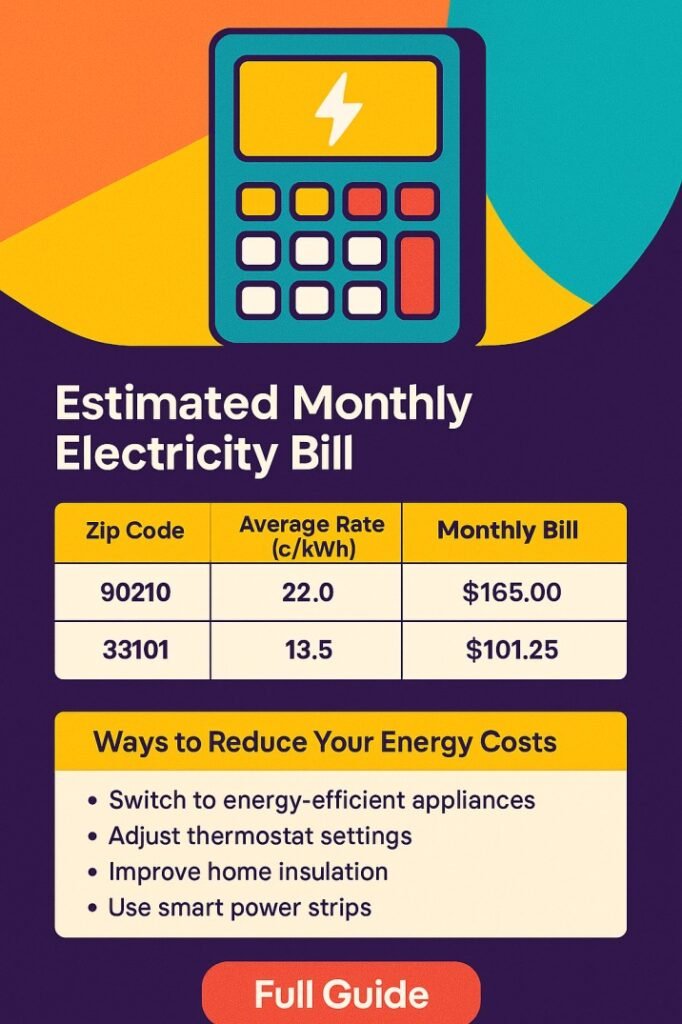
Table of Contents
Accurate calculations are essential for budgeting, planning energy efficiency measures, and evaluating equipment operation costs. Misestimating electricity costs can lead to overspending, inefficient system design, or improper load management. This calculator ensures precise cost estimations that align with both practical and regulatory electrical practices.
Electricity Cost Calculator by ZIP Code
Enter your energy usage, zip code, and utility details into the calculator to get an instant estimate of your electricity costs. Adjust values as needed to analyze different scenarios and optimize your energy planning.
Electricity Cost Calculator by ZIP Code
Estimate monthly and annual electricity costs using ZIP‑based typical rates. IEC efficiency context and NEC installation adders included.
Inputs
How to use
- ZIP & period: Enter your ZIP code and choose monthly or annual billing.
- Usage: Enter kWh for the selected period. Optional IEC efficiency (%) reduces kWh before cost calculation.
- Tariff: Use flat rate (auto‑filled from ZIP) or TOU with peak/off rates and peak share.
- Charges: Fixed service charge and optional demand charge ($/kW‑month) can be auto‑filled or overridden. Sales tax (%) applies to energy + fixed + demand.
- Run: Click Calculate to see monthly/annual totals, effective rate, and a breakdown of energy, fixed+demand, and tax.
Technical notes
- Energy (flat): $ = kWh · (¢/kWh ÷ 100).
- Energy (TOU): $ = kWh · (peakShare·peak¢ + (1−peakShare)·off¢)/100.
- Fixed: Monthly fixed = service charge; Annual = monthly × 12.
- Demand: Monthly demand $ = peak kW · ($/kW‑month); Annual = monthly × 12.
- Tax: Tax $ = (energy + fixed + demand) · tax%.
- IEC efficiency: kWh_eff = kWh · (1 − IEC%). NEC adders are added monthly and scaled annually.
Find more Electrical Engineering Tools for easy electrical calculations and estimations.
How to Use Electricity Cost Calculator by ZIP Code (Step-by-Step)
- Enter Your Zip Code – This allows the calculator to apply local electricity rates for your region.
- Input Monthly or Annual Energy Usage – Provide the total kilowatt-hours (kWh) consumed. For appliances or industrial equipment, include estimated usage per month.
- Select Utility Type – Choose residential, commercial, or industrial tariffs if applicable.
- Adjust Additional Factors – Some calculators may allow you to include peak/off-peak usage or demand charges.
- Click Calculate – The tool will provide your estimated electricity cost. Review the results and, if necessary, modify inputs to test different scenarios.
Use our online tool Generator Power Consumption Calculator – Accurate Tool to Estimate Fuel and Load Usage
How the Calculation Works
The electricity cost calculator by zip code works by combining your energy consumption with the applicable local utility rate. It considers:
- Total energy usage over the selected period
- Applicable rate per kilowatt-hour for your zip code
- Optional demand or time-of-use charges
Essentially, it multiplies the energy consumed by the local electricity rate and adds any additional fees to give a realistic cost estimate. This approach allows users to see how changes in energy consumption or local rates affect overall expenses.
Practical Electrical Example
Consider a small manufacturing facility in a region where electricity costs vary by zip code.
Given values:
- Zip code: 12345
- Monthly energy consumption: 4,500 kWh
- Utility type: Industrial
Steps:
- Enter zip code 12345 to apply local industrial rates.
- Input 4,500 kWh as monthly usage.
- Select “Industrial” as the utility type.
- Click calculate.
Access our powerful online calculator now Conduit Fill Calculator (NEC Standard): Best Tool
Result interpretation:
The calculator estimates monthly electricity cost based on local industrial rates. If the result shows $540, facility managers can plan budget allocation, check energy efficiency measures, or compare different rate plans for potential savings.
Key Factors That Affect the Result
- Voltage Level: Higher voltage systems may have different tariff structures.
- Load Type: Resistive, inductive, and motor loads can impact demand charges.
- Power Factor: Low power factor may increase costs for commercial or industrial users.
- Efficiency: Inefficient equipment increases consumption and overall cost.
- Environmental Conditions: Temperature and seasonal changes can affect energy demand.
- Utility Rate Variations: Zip code-based rate differences influence calculation accuracy.
Common Mistakes to Avoid
- Entering incorrect energy usage data, such as confusing kWh with kW, leads to inaccurate cost estimates.
- Selecting the wrong utility type can distort industrial versus residential rates.
- Ignoring peak/off-peak differences may understate actual expenses.
- Not accounting for inefficient or legacy equipment may produce overly optimistic cost projections.
- Failing to cross-check results against utility bills can reduce the reliability of planning decisions.
Use our online tool Power Consumption Calculator: Instantly Track & Reduce Your Energy Bills
Why Use This Electrical Calculator
- Accuracy: Provides precise cost estimates by using zip code-specific rates.
- Time-Saving: Eliminates manual calculations for multiple scenarios.
- Engineering Reliability: Assists in designing energy-efficient systems and evaluating equipment operation costs.
- Decision Support: Helps users compare tariffs, plan budgets, and identify cost-saving opportunities.
Electrical Standards & Practical Considerations
Following electrical standards ensures that system design and energy calculations are safe and compliant. Using standardized load assumptions, voltage levels, and demand factors enhances reliability and reduces the risk of overloading or inefficiency. Additionally, compliance with general utility guidelines prevents potential billing disputes and ensures operational consistency.
Use our online tool KWh Cost Calculator UK: Instantly Check & Slash Your Electricity Bills
Frequently Asked Questions (FAQs)
Q1: Can I use this calculator for both residential and industrial purposes?
Yes, the calculator allows selection of different utility types to accommodate residential, commercial, and industrial rates.
Q2: How accurate are the cost estimates?
Results are based on local electricity rates and consumption inputs. Accuracy depends on providing correct usage data and selecting the appropriate utility type.
Q3: Do I need to know my exact electricity tariff?
For most cases, entering your zip code applies the correct local rate automatically. For specialized tariffs, you can manually adjust the rate if known.
Q4: Can I compare costs between multiple zip codes?
Yes, by entering different zip codes and the same energy consumption, you can evaluate how regional rates affect total electricity expenses.
Q5: Does the calculator account for seasonal changes in consumption?
It estimates based on the input period. Users can run separate calculations for different months to reflect seasonal variations.
Use our online tool Watts to KWh Cost Calculator UK: Instantly Check & Slash Your Electricity Bills
Follow Us on Social:
Subscribe our Newsletter on Electrical Insights for latest updates from Electrical Engineering Hub
#ElectricityCostCalculator, #EnergySavings, #ElectricityBill, #CostCalculator, #ZipCodeCalculator, #EnergyCalculator, #UtilityBill, #ElectricityRates, #SaveEnergy, #HomeEnergy