
Diversity Factor for Transformer Sizing – Accurate Load Calculation & kVA Selection Guide
Selecting the right transformer capacity is one of the most critical decisions in electrical system design. An oversized transformer increases capital cost and no-load losses. An undersized unit leads to overheating, voltage drop, insulation stress, and early failure. This is where diversity factor for transformer sizing becomes essential. It allows electrical engineers to calculate realistic maximum demand instead of simply adding connected loads.
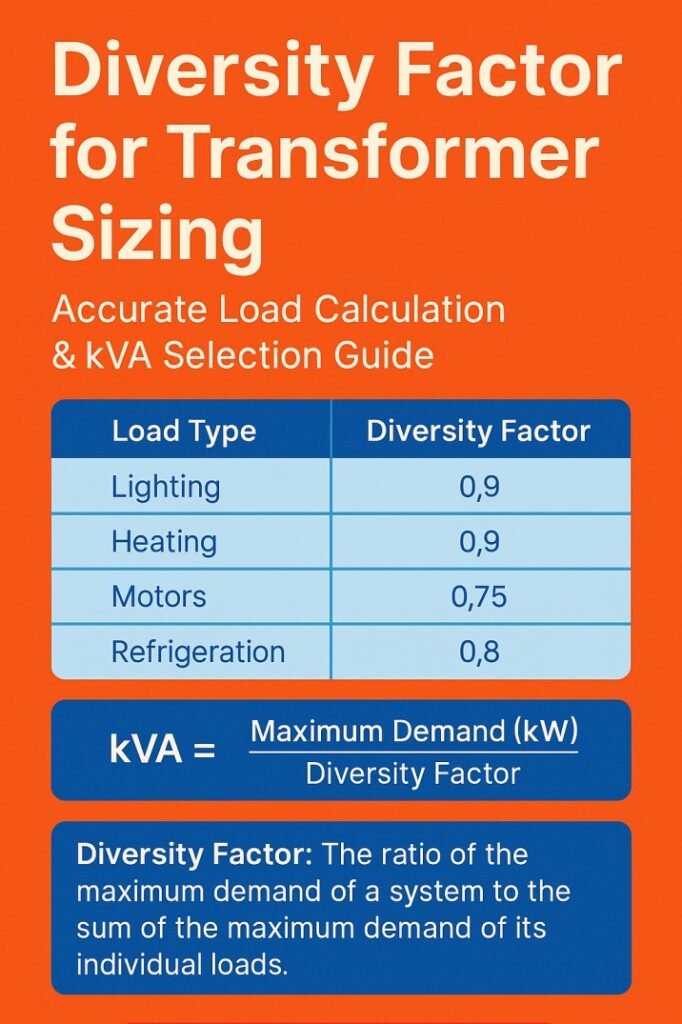
Table of Contents
In practical projects such as commercial buildings, solar plants, industrial facilities, and residential complexes, not all loads operate at full capacity at the same time. Understanding diversity factor for transformer sizing ensures accurate kVA selection, better energy efficiency, and long-term system reliability.
This guide explains the concept in detail, including formulas, calculation steps, practical examples, and engineering considerations.
Understanding Diversity Factor in Electrical Systems
Diversity factor is the ratio of the sum of individual maximum demands to the maximum demand of the entire system.
Diversity Factor = Sum of Individual Maximum Demands / Maximum Demand of the Whole System
The value of diversity factor is always greater than 1. This is because individual loads reach their peak at different times. For transformer selection, this principle helps reduce the required kVA rating compared to total connected load.
Access our powerful online calculator now Electrical Diversity Calculator for accurate Load Estimation and efficient electrical Design.
It is important not to confuse diversity factor with demand factor or load factor. Each has a different role in load estimation.
The correct application of diversity factor for transformer sizing ensures optimal transformer loading under realistic operating conditions.
Why Diversity Factor Matters in Transformer Sizing
If you simply add all connected loads, you will oversize the transformer. For example, in a commercial plaza, lighting, HVAC, elevators, and socket loads do not peak simultaneously. Applying diversity factor for transformer sizing gives a more practical maximum demand.
Key benefits include:
- Reduced capital investment
- Improved transformer efficiency
- Lower no-load losses
- Better voltage regulation
- Optimized power distribution design
Accurate load calculation is essential for proper kVA selection, feeder sizing, switchgear rating, and protection coordination.
Difference Between Connected Load and Maximum Demand
Before applying diversity factor for transformer sizing, it is important to understand connected load and maximum demand.
Know more about What is Demand Factor and Diversity Factor? Quick Concepts
- Connected load is the total rated power of all installed equipment.
- Maximum demand is the highest load expected to occur at any time.
- The difference between these values is where diversity factor plays its role.
Below is a simple comparison:
Table 1: Connected Load vs Maximum Demand
| Parameter | Connected Load | Maximum Demand |
|---|---|---|
| Definition | Total installed load | Highest expected operating load |
| Value | Always higher | Lower than connected load |
| Used For | Initial planning | Transformer and generator sizing |
| Practical Importance | Theoretical limit | Real operating condition |
Using maximum demand rather than connected load leads to accurate transformer kVA rating.
Typical Diversity Factor Values
Diversity factor varies depending on the type of installation. Residential buildings have higher diversity compared to industrial plants where machines may operate simultaneously.
Know more about Coincidence Factor vs Diversity Factor: The Load Calculation Mistake Engineers Still Make
Table 2: Typical Diversity Factor by Installation Type
| Installation Type | Typical Diversity Factor |
|---|---|
| Residential Apartments | 1.5 – 2.0 |
| Commercial Buildings | 1.3 – 1.6 |
| Office Complex | 1.4 – 1.8 |
| Industrial Plant | 1.1 – 1.3 |
| Hospitals | 1.2 – 1.5 |
| Shopping Mall | 1.3 – 1.7 |
These values are indicative. Actual values depend on load study, operating schedule, and historical demand data.
Applying correct diversity factor for transformer sizing avoids conservative oversizing.
Step-by-Step Calculation for Transformer kVA Selection
Let us understand the practical process.
Step 1: List all connected loads
Include lighting, HVAC, motors, lifts, socket loads, process equipment, and future expansion if required.
Step 2: Calculate total connected load
Sum all loads in kW.
Step 3: Apply demand factor if required
Demand factor adjusts installed load to expected operating load.
Step 4: Apply diversity factor
Divide the sum of individual maximum demands by diversity factor.
Step 5: Convert kW to kVA
kVA = kW / Power Factor
Step 6: Add design margin
Typically 10% to 20% for future expansion and safety.
The correct application of diversity factor for transformer sizing ensures realistic kVA selection.
Practical Example of Diversity Factor for Transformer Sizing
Assume a commercial building with the following loads:
Table 3: Load Calculation Example
| Load Type | Connected Load (kW) |
|---|---|
| Lighting | 80 |
| HVAC | 200 |
| Elevators | 60 |
| Socket Load | 100 |
| Water Pumps | 40 |
| Total Connected Load | 480 kW |
- Assume diversity factor = 1.5
- Maximum Demand = 480 / 1.5
Maximum Demand = 320 kW - Assume power factor = 0.9
- Required kVA = 320 / 0.9
Required kVA = 356 kVA - Add 15% design margin:
- 356 × 1.15 = 409 kVA
Nearest standard transformer size: 400 kVA or 500 kVA depending on expansion planning.
Without applying diversity factor for transformer sizing, the transformer would be selected based on 480 kW, leading to approximately 533 kVA requirement. That would significantly increase project cost.
Impact on Transformer Efficiency and Performance
Transformers operate most efficiently between 60% and 80% loading. If you oversize the transformer, it may operate below 40% load most of the time. This increases core losses and reduces overall efficiency.
Applying diversity factor for transformer sizing keeps the transformer within optimal loading range. This improves:
- Voltage stability
- Thermal performance
- Insulation life
- Energy efficiency
Proper load estimation also improves protection coordination and short circuit calculations.
Diversity Factor in Industrial Installations
In industrial plants, diversity factor is usually lower because multiple machines may operate simultaneously. However, even in process industries, certain loads cycle based on production stages.
Motor starting current, duty cycle, and process scheduling should be considered when applying diversity factor for transformer sizing.
For example:
- Batch processing plants may have higher diversity
- Continuous process plants have lower diversity
- Standby equipment increases connected load but not maximum demand
Load study and historical data analysis improve accuracy.
Use our online tool for free Transformer Neutral Current Calculator – Accurate Neutral Current Estimation
Common Mistakes in Transformer Sizing
Many engineers make errors when selecting transformer capacity. Some common mistakes include:
- Ignoring diversity and selecting transformer based on connected load
- Using unrealistic diversity values without justification
- Not considering power factor correction
- Ignoring future load growth
- Failing to analyze peak demand trends
The proper application of diversity factor for transformer sizing eliminates these mistakes and results in cost-effective design.
Relationship with Demand Factor and Load Factor
For accurate load calculation, it is important to understand related terms.
- Demand factor = Maximum Demand / Connected Load
- Load factor = Average Load / Maximum Demand
Diversity factor works at system level, while demand factor works at equipment level. Combining these concepts ensures precise transformer kVA selection.
Try our free online tool Transformer Temperature Rise Calculator: Accurate and Easy Guide
Electrical design consultants often use demand factor first, then apply diversity factor for transformer sizing to refine the maximum demand.
Design Margin and Future Expansion
No transformer should be selected exactly equal to calculated demand. A margin of 10% to 20% is common practice. In growing facilities such as shopping malls or housing societies, future load growth may require higher margin.
However, excessive margin defeats the purpose of applying diversity factor for transformer sizing. Balance is key.
In large facilities, parallel transformers may be used instead of one oversized unit. This improves reliability and load management.
Role in Solar and Renewable Projects
In solar PV plants and hybrid systems, transformer sizing must consider inverter output diversity. Not all inverters may operate at full capacity simultaneously due to irradiance variation.
Applying diversity factor for transformer sizing in renewable energy systems helps optimize step-up transformer capacity and reduces unnecessary capital cost.
Use our tool online at no cost Transformer Losses Calculation Tool – Accurate & Easy Energy Loss Analysis
This is especially important in grid-connected systems where export power fluctuates throughout the day.
Final Thoughts on Accurate kVA Selection
Accurate transformer sizing is a balance between engineering judgment and mathematical calculation. Diversity factor for transformer sizing is not just a theoretical concept. It is a practical design tool that improves system reliability and cost efficiency.
By understanding load behavior, applying realistic diversity values, and adding a reasonable safety margin, engineers can select the right transformer kVA rating without overspending.
Whether you are designing a residential complex, commercial building, industrial plant, or renewable energy project, applying diversity factor for transformer sizing ensures accurate load calculation and optimal transformer performance.
Access our online tool completely free Transformer Vector Group Calculation Tool | Easy & Accurate Vector Group Calculator
Follow Us on Social:
Subscribe our Newsletter on Electrical Insights for latest updates from Electrical Engineering Hub
#diversityfactorfortransformersizing, #transformersizingcalculation, #electricalloaddiversity, #powerdistributiondesign, #transformerkvaselection, #electricalengineeringguide, #loadcalculationmethods, #powerfactorconsideration, #commercialelectricaldesign, #substationdesign