Cable Size Chart Polycab: Best NEC-Compliant Sizing Guide for Engineers & Contractors
Choosing the right cable is a critical task for engineers, electricians, and contractors working in industrial, commercial, or residential projects. The selection process directly affects system efficiency, safety, and longevity. A common question that arises during installation planning is: “Which cable size is appropriate for this application?” The cable size chart Polycab provides a comprehensive, NEC-compliant reference to ensure proper sizing, considering factors like current-carrying capacity, voltage drop, and installation conditions.
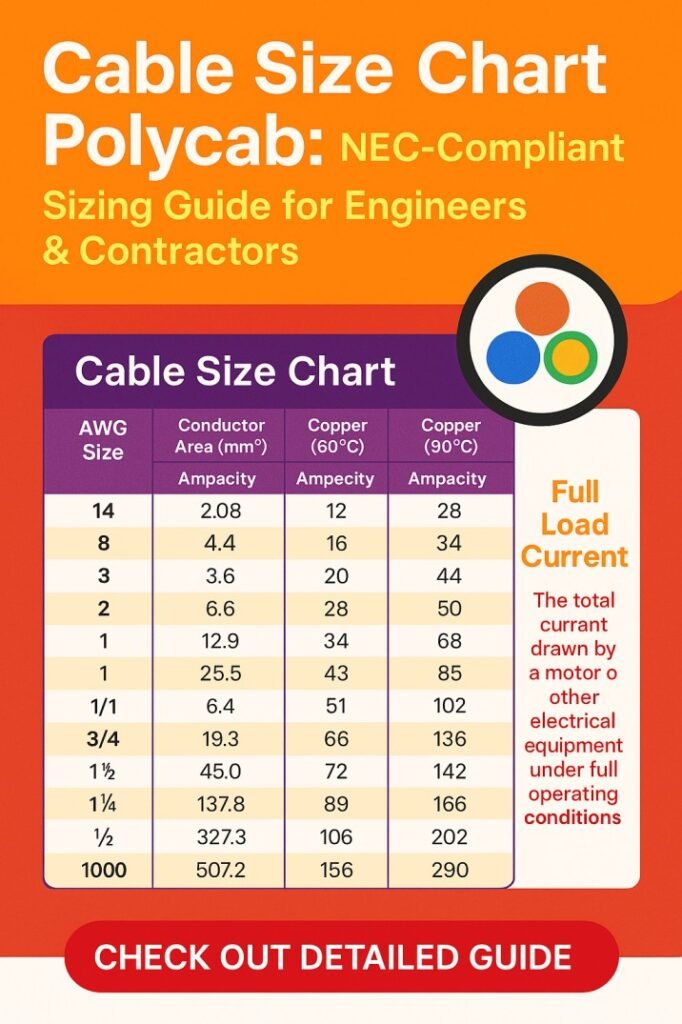
Table of Contents
Polycab, one of the leading cable manufacturers in India, offers a wide range of cables suitable for low-voltage, medium-voltage, and high-voltage applications. Engineers rely on Polycab cables not only for their quality but also for their consistent compliance with international standards like the National Electrical Code (NEC). The cable size chart Polycab simplifies the selection process, ensuring projects remain safe and efficient.
Explore our professional online tool for quick calculations kw to cable size calculator
Understanding Cable Sizing Principles
Correct cable sizing is essential to prevent overheating, voltage drop, and potential hazards. When determining the right cable, several factors need consideration:
- Load Current: The maximum current the cable will carry under normal conditions.
- Voltage Level: Ensuring the cable insulation can handle system voltage.
- Ambient Temperature: Higher temperatures can reduce a cable’s current-carrying capacity.
- Installation Conditions: Cables laid in conduits, trays, or buried underground have different derating factors.
- Short-Circuit Protection: The cable should withstand potential fault currents for the required duration.
The cable size chart Polycab provides a structured reference that incorporates these factors, making it easier for professionals to select the right conductor size for various installations.
NEC Compliance and Polycab Cables
The National Electrical Code (NEC) sets safety standards for electrical installations, including guidelines for conductor sizing, insulation ratings, and installation methods. Polycab’s cable range follows these standards, which helps engineers and contractors ensure that installations are compliant.
By using the cable size chart Polycab, professionals can quickly identify conductor sizes for different applications while ensuring compliance with NEC guidelines. This is particularly useful in industrial projects where multiple circuits, high load demands, and strict safety regulations are involved.
Make your task simple with our online tool electrical cable size calculator
Key Considerations in Using the Cable Size Chart Polycab
When referring to the cable size chart Polycab, keep in mind these important aspects:
- Conductor Material: Polycab cables are primarily copper-based, though some aluminum options exist. Copper offers lower resistance and higher current-carrying capacity.
- Insulation Type: PVC, XLPE, and EPR insulation have different temperature ratings and derating factors.
- Application Type: Residential, commercial, or industrial applications have unique load and safety requirements.
- Derating Factors: For grouped cables, elevated temperatures, or long-distance runs, appropriate adjustments should be applied.
These considerations ensure that the cable selected not only carries the intended load but also maintains safety, durability, and energy efficiency. Use our online tool for free Wire Size Calculator for Motors – Accurate Motor Cable Sizing Tool for Electric Loads
Polycab Cable Size Reference Table
The following cable size chart Polycab provides a clear reference for copper conductors with PVC insulation, commonly used in residential and commercial installations. Values are based on NEC guidelines and typical installation conditions (ambient temperature 30°C, single-phase load):
| Cable Size (sq.mm) | Current Rating (A) | Voltage Rating (V) | Typical Application |
|---|---|---|---|
| 1.5 | 15 | 450 | Lighting circuits |
| 2.5 | 20 | 450 | Small appliances |
| 4 | 25 | 450 | Fan, lighting with moderate load |
| 6 | 32 | 450 | Air conditioners, heavier loads |
| 10 | 50 | 450 | High-power appliances |
| 16 | 70 | 450 | Industrial motors, UPS inputs |
| 25 | 95 | 450 | Distribution boards |
| 35 | 115 | 450 | Large motors, heavy machinery |
| 50 | 145 | 450 | Main service lines |
| 70 | 185 | 450 | Industrial main feeders |
| 95 | 225 | 450 | High-load distribution |
| 120 | 260 | 450 | Power distribution in factories |
| 150 | 300 | 450 | Large commercial installations |
| 185 | 340 | 450 | Heavy-duty industrial applications |
This cable size chart Polycab helps engineers quickly match the conductor size with the load requirements while staying NEC-compliant.
You might find this tool useful for tackling similar tasks Sub Panel Wire Size Calculator – Accurate Wire Gauge & Load Sizing Tool
Factors Affecting Cable Selection in Real-World Projects
While the chart provides a baseline, real-world applications often require adjustments:
- Voltage Drop: For long cable runs, ensure voltage drop does not exceed recommended limits (typically 3% for lighting, 5% for power circuits).
- Ambient Temperature Variations: In high-temperature areas, current-carrying capacity may reduce by 10-20%.
- Cable Grouping: Multiple cables in close proximity require derating to prevent overheating.
- Future Load Expansion: Consider potential load growth to avoid frequent replacements.
Using the cable size chart Polycab in conjunction with these considerations ensures a safe and efficient design.
Polycab Cable Types and Applications
Polycab offers various cable types suitable for different environments. Understanding their applications is essential for proper selection:
- Single-Core Cables: Suitable for fixed wiring in buildings and industrial setups. Often used in main distribution and sub-distribution lines.
- Multi-Core Cables: Ideal for complex circuits, control panels, and lighting systems.
- XLPE Cables: Cross-linked polyethylene insulation is ideal for high-temperature environments and industrial setups.
- Armored Cables: Provide mechanical protection, suitable for underground or exposed installations.
Each cable type is included in the cable size chart Polycab with its current-carrying capacity, making selection straightforward. Take a look at this tool for a smarter way to handle feeder wire sizing Feeder Wire Size Calculator – Accurate Guide for Electricians and Homeowners
Practical Tips for Using the Cable Size Chart Polycab
- Always verify load calculations before selecting a cable. Use accurate demand and diversity factors.
- Apply NEC derating factors for grouped cables or high ambient temperatures.
- Consider both short-term and long-term loading to prevent thermal stress.
- For critical systems, choose a cable size one step higher than the minimum required for added safety.
- Periodically review cable sizing guidelines, as standards may update with NEC revisions.
By following these tips alongside the cable size chart Polycab, professionals can ensure compliance, safety, and operational efficiency.
Example Mini Calculation
Suppose you need to select a cable for a 5 kW motor operating on a 3-phase, 415 V supply.
- Calculate full load current:
I = P / (√3 × V × PF)
Assume PF = 0.85:
I = 5000 / (1.732 × 415 × 0.85) ≈ 8.3 A - From the cable size chart Polycab, a 2.5 sq.mm cable is sufficient for 8.3 A. However, considering future expansion and potential temperature derating, a 4 sq.mm cable would provide safer operation.
This example highlights how the chart assists in selecting an NEC-compliant conductor while accounting for real-world conditions.
We recommend this tool for anyone struggling with the sizing of subpanels. Try here Wire Size Calculator for Subpanels and Feeders – NEC Guidelines Included
Advantages of Using Polycab Cables
- High-Quality Conductors: Low resistance and superior conductivity.
- Wide Product Range: Options for residential, commercial, and industrial applications.
- NEC Compliance: Ensures installations meet international safety standards.
- Durability: Resistant to temperature, chemicals, and mechanical stress.
- Ease of Selection: The cable size chart Polycab simplifies planning and reduces errors.
These benefits make Polycab cables a preferred choice for engineers, electricians, and contractors.
Conclusion
Accurate cable sizing is fundamental to safe and efficient electrical installations. The cable size chart Polycab serves as a reliable, NEC-compliant guide for selecting the right conductor for various loads and applications. By considering load current, voltage drop, installation conditions, and future expansions, professionals can ensure optimal system performance. Polycab’s extensive cable range, combined with proper usage of the chart, minimizes risks, enhances safety, and supports long-term reliability in every project.
Try this tool out to save time and effort for easy conversions Amps to Wire Size Calculator – Choose the Right Cable for 10A, 20A, 40A Loads
Using this reference, engineers and contractors can streamline their design process, reduce errors, and maintain compliance with international standards, ensuring successful project outcomes every time.
Follow Us on Social:
Subscribe our Newsletter on Electrical Insights for latest updates from Electrical Engineering Hub
#cablesizechartpolycab, #electricalengineering, #NECcompliance, #cablesizing, #polycabcables, #industrialwiring, #electricalcontractors, #powerdistribution, #wiregaugeguide, #professionalengineering