
Testing Well Pump With Multimeter | Complete Diagnostic Guide for Accurate Pump Testing
A faulty well pump can quickly disrupt the water supply in any home, farm, or irrigation system. Before replacing expensive parts or calling a technician, many common problems can be identified with a digital multimeter. Testing Well Pump With Multimeter is one of the most effective ways to diagnose electrical faults, motor issues, voltage drops, and wiring failures without unnecessary guesswork.
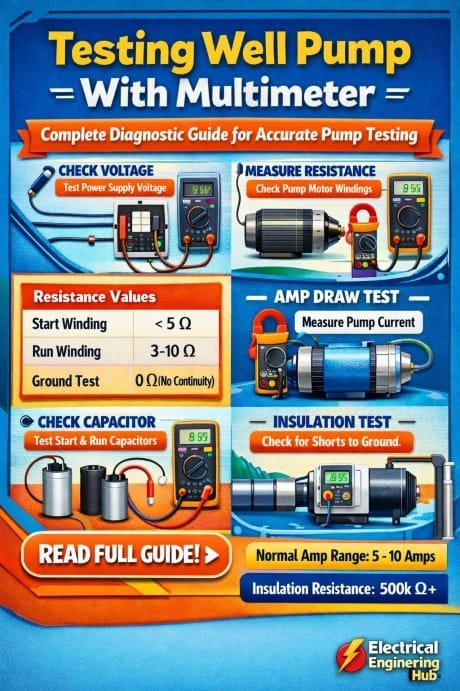
Table of Contents
This guide explains how to safely test a well pump step by step. You will learn how to check voltage, resistance, continuity, capacitor condition, and motor winding health using a multimeter. Whether you are troubleshooting a submersible pump or a shallow well pump, proper testing can help prevent major repair costs and improve pump performance.
Why Testing a Well Pump Is Important
A well pump works under demanding conditions and depends on stable electrical connections. Over time, motors wear out, wires become damaged, and capacitors fail. These issues may cause symptoms such as:
- Low water pressure
- Pump not starting
- Frequent breaker trips
- Continuous pump operation
- Strange noises from the motor
- Intermittent water supply
Testing Well Pump With Multimeter helps identify the exact source of the problem. Instead of replacing the entire pump system, you can narrow down the fault and repair only the damaged component.
Know more about Top 20 Electrical Testing Tools Which You Must Have
Tools Required for Well Pump Testing
Before starting the diagnostic process, gather the following tools and safety equipment.
| Tool | Purpose |
|---|---|
| Digital Multimeter | Measures voltage, resistance, and continuity |
| Insulated Screwdriver | Opens control panels safely |
| Clamp Meter | Optional for checking current draw |
| Safety Gloves | Protects against electric shock |
| Electrical Tape | Covers exposed wires |
| Flashlight | Improves visibility in pump areas |
Always use a reliable multimeter with AC voltage and resistance testing functions.
Safety Precautions Before Testing
Electric well pumps operate on high voltage, usually 120V or 240V. Improper handling can cause serious injury.
Follow these safety steps before Testing Well Pump With Multimeter:
- Turn off the breaker connected to the pump.
- Confirm power is disconnected using the multimeter.
- Keep hands dry during testing.
- Avoid standing on wet surfaces.
- Label wires before disconnecting them.
- Use insulated tools only.
Safety should always come before diagnostics.
Know more about AC Hipot Test Acceptable Leakage Current
Understanding Basic Well Pump Components
To properly troubleshoot the system, it helps to understand the main pump components.
| Component | Function |
|---|---|
| Pressure Switch | Starts and stops the pump |
| Pump Motor | Moves water from the well |
| Capacitor | Helps motor startup |
| Control Box | Manages motor operation |
| Wiring Connections | Supplies electrical power |
Electrical testing usually focuses on these areas.
Choosing the right meter can improve troubleshooting efficiency. Explore our recommendations for the Best Multimeter Under $50 before making a purchase.
How to Check Voltage at the Pressure Switch
The pressure switch is often the first place to inspect when the pump stops working.
Step-by-Step Voltage Test
- Set the multimeter to AC voltage.
- Remove the pressure switch cover.
- Turn the breaker back on carefully.
- Place multimeter probes on the line terminals.
- Read the voltage display.
Expected Readings
| Pump Type | Expected Voltage |
|---|---|
| Standard Residential Pump | 120V |
| Deep Well Pump | 240V |
If voltage is missing, the issue may involve the breaker, wiring, or electrical panel.
If voltage reaches the switch but the pump does not run, continue Testing Well Pump With Multimeter by checking motor continuity and resistance.
Know more about How to Check 3 Phase Motor Winding with Multimeter
Testing Well Pump Motor Resistance
Motor winding resistance testing helps identify open circuits or shorted windings.
Steps to Measure Resistance
- Turn off power completely.
- Disconnect motor wires.
- Set the multimeter to Ohms (Ω).
- Touch probes across motor terminals.
- Record resistance readings.
Normal Resistance Ranges
| Horsepower | Typical Resistance |
|---|---|
| 1/2 HP | 4–8 Ω |
| 1 HP | 2–6 Ω |
| 1.5 HP | 1–4 Ω |
A reading of infinite resistance usually indicates a broken winding. Very low resistance may suggest a short circuit inside the motor.
Performing a Continuity Test
A continuity test checks whether electrical current can flow through wires and motor circuits.
How to Test Continuity
- Keep power disconnected.
- Set the multimeter to continuity mode.
- Place probes at both ends of the wire.
- Listen for the beep or check for low resistance.
No continuity usually means damaged wiring or a failed motor connection.
Testing Well Pump With Multimeter using continuity mode is especially useful when troubleshooting underground cable damage.
Find all about How to Test Resistance With Multimeter
How to Test a Well Pump Capacitor
Many well pumps use a start capacitor to help the motor begin spinning. A failed capacitor can prevent startup.
Signs of a Bad Capacitor
- Pump hums but does not start
- Breaker trips repeatedly
- Slow motor startup
- Burning smell near control box
Capacitor Testing Process
- Turn off power.
- Discharge the capacitor safely.
- Remove capacitor wires.
- Set the multimeter to capacitance mode if available.
- Compare reading with capacitor rating.
| Capacitor Rating | Acceptable Range |
|---|---|
| 40 µF | 36–44 µF |
| 60 µF | 54–66 µF |
If readings fall outside the range, replacement is usually necessary.
Checking for Ground Faults
Ground faults are dangerous and often cause breaker trips.
Ground Fault Test
- Set multimeter to resistance mode.
- Place one probe on a motor wire.
- Touch the second probe to metal casing or ground.
A reading close to zero indicates a short to ground. In most cases, the motor will need professional repair or replacement.
Know more about How to Test Solar Panel With Multimeter
Diagnosing Common Well Pump Problems
The table below summarizes common symptoms and possible causes.
| Problem | Possible Cause |
|---|---|
| Pump not turning on | No voltage or failed pressure switch |
| Low water pressure | Worn impeller or voltage drop |
| Breaker keeps tripping | Short circuit or motor overload |
| Pump runs continuously | Pressure tank issue or leak |
| Clicking sounds | Faulty relay or pressure switch |
Testing Well Pump With Multimeter allows you to isolate these problems quickly and accurately.
Tips for Accurate Pump Testing
Proper technique improves diagnostic accuracy and protects equipment.
Best Practices
- Use a calibrated digital multimeter
- Test voltage under load conditions
- Inspect wires for corrosion
- Compare readings with manufacturer specifications
- Record all measurements for reference
Avoid rushing through tests because small errors can lead to incorrect conclusions.
When to Replace the Well Pump
Electrical testing can reveal whether repair is practical or if replacement is the better option.
Replace the Pump If:
- Motor windings are burned
- Pump repeatedly overheats
- Internal short circuits exist
- Repair costs exceed replacement value
- Pump age exceeds expected lifespan
Most residential well pumps last between 8 and 15 years depending on water quality and usage.
Know more about How to Check Transistor With Multimeter
Common Mistakes During Pump Testing
Many homeowners accidentally damage equipment during troubleshooting.
Avoid These Errors
- Testing live wires without protection
- Using incorrect multimeter settings
- Ignoring grounding problems
- Reconnecting wires incorrectly
- Skipping voltage verification
Careful Testing Well Pump With Multimeter prevents unnecessary repairs and improves system reliability.
Final Thoughts
A multimeter is one of the most valuable tools for diagnosing well pump issues. From checking voltage and continuity to testing motor resistance and capacitors, accurate electrical measurements help identify faults before major failures occur.
Know more about Difference Between VLF and Megger
Testing Well Pump With Multimeter provides a practical and cost-effective method for troubleshooting residential and agricultural water systems. With proper safety procedures and systematic testing, you can determine whether the problem involves wiring, switches, capacitors, or the pump motor itself.
Regular electrical inspection also improves pump efficiency, reduces downtime, and extends equipment life. By understanding how to use a multimeter correctly, homeowners and technicians can maintain reliable water supply systems with greater confidence.
Follow Us on Social:
Subscribe our Newsletter on Electrical Insights for latest updates from Electrical Engineering Hub
#TestingWellPump,#WellPumpTesting,#MultimeterTesting,#WaterPumpRepair,#PumpDiagnostics,#ElectricalTesting,#WellPumpMaintenance,#SubmersiblePump,#PumpTroubleshooting,#DIYWellPump
