
How to Check Transistor With Multimeter | Easy Testing Guide for NPN & PNP Transistors
Transistors are one of the most important components used in electronic circuits. They work as switches or amplifiers in devices like power supplies, amplifiers, televisions, computers, and industrial control systems. When an electronic circuit stops working, technicians often need to check transistor with multimeter to identify whether the component is good or faulty.
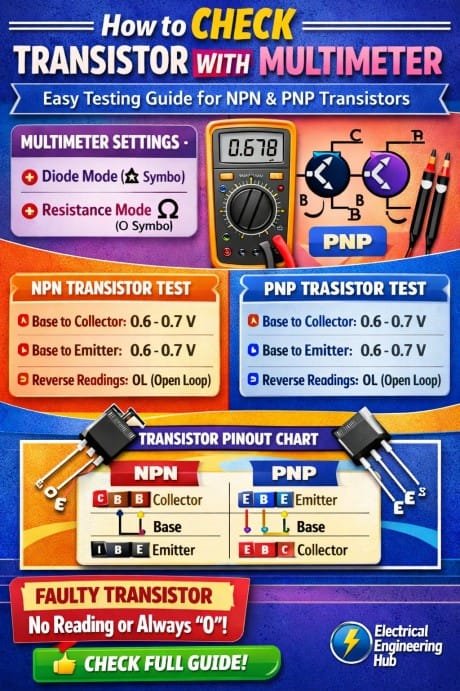
Table of Contents
A digital multimeter makes transistor testing simple and quick. You do not need advanced laboratory equipment for basic testing. By understanding transistor terminals and using the diode mode of a multimeter, you can easily test both NPN and PNP transistors within minutes.
In this guide, you will learn step-by-step methods to test transistors, identify damaged components, and understand common readings for accurate troubleshooting.
What Is a Transistor?
A transistor is a semiconductor device that controls current flow in electronic circuits. It usually has three terminals:
| Terminal | Function |
|---|---|
| Base | Controls transistor operation |
| Collector | Main current input/output |
| Emitter | Releases current flow |
The two most common transistor types are:
- NPN transistor
- PNP transistor
Both types operate differently, but the testing method using a multimeter is very similar.
Find all about Types of Transistor
Why It Is Important to Check Transistor With Multimeter
Faulty transistors can cause many electronic problems such as:
- Circuit failure
- No power output
- Overheating
- Short circuits
- Distorted signals
- Device shutdown
When you check transistor with multimeter, you can quickly determine whether the component is open, shorted, or functioning correctly. This saves repair time and prevents replacing unnecessary parts.
Tools Required for Transistor Testing
Before starting, gather the following tools:
| Tool | Purpose |
|---|---|
| Digital Multimeter | Measures diode and resistance values |
| Transistor Datasheet | Identifies pin configuration |
| PCB Tweezers | Helps remove components safely |
| Soldering Tools | Useful for circuit removal if needed |
A digital multimeter with diode testing mode is highly recommended because it provides more accurate transistor readings.
Understanding NPN and PNP Transistors
Before testing, it is important to know the difference between NPN and PNP transistors.
| Feature | NPN Transistor | PNP Transistor |
|---|---|---|
| Current Flow | Collector to Emitter | Emitter to Collector |
| Multimeter Reading Direction | Positive to Base | Negative to Base |
| Common Usage | Amplifier and switching circuits | Complementary switching circuits |
Knowing the transistor type helps you place multimeter probes correctly.
Know more about Types of Field Effect Transistor
How to Identify Transistor Pins
Most transistors contain three pins:
- Base
- Collector
- Emitter
Manufacturers usually print a part number on the transistor body. You can search the datasheet online to confirm pin positions.
Some common transistor packages include:
| Package Type | Common Use |
|---|---|
| TO-92 | Small signal transistors |
| TO-220 | Power transistors |
| SMD Package | Surface mount electronics |
Incorrect pin identification may produce false readings during testing.
Step-by-Step Guide to Check Transistor With Multimeter
Set the Multimeter to Diode Mode
Turn your digital multimeter to diode testing mode. This mode helps measure the semiconductor junctions inside the transistor.
The diode symbol usually appears on the multimeter selector knob.
Testing an NPN Transistor
Follow these steps carefully:
Step 1: Connect Positive Probe to Base
Place the red probe on the base terminal.
Step 2: Test Base to Emitter
Touch the black probe to the emitter terminal.
A healthy transistor usually shows a voltage drop between:
- 0.5V to 0.8V
Step 3: Test Base to Collector
Move the black probe from emitter to collector.
You should again see a reading around:
- 0.5V to 0.8V
If you need a budget-friendly electrical testing tool, don’t miss our detailed review of the Best Multimeter Under $50 available today.
Step 4: Reverse the Probes
Now reverse the probes.
- Black probe on base
- Red probe on emitter or collector
The multimeter should display:
- OL
- Open circuit
- No reading
This confirms proper transistor junction behavior.
Know more about N-channel Enhancement Type MOSFET
Testing a PNP Transistor
The process for PNP transistors is similar but probe polarity changes.
Step 1: Connect Black Probe to Base
Place the black probe on the base terminal.
Step 2: Test Base to Emitter
Touch the red probe to the emitter.
A healthy reading should be:
- 0.5V to 0.8V
Step 3: Test Base to Collector
Move the red probe to the collector.
Again, a proper transistor shows:
- 0.5V to 0.8V
Step 4: Reverse Probe Direction
Reverse the probes completely.
The multimeter should show:
- OL
- Infinite resistance
- No continuity
This indicates a good PNP transistor.
Common Multimeter Readings Explained
Understanding readings helps identify transistor faults correctly.
| Multimeter Reading | Transistor Condition |
|---|---|
| 0.5V to 0.8V | Normal transistor junction |
| OL or Infinite | Open junction |
| 0V or Very Low | Shorted transistor |
| Reading Both Directions | Faulty transistor |
If readings differ significantly, the transistor may be damaged.
Know more about Floating Gate MOSFET: A Comprehensive Guide
How to Check for Shorted Transistor
A shorted transistor is very common in power circuits.
To detect a short:
- Measure collector to emitter resistance
- Reverse probe direction
- Compare both readings
If the multimeter beeps continuously or shows near-zero resistance in both directions, the transistor is likely shorted.
Shorted transistors often cause:
- Burned resistors
- Fuse failure
- Overcurrent problems
- Heating issues
How to Test Transistor on PCB
Sometimes you need to check transistor with multimeter without removing it from the circuit board.
This method works for quick diagnosis but may produce inaccurate readings because nearby components affect measurements.
For accurate results:
- Remove at least one transistor leg from PCB
- Retest outside the circuit
This eliminates parallel circuit interference.
Signs of a Faulty Transistor
Here are common symptoms of transistor failure:
| Symptom | Possible Cause |
|---|---|
| No output voltage | Open transistor |
| Excessive heat | Internal short |
| Distorted sound | Weak transistor gain |
| Blown fuse | Collector-emitter short |
| Device not powering on | Damaged switching transistor |
Identifying these signs helps during electronic troubleshooting.
Know more about Leakage Current in MOSFET
Analog vs Digital Multimeter for Transistor Testing
Both analog and digital multimeters can test transistors, but digital meters are more accurate.
| Feature | Digital Multimeter | Analog Multimeter |
|---|---|---|
| Accuracy | High | Medium |
| Ease of Use | Simple | Moderate |
| Diode Mode | Available | Limited |
| Reading Stability | Stable | Needle fluctuation |
Most technicians prefer digital multimeters for semiconductor testing.
Safety Tips During Transistor Testing
Follow these precautions while testing electronic components:
- Disconnect power supply completely
- Discharge capacitors before handling circuits
- Avoid static electricity damage
- Use insulated probes
- Never force probes into PCB tracks
These safety practices protect both the technician and electronic components.
Common Mistakes While Testing Transistors
Many beginners make simple testing errors.
Avoid these mistakes:
- Wrong transistor pin identification
- Using resistance mode instead of diode mode
- Testing inside powered circuits
- Ignoring datasheet specifications
- Confusing NPN with PNP polarity
Correct testing procedures improve accuracy and troubleshooting efficiency.
Know more about ESP12F vs ESP32
Conclusion
Learning how to check transistor with multimeter is an essential skill for electronics repair and troubleshooting. Whether you are working on amplifiers, power supplies, motor controllers, or industrial circuits, proper transistor testing helps identify faults quickly and accurately.
By using the diode mode of a digital multimeter, you can easily test both NPN and PNP transistors. A healthy transistor normally shows a voltage drop between 0.5V and 0.8V in one direction and open circuit in reverse direction.
With regular practice, transistor testing becomes simple and fast. Understanding readings, identifying terminals, and following proper safety steps will help you diagnose electronic problems confidently and efficiently.
Here is a detailed guide on esp12f pinout
Follow Us on Social:
Subscribe our Newsletter on Electrical Insights for latest updates from Electrical Engineering Hub
#HowToCheckTransistorWithMultimeter,#TransistorTesting,#MultimeterTesting,#ElectronicsRepair,#PNPTransistor,#NPNTransistor,#DigitalMultimeter,#ElectronicsTutorial,#CircuitTesting,#ElectricalEngineering
