Partial Discharge Testing for Underground Cables: Step-by-Step Guide for Accurate Cable Diagnostics & Reliable Insulation Testing
Partial discharge testing for underground cables plays a critical role in maintaining power system reliability. Underground cable networks are often exposed to moisture, thermal stress, and aging, which can gradually weaken insulation. Small electrical discharges inside the insulation may not cause immediate failure, but they indicate early-stage defects that can lead to costly breakdowns if ignored.
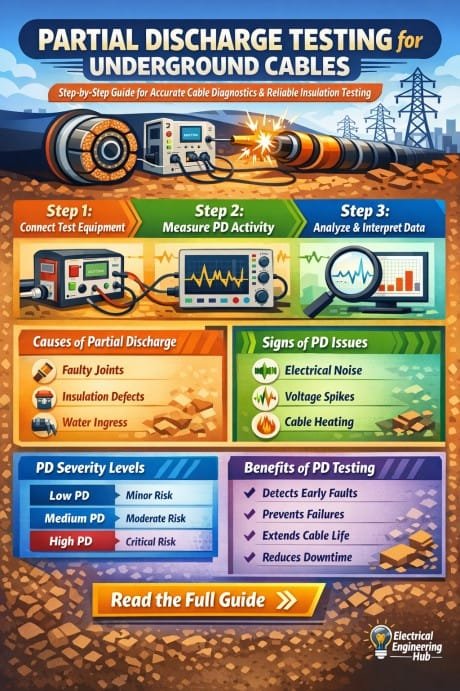
Table of Contents
Understanding how partial discharge testing for underground cables works helps engineers detect faults early, reduce downtime, and extend cable life. This guide explains the process in a clear and practical way, so you can apply it effectively in real-world conditions.
What is Partial Discharge for Underground Cables
Partial discharge refers to localized electrical discharges that do not completely bridge the insulation between conductors. These discharges occur due to voids, cracks, or contamination within the insulation system.
Explore details on iec standard for underground cable laying
In underground cables, common causes include:
- Manufacturing defects
- Poor jointing or termination
- Moisture ingress
- Aging insulation material
- Mechanical damage during installation
Even though these discharges are small, they gradually degrade insulation. Over time, this leads to insulation failure and unexpected outages.
Why Partial Discharge Testing is Important
Partial discharge testing for underground cables helps identify hidden defects before they become critical. It is widely used in commissioning, maintenance, and condition assessment of medium and high voltage cables.
Key benefits include:
- Early fault detection
- Improved system reliability
- Reduced maintenance costs
- Prevention of unexpected failures
- Accurate insulation condition assessment
Use this tool if you are trying to calculate cable size for underground cables. Try here Underground Cable Size Calculator – Find Correct Wire Size for Long Distance Runs
Utilities and industries rely on this testing method to ensure safe and efficient power delivery.
Types of Partial Discharge Testing Methods
Different methods are used depending on cable type, voltage level, and testing conditions.
| Method Type | Description | Application |
|---|---|---|
| Offline Testing | Conducted when the cable is disconnected from service | Commissioning and detailed diagnostics |
| Online Testing | Performed while the cable is energized | Continuous monitoring |
| VLF Testing | Uses very low frequency voltage | Suitable for long cable lengths |
| HFCT Method | Detects high-frequency signals on grounding conductors | Quick field testing |
| Acoustic Method | Detects sound waves from discharge activity | Fault localization |
Each method has its own advantages, but offline testing provides the most detailed results.
Equipment Required for Testing
To perform partial discharge testing for underground cables, specialized equipment is required. The accuracy of results depends heavily on proper setup and calibration.
| Equipment | Purpose |
|---|---|
| VLF Test Set | Applies test voltage to the cable |
| PD Detector | Measures discharge activity |
| Coupling Capacitor | Captures discharge signals |
| Measuring Impedance | Converts signals for analysis |
| Data Acquisition System | Records and analyzes results |
Modern systems also include software for waveform analysis and defect classification.
Find all about Partial Discharge vs Tan Delta Cable Testing: Important Key Differences Every Engineer Must Know
Step-by-Step Procedure Partial Discharge Testing for Underground Cables
A structured approach ensures reliable results and safe operation. Below is a practical step-by-step method used in the field.
Step 1: Visual Inspection
Before testing, inspect the cable route, joints, and terminations. Look for visible damage, moisture entry, or improper installations.
Step 2: Isolation and Safety Measures
Disconnect the cable from the power supply. Ensure proper grounding and follow safety protocols to avoid electrical hazards.
Step 3: Equipment Setup
Connect the testing equipment as per the configuration:
- Connect VLF source to the cable
- Attach coupling capacitor
- Install PD sensors
- Ensure proper grounding
Double-check all connections before proceeding.
Step 4: Calibration
Calibrate the system to ensure accurate measurement. This step is crucial for identifying real discharge signals and filtering noise.
Know more about Partial Discharge Test Equipment Price in USA & Europe
Step 5: Voltage Application
Gradually apply voltage up to the required test level. Maintain the voltage for a specified duration while monitoring discharge activity.
Step 6: Data Collection
Record partial discharge magnitude, repetition rate, and phase-resolved patterns. These values help in identifying the severity and type of defect.
Step 7: Analysis
Analyze the recorded data using software tools. Look for patterns that indicate insulation defects such as voids or surface discharges.
Step 8: Reporting
Prepare a detailed report including:
- Test conditions
- Observed discharge levels
- Location of faults
- Recommendations for maintenance
Interpreting Test Results
Understanding test results is key to making informed decisions. Not all discharge activity indicates immediate failure, but certain thresholds require attention.
| PD Level (pC) | Condition | Action Required |
|---|---|---|
| 0–50 | Normal | No action needed |
| 50–200 | Moderate | Monitor regularly |
| 200–500 | High | Plan maintenance |
| Above 500 | Critical | Immediate action |
Trend analysis over time provides better insight than a single test result.
Find all about Top 15 Partial Discharge Tester Suppliers in United States
Common Challenges in Testing
Partial discharge testing for underground cables can face several challenges, especially in field conditions.
- Electrical noise interference
- Long cable lengths affecting signal strength
- Improper grounding
- Environmental conditions like humidity
- Incorrect sensor placement
Using advanced filtering techniques and proper setup can minimize these issues.
Best Practices for Accurate Testing
To achieve reliable results, follow these best practices:
- Use calibrated and certified equipment
- Perform testing in low-noise environments
- Ensure proper grounding and shielding
- Maintain consistent testing procedures
- Train personnel for accurate interpretation
Consistency in testing improves long-term diagnostics and decision-making.
Findt all about AC Hipot Test Procedure for Cables
Role of Partial Discharge Testing in Predictive Maintenance
Modern power systems are shifting toward predictive maintenance. Instead of reacting to failures, utilities now focus on early detection and prevention.
Partial discharge testing for underground cables supports this approach by:
- Identifying weak points in insulation
- Allowing planned maintenance schedules
- Reducing emergency repairs
- Improving asset management
This leads to better reliability and cost savings over time.
Comparison with Other Cable Testing Methods
Partial discharge testing is often used alongside other diagnostic methods.
| Test Method | Purpose | Limitation |
|---|---|---|
| Insulation Resistance Test | Measures insulation strength | Cannot detect localized defects |
| Tan Delta Test | Evaluates dielectric losses | Limited fault localization |
| High Voltage Withstand Test | Checks insulation capability | May stress weak insulation |
| Partial Discharge Test | Detects early-stage defects | Requires skilled analysis |
Combining these methods provides a complete picture of cable health.
Find all about AC Hipot Tester TOS5200 Suppliers in USA
Conclusion
Partial discharge testing for underground cables is one of the most effective tools for ensuring reliable insulation performance. It helps detect hidden defects, prevent failures, and extend the life of cable systems. By following a structured testing procedure and using the right equipment, engineers can obtain accurate and meaningful results.
With increasing demand for uninterrupted power supply, the importance of partial discharge testing for underground cables continues to grow. Adopting this method as part of routine maintenance ensures long-term reliability, safety, and efficiency of underground power networks.
Discover everything about cable bending radius iec standard
Follow Us on Social:
Subscribe our Newsletter on Electrical Insights for latest updates from Electrical Engineering Hub
#partialdischargetesting,#undergroundcabletesting,#cableinsulationtesting,#highvoltagetesting,#partialdischargeanalysis,#powercablediagnostics,#electricaltesting,#pdtestingprocedure,#cablefaultdetection,#insulationdiagnostics