Partial Discharge Test of Transformer: Step-by-Step Guide for Accurate Diagnostics & Reliable Insulation Testing
Transformers are critical assets in power systems, and their insulation condition directly impacts performance and reliability. The partial discharge test of transformer is one of the most effective methods to assess insulation health without causing damage. It helps detect early-stage insulation defects that are not visible during routine inspections. When done correctly, it improves maintenance planning, prevents unexpected failures, and extends equipment life.
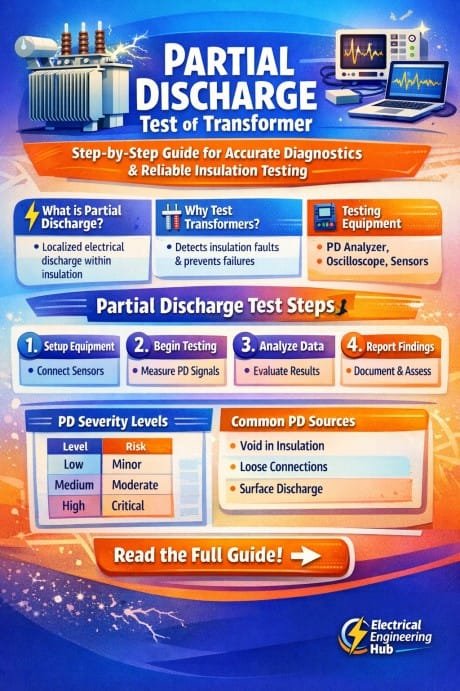
Table of Contents
What is Partial Discharge in Transformers
Partial discharge refers to a localized electrical discharge that partially bridges the insulation between conductors. It does not completely short the insulation but slowly weakens it over time. These discharges usually occur in voids, cracks, or defects within insulation materials.
Common sources of partial discharge include:
- Air gaps in solid insulation
- Contaminated oil or moisture ingress
- Sharp edges causing high electric stress
- Aging insulation materials
Detecting these issues early through the partial discharge test of transformer allows corrective action before a major breakdown.
Find all about Partial Discharge vs Tan Delta Cable Testing: Important Key Differences Every Engineer Must Know
Importance of Partial Discharge Testing
Power transformers operate under high voltage stress. Even a small insulation defect can grow into a serious fault. Partial discharge testing provides insights that other electrical tests cannot offer.
Key benefits include:
- Early detection of insulation degradation
- Improved asset reliability
- Reduced risk of catastrophic failures
- Better maintenance scheduling
- Compliance with international standards
Utilities and industries rely on this test as part of condition monitoring and preventive maintenance programs.
Types of Partial Discharge Measurement Methods
Different techniques are used depending on the application and site conditions. Each method provides valuable data for insulation diagnostics.
| Method Type | Description | Application Area |
|---|---|---|
| Electrical Method | Measures discharge pulses using coupling devices | Factory and lab testing |
| Acoustic Method | Detects sound waves from discharges | Field testing of transformers |
| UHF Detection | Uses ultra-high frequency sensors | GIS and enclosed systems |
| Optical Detection | Captures light emitted from discharges | Specialized diagnostics |
Among these, the electrical method is widely used for the partial discharge test of transformer during factory acceptance tests.
Know more about Partial Discharge Test Equipment Price in USA & Europe
Equipment Required for Testing
Accurate testing requires proper instruments and setup. The quality of results depends on calibration and noise control.
| Equipment | Function |
|---|---|
| High Voltage Source | Applies test voltage |
| Coupling Capacitor | Detects discharge signals |
| Measuring Impedance | Converts signals into measurable values |
| PD Detector / Analyzer | Displays and records discharge activity |
| Calibration Generator | Ensures accuracy of measurements |
Proper grounding and shielding are also essential to reduce external interference.
Step-by-Step Procedure for Partial Discharge Test
Conducting the partial discharge test of transformer involves a structured approach. Each step must be followed carefully to ensure reliable results.
Step 1: Preparation
- Ensure transformer is isolated and properly grounded
- Clean bushings and terminals
- Check oil level and insulation condition
- Verify calibration of test instruments
Find all about Top 15 Partial Discharge Tester Suppliers in United States
Step 2: Test Setup
- Connect coupling capacitor to transformer terminals
- Attach measuring impedance and PD analyzer
- Establish proper shielding to minimize electrical noise
Step 3: Calibration
- Inject known calibration signals
- Adjust measuring system for accurate readings
- Confirm sensitivity levels
Step 4: Voltage Application
- Gradually increase voltage to the specified test level
- Maintain voltage for a defined duration
- Monitor discharge levels continuously
Step 5: Measurement and Recording
- Record apparent charge in picocoulombs (pC)
- Observe discharge patterns and repetition rate
- Identify phase-resolved discharge behavior
Find all about High Voltage Cable Testing Standards: Complete Guide for Engineers
Step 6: Analysis
- Compare results with standard limits
- Identify type and location of defects
- Evaluate insulation condition
Step 7: Reporting
- Document readings and observations
- Provide recommendations for maintenance or repair
Acceptable Limits for Partial Discharge
Standards define acceptable discharge levels depending on transformer rating and insulation class. These limits help determine whether equipment is fit for service.
| Transformer Type | Acceptable PD Level (pC) |
|---|---|
| Distribution Transformer | Up to 100 pC |
| Power Transformer | 50 – 500 pC |
| High Voltage Units | As per IEC/IEEE standards |
Values above limits indicate insulation weakness and require further investigation.
Common Causes of High Partial Discharge
High readings during the partial discharge test of transformer often point to specific issues. Understanding these causes helps in accurate diagnosis.
- Moisture contamination in oil
- Aging or thermal degradation of insulation
- Poor manufacturing quality
- Mechanical damage during transport
- Improper installation practices
Addressing these factors improves transformer reliability and reduces maintenance costs.
Know more about HT Motor Tan Delta Testing – Best Guide for High Voltage Motor Insulation Diagnostic & Preventive Maintenance
Challenges in Partial Discharge Testing
While the test is highly effective, certain challenges can affect accuracy.
- Electrical noise from nearby equipment
- Improper grounding
- Incorrect calibration
- Environmental interference
- Lack of skilled personnel
Advanced filtering techniques and proper training help overcome these issues.
Best Practices for Accurate Results
Following best practices ensures consistent and reliable outcomes.
- Use calibrated and high-quality equipment
- Maintain proper shielding and grounding
- Conduct testing in low-noise environments
- Follow IEC 60270 and IEEE standards
- Analyze trends instead of single readings
Know more about 11kV to 415V Transformer Design & Specification – Ratings, Losses, Cooling and Practical Selection Guide
Routine monitoring using the partial discharge test of transformer provides better insights than one-time testing.
Role in Predictive Maintenance
Modern asset management relies on predictive maintenance strategies. Partial discharge monitoring plays a key role in this approach.
Instead of waiting for failures, utilities can track insulation health over time. This reduces downtime and improves operational efficiency. Integration with digital monitoring systems further enhances decision-making.
Conclusion
The partial discharge test of transformer is a vital tool for ensuring insulation integrity and long-term performance. It helps identify hidden defects, supports preventive maintenance, and improves system reliability. By following a structured testing approach and using proper equipment, engineers can achieve accurate diagnostics and extend transformer life.
Know more about HVDC Transformer Working Principle Explained – How Converter Transformers Handle Extreme DC Power
With growing demand for reliable power systems, this test has become an essential part of transformer testing and condition monitoring. Regular implementation not only safeguards equipment but also ensures uninterrupted power supply in industrial and utility applications.
Follow Us on Social:
Subscribe our Newsletter on Electrical Insights for latest updates from Electrical Engineering Hub
#partialdischargetest,#transformertesting,#highvoltagetesting,#electricalmaintenance,#powertransformer,#diagnostictesting,#insulationtesting,#substationmaintenance,#electricalengineering,#conditionmonitoring