IEC Standard for IP Rating – Complete Guide to Ingress Protection Classification & Compliance
Electrical and electronic equipment is often exposed to dust, moisture, and environmental contaminants. To ensure reliability and safety, manufacturers must follow internationally recognized protection standards. The IEC standard for IP rating provides a globally accepted system to classify the level of protection offered by enclosures against solid objects and liquids.
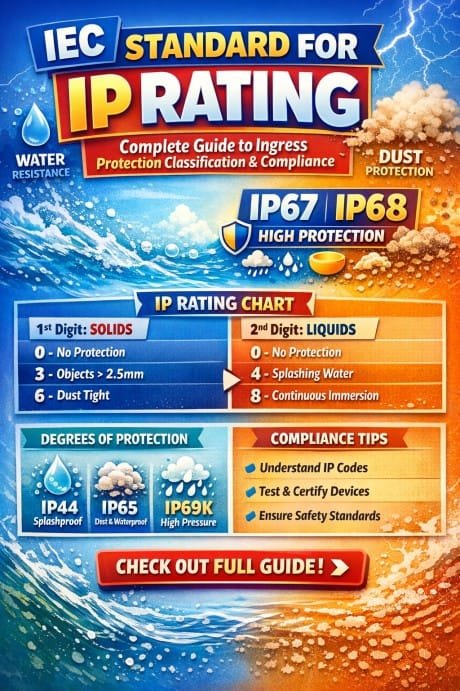
Table of Contents
Understanding this classification is important for engineers, technicians, manufacturers, and procurement teams. It helps in selecting the right equipment for industrial, commercial, and outdoor environments. This guide explains the fundamentals, structure, classification system, and compliance requirements defined in the IEC standard for IP rating.
Know more about IEC Standard for Neutral to Earth Voltage – Limits, Measurement & Safety Guidelines
What is the IEC Standard for IP Rating
The IEC standard for IP rating refers to IEC 60529, a standard published by the International Electrotechnical Commission (IEC). It defines how enclosure protection is classified against the intrusion of foreign objects and water.
The term IP stands for Ingress Protection or sometimes International Protection. It uses a two-digit code to describe the degree of protection.
An IP code generally appears in the following format:
IPXY
Where:
• X indicates protection against solid objects and dust
• Y indicates protection against water ingress
For example, an enclosure marked IP65 means it is dust tight and protected against water jets.
The IEC standard for IP rating is widely used in electrical panels, industrial motors, lighting fixtures, switchgear, outdoor equipment, and electronic devices. Find all about Capacitor Bank Sizing for Power Factor Correction – Step by Step
Structure of the IP Rating Code
The IP rating defined by IEC consists of two numerical digits. Each digit represents a specific protection category.
| Code Element | Meaning | Example |
|---|---|---|
| IP | Ingress Protection | IP |
| First Digit | Protection against solid objects | 6 |
| Second Digit | Protection against water | 5 |
Example: IP65
| Digit | Protection Level |
|---|---|
| 6 | Dust tight enclosure |
| 5 | Protection against water jets |
This classification system allows engineers to quickly determine how well an enclosure can resist environmental exposure.
Protection Against Solid Objects (First Digit)
The first digit in the IEC standard for IP rating represents protection against solid objects such as dust, tools, and accidental contact.
| First Digit | Protection Level | Description |
|---|---|---|
| 0 | No protection | No protection against contact or objects |
| 1 | >50 mm | Protection against large body parts |
| 2 | >12.5 mm | Protection against fingers |
| 3 | >2.5 mm | Protection against tools and thick wires |
| 4 | >1 mm | Protection against small wires |
| 5 | Dust protected | Limited dust ingress allowed |
| 6 | Dust tight | Complete protection against dust |
For industrial environments such as cement plants, chemical factories, and outdoor installations, IP6X ratings are commonly required.
Find all about IEC Standard for Relay Testing: Best Guide
Protection Against Water (Second Digit)
The second digit describes the protection level against moisture, splashing water, and immersion conditions.
| Second Digit | Protection Level | Description |
|---|---|---|
| 0 | No protection | No water protection |
| 1 | Dripping water | Vertical dripping protection |
| 2 | Dripping at 15° | Protection when tilted |
| 3 | Spraying water | Water spray up to 60° |
| 4 | Splashing water | Protection from splashes |
| 5 | Water jets | Protection against low pressure jets |
| 6 | Powerful jets | Protection against strong water jets |
| 7 | Temporary immersion | Immersion up to 1 meter |
| 8 | Continuous immersion | Long duration underwater |
| 9 | High pressure jets | Protection against high pressure and steam |
The IEC standard for IP rating ensures that manufacturers clearly define how their equipment performs in wet or outdoor conditions. Find all about BS 7671 Wiring Regulations: Expert Guide to Compliance, Safety, and Practical Applications
Common IP Ratings Used in Electrical Equipment
Different applications require different protection levels. The IEC standard for IP rating helps engineers choose the right enclosure depending on environmental conditions.
| IP Rating | Typical Application |
|---|---|
| IP20 | Indoor electrical panels |
| IP44 | Household appliances |
| IP54 | Industrial control panels |
| IP55 | Outdoor lighting |
| IP65 | Industrial motors and panels |
| IP66 | Outdoor telecom equipment |
| IP67 | Underground equipment |
| IP68 | Submersible pumps |
For example, outdoor electrical cabinets often require IP65 or IP66 ratings because they must resist both dust and water jets. Know all about ieee and iec standards
Importance of IEC Standard for IP Rating in Industry
The IEC standard for IP rating plays a vital role in ensuring equipment reliability and safety. It helps engineers evaluate enclosure performance under different environmental conditions.
Key benefits include:
• Standardized protection classification worldwide
• Improved safety for electrical installations
• Increased reliability of equipment in harsh environments
• Better product comparison for buyers and engineers
• Compliance with international electrical safety requirements
Many industries such as power generation, automation, telecommunications, and renewable energy rely on this standard when designing electrical systems.
Testing Methods Defined by IEC 60529
To comply with the IEC standard for IP rating, equipment must pass specific laboratory tests.
Solid Particle Testing
Dust protection testing is performed using controlled dust chambers. The enclosure is exposed to circulating fine particles for a specific duration. Know more about Transformer Oil Testing: 9 Important Tests for Healthiness
Dust tight equipment must prevent any dust ingress during testing.
Water Ingress Testing
Water protection is tested using different methods depending on the rating.
| Test Type | Method |
|---|---|
| Drip Test | Simulated rainfall |
| Spray Test | Water sprayed from nozzles |
| Jet Test | High pressure water jets |
| Immersion Test | Equipment submerged in water |
These tests confirm whether an enclosure meets the IEC standard for IP rating requirements.
Differences Between IP Rating and NEMA Rating
Many engineers confuse IP ratings with NEMA enclosure ratings. Although both indicate protection levels, they follow different standards.
| Feature | IP Rating | NEMA Rating |
|---|---|---|
| Standard Body | IEC | National Electrical Manufacturers Association |
| Region | International | Primarily North America |
| Protection Scope | Dust and water | Dust, water, corrosion, icing |
| Format | IPXX code | NEMA Type numbers |
The IEC standard for IP rating is more widely used globally, especially in Europe, Asia, and international electrical projects. Know more about IEC Standard for MV Cable Testing: Complete Acceptance, Routine & Type Test Guide
Applications of IP Rated Equipment
Equipment designed according to the IEC standard for IP rating is used across many industries.
Common applications include:
• Industrial control panels
• Electric motors and drives
• Outdoor lighting systems
• Solar power installations
• Switchgear and distribution boards
• Telecommunications equipment
• Marine electrical systems
• Smart devices and consumer electronics
Choosing the correct IP rating ensures that equipment operates safely even in challenging environmental conditions.
How to Select the Correct IP Rating
Selecting the appropriate enclosure protection depends on several factors.
Engineers usually consider:
• Installation environment (indoor or outdoor)
• Dust exposure level
• Rain or washdown conditions
• Risk of water immersion
• Maintenance requirements
For example, a food processing facility often requires IP66 or IP69 rated enclosures because equipment must withstand frequent cleaning and water spray. Know more about IEC Standard for Insulation Resistance Test – Procedures, Limits & Best Practices Explained
Following the IEC standard for IP rating helps ensure the correct level of protection without unnecessary over-engineering.
Compliance and Certification
Manufacturers must ensure their equipment meets the IEC standard for IP rating through proper testing and documentation.
Compliance typically involves:
• Laboratory testing according to IEC 60529
• Product certification
• Technical documentation
• Marking the enclosure with the IP code
Third-party testing laboratories often perform certification to ensure credibility and compliance with international electrical standards.
Know more about IEC Standard for Earthing System
Conclusion
The IEC standard for IP rating is an essential classification system used to define the protection level of electrical enclosures against dust and water. By following IEC 60529 guidelines, manufacturers and engineers can ensure equipment reliability, safety, and environmental durability.
Understanding the IP classification system allows professionals to select the right equipment for industrial, commercial, and outdoor applications. Whether designing electrical panels, installing outdoor lighting, or selecting industrial machinery, compliance with the IEC standard for IP rating ensures that equipment performs reliably even in harsh operating conditions. Know more about IEC Standard for Busbar Clearance
Get new guides in your feed. Follow Electrical Insights on LinkedIn for new electrical standards guides, calculators and design tips from Azad Circuit Hub.
#IECStandardForIPRating, #IPRating, #IngressProtection, #IEC60529, #ElectricalStandards, #ElectricalSafety, #EquipmentProtection, #IndustrialElectronics, #ElectricalEngineering, #ProtectionRating