Power Frequency Withstand Voltage Test Procedure | Important High Voltage Testing Guide for Electrical Engineers
The power frequency withstand voltage test is one of the most important dielectric tests performed on electrical equipment to verify insulation strength and operational safety. Electrical engineers commonly use this test during factory acceptance testing, commissioning, and maintenance of high-voltage equipment. It ensures that insulation systems can withstand temporary overvoltages that may occur in service conditions.
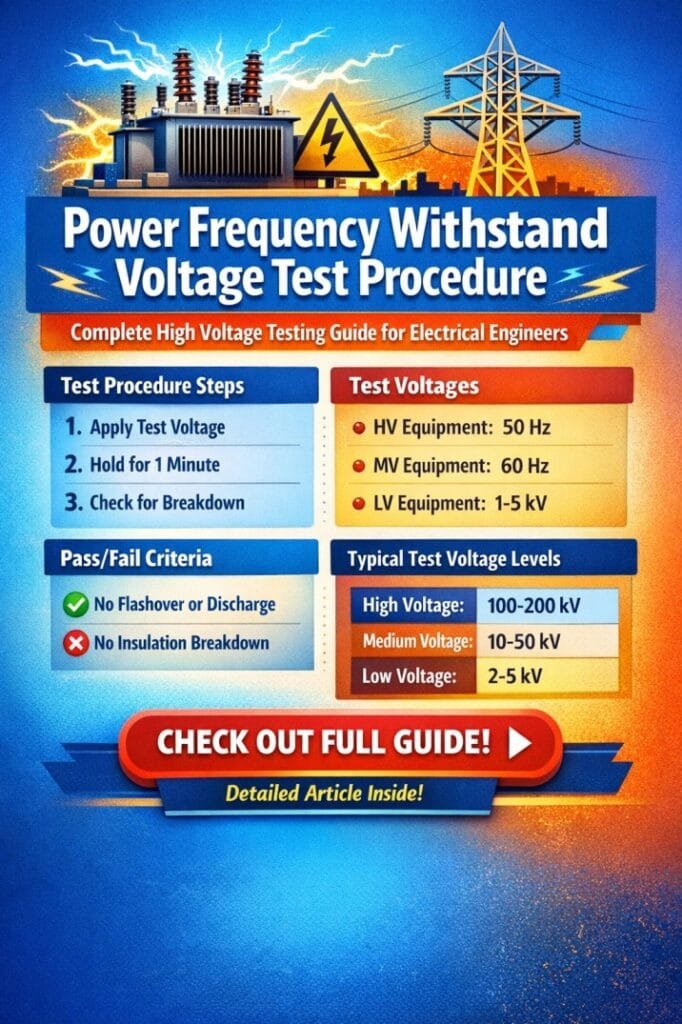
Table of Contents
Electrical assets such as transformers, switchgear, cables, busbars, and insulators must operate reliably under normal system frequency. The power frequency withstand voltage test simulates these stresses using controlled AC voltage, typically at 50 Hz or 60 Hz depending on the power system standard.
Know more about Top 20 Electrical Testing Tools Which You Must Have
A properly executed test helps detect insulation weaknesses, manufacturing defects, contamination, or deterioration that could lead to insulation failure. This guide explains the complete procedure, equipment requirements, safety precautions, and interpretation of results so electrical engineers can perform the test correctly and confidently.
Understanding the Power Frequency Withstand Voltage Test
The power frequency withstand voltage test is a high voltage AC test performed at the system power frequency. The objective is to verify that the insulation of electrical equipment can withstand a specified voltage level for a defined time without breakdown.
This test is commonly referred to as:
- AC withstand test
- High voltage dielectric test
- AC hi-pot test
Unlike impulse testing, which simulates lightning or switching surges, the power frequency withstand voltage test evaluates insulation performance under sustained AC voltage stress.
The voltage applied during testing is higher than the normal operating voltage. This ensures a safety margin and confirms the reliability of insulation systems.
Typical applications include testing of:
- Power transformers
- Switchgear and circuit breakers
- Power cables
- Insulators and bushings
- Motor windings
- Busbar systems
International standards such as IEC, IEEE, and ANSI define the test levels and procedures.
Know more about Best Megger Testers for Industrial Use
Purpose of the Power Frequency Withstand Voltage Test
The power frequency withstand voltage test serves several important purposes in electrical engineering practice.
Primary objectives include:
- Verifying insulation integrity of electrical equipment
- Detecting manufacturing defects in insulation materials
- Ensuring compliance with international standards
- Confirming proper installation during commissioning
- Identifying insulation deterioration during maintenance
By performing this test, engineers can reduce the risk of unexpected electrical breakdowns and improve system reliability.
Test Equipment Required
Specialized high voltage equipment is required to perform the power frequency withstand voltage test safely and accurately.
The typical test setup consists of the following components.
| Equipment | Function |
|---|---|
| High Voltage Test Transformer | Steps up voltage to the required test level |
| Voltage Regulator | Controls the applied test voltage |
| Measuring Instruments | Monitor voltage, current, and leakage |
| Protection Devices | Protect equipment in case of flashover |
| Control Panel | Allows controlled voltage application |
| Safety Earthing System | Ensures safe grounding of equipment |
In modern testing laboratories, digital control panels and automated measurement systems are often used to improve accuracy and safety.
Know more about How to Use Megger Insulation Tester 1000V
Standard Test Voltage Levels
The test voltage for the power frequency withstand voltage test depends on the rated voltage of the equipment and the applicable international standard.
Typical test voltage values are summarized below.
| Equipment Rated Voltage | Typical AC Withstand Test Voltage |
|---|---|
| 11 kV equipment | 28 kV AC |
| 33 kV equipment | 70 kV AC |
| 66 kV equipment | 140 kV AC |
| 132 kV equipment | 275 kV AC |
These values may vary depending on IEC or IEEE standards and the specific equipment design.
Pre-Test Preparation
Before performing the power frequency withstand voltage test, proper preparation is essential to ensure safe and accurate testing.
Important preparation steps include:
- Disconnect the equipment from the power system.
- Visually inspect insulation for damage or contamination.
- Clean insulators and bushings if required.
- Verify that all protective earthing connections are in place.
- Check calibration of measuring instruments.
- Ensure test personnel follow safety procedures.
Failure to prepare properly can lead to inaccurate test results or safety hazards.
Explore all about How to Test a 3 Phase Motor With a Megger
Power Frequency Withstand Voltage Test Procedure
The power frequency withstand voltage test must be performed using a controlled step-by-step procedure. This ensures accurate results and protects both personnel and equipment.
Step 1: Connect the Test Circuit
The equipment under test is connected to the high voltage test transformer according to the required configuration.
Typical connections include:
- High voltage terminal connected to the test object
- Ground terminal connected to earth
- Measuring instruments connected for monitoring voltage and leakage current
Step 2: Apply Voltage Gradually
The test voltage should be increased slowly and smoothly using a voltage regulator.
This gradual increase helps prevent sudden insulation stress and allows monitoring of abnormal current behavior. Know more about How to Use Megger Insulation Tester MIT2500
Step 3: Reach the Specified Test Voltage
The voltage is raised until the specified test level is reached according to the applicable standard.
At this stage, the power frequency withstand voltage test voltage must remain stable.
Step 4: Maintain Test Voltage for the Required Duration
The standard test duration is typically 60 seconds.
During this time engineers observe:
- Leakage current behavior
- Partial discharge indications
- Audible discharge or flashover
Step 5: Reduce Voltage Gradually
After the test duration is completed, the voltage is slowly reduced to zero before disconnecting the equipment.
Sudden voltage removal should always be avoided.
Acceptance Criteria
The equipment passes the power frequency withstand voltage test if it satisfies the following conditions.
- No flashover or breakdown occurs
- Leakage current remains within acceptable limits
- No visible insulation damage is observed
If breakdown occurs during testing, the insulation system requires investigation and corrective action.
Find all about Best Megger Insulation Testers 5000V
Safety Precautions During Testing
High voltage testing involves significant risk, therefore strict safety procedures must be followed during the power frequency withstand voltage test.
Key safety practices include:
- Establish a controlled test area with warning signs
- Maintain safe clearance distances
- Use proper grounding techniques
- Ensure emergency shutdown capability
- Allow only trained personnel inside the test zone
Engineers must also discharge the equipment completely after testing to eliminate stored electrical energy.
Common Problems Observed During Testing
During the power frequency withstand voltage test, several issues may indicate insulation problems.
Common observations include:
| Observation | Possible Cause |
|---|---|
| Sudden current increase | Insulation weakness |
| Partial discharge sound | Air gaps or insulation defects |
| Flashover | Surface contamination |
| Breakdown | Insulation failure |
Identifying these symptoms early helps prevent catastrophic equipment failure in service.
Applications in Electrical Engineering
The power frequency withstand voltage test is widely used in many stages of electrical equipment lifecycle.
Major applications include:
- Factory routine testing of electrical equipment
- Commissioning of substations and power plants
- Preventive maintenance of switchgear and transformers
- Quality assurance during manufacturing
This test remains a fundamental method for verifying insulation strength in modern power systems.
Know more about Top 12 Electrical Testing Equipment Suppliers in USA
Difference Between AC Withstand Test and DC Hi-Pot Test
Electrical engineers often compare AC and DC dielectric testing methods.
The table below summarizes the key differences.
| Parameter | AC Withstand Test | DC Hi-Pot Test |
|---|---|---|
| Voltage Type | Alternating Current | Direct Current |
| Frequency | 50/60 Hz | 0 Hz |
| Equipment Size | Larger | Smaller |
| Accuracy for AC equipment | Higher | Lower |
| Typical Application | Switchgear, transformers | Long power cables |
For most AC power system equipment, the power frequency withstand voltage test provides a more realistic evaluation of insulation performance.
Importance for Modern Power Systems
Reliable insulation systems are essential for safe and uninterrupted power supply. The power frequency withstand voltage test plays a critical role in ensuring that electrical equipment can handle voltage stresses without failure.
Find all about Partial Discharge vs Tan Delta Cable Testing: Important Key Differences Every Engineer Must Know
With increasing grid complexity, renewable integration, and higher transmission voltages, insulation reliability has become even more important.
Electrical engineers rely on standardized high voltage testing methods to maintain system integrity, prevent outages, and protect expensive equipment investments.
Conclusion
The power frequency withstand voltage test remains a fundamental dielectric testing method used throughout the electrical power industry. It verifies the insulation strength of electrical equipment under sustained AC voltage stress and ensures compliance with international standards.
By following the correct procedure, using proper test equipment, and observing strict safety precautions, engineers can accurately evaluate insulation performance and detect potential weaknesses before equipment enters service.
Whether performed during manufacturing, commissioning, or maintenance, the power frequency withstand voltage test provides critical assurance that power system components will operate safely and reliably under real operating conditions.
Find all about VLF Tan Delta Testing of MV Cables: Ensure Reliable High-Voltage Cable Performance
Follow Us on Social:
Subscribe our Newsletter on Electrical Insights for latest updates from Electrical Engineering Hub
#PowerFrequencyTest, #HighVoltageTesting, #WithstandVoltageTest, #ElectricalTesting, #InsulationTesting, #ElectricalEngineering, #HVTestingProcedure, #ElectricalSafety, #PowerSystemTesting, #SubstationTesting