
Dry Type Transformer Sizing Chart – Accurate kVA Selection Guide for Electrical Engineers
Selecting the correct transformer capacity is one of the most important steps in electrical system design. An undersized transformer leads to overheating and insulation failure. An oversized unit increases capital cost and reduces efficiency. This is where a dry type transformer sizing chart becomes a practical engineering tool. It helps electrical engineers determine the right kVA rating based on connected load, demand factor, and system voltage.
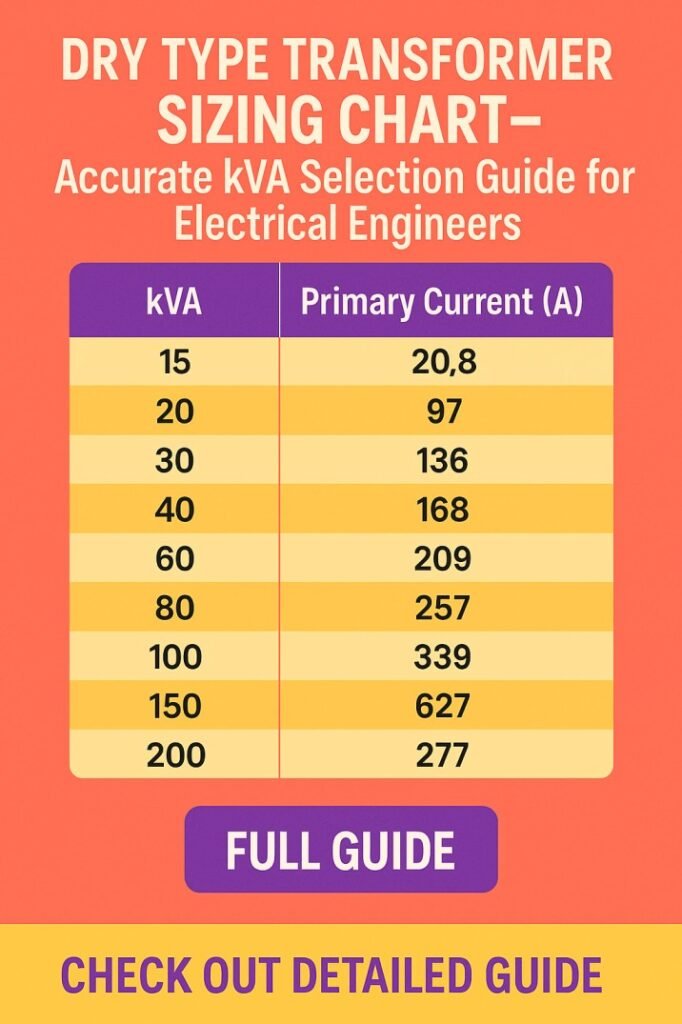
Table of Contents
In commercial buildings, hospitals, data centers, and industrial facilities, dry type transformers are widely used because they are safer indoors and require less maintenance than oil-filled units. However, correct sizing remains critical. This guide explains how to use a dry type transformer sizing chart properly, how to calculate load demand, and how to select the most accurate kVA rating for reliable long-term operation.
Know more about Transformer Sizing for Residential Building
Understanding Dry Type Transformers in Modern Power Systems
Dry type transformers use air as the cooling medium instead of oil. Most units are either ventilated (VPI – Vacuum Pressure Impregnated) or cast resin transformers. They are commonly installed inside electrical rooms due to their fire safety and environmental advantages.
Typical applications include:
- Commercial buildings
- Shopping malls
- Hospitals
- Schools and universities
- Data centers
- Industrial control panels
When selecting capacity, engineers rely on load calculation methods and refer to a dry type transformer sizing chart to match calculated kVA with standard transformer ratings.
Know more about Top Dry Type Transformer Manufacturers in the USA
Why Proper Transformer Sizing Matters
Transformer sizing affects:
- Voltage regulation
- Temperature rise
- System efficiency
- Equipment lifespan
- Future expansion capability
If the transformer operates continuously above 100% load, insulation life reduces rapidly. If it runs below 40% load most of the time, efficiency drops due to core losses dominating.
A properly prepared dry type transformer sizing chart simplifies decision-making and prevents these design errors.
Know more about Transformer Cooling Methods: ONAN, ONAF, OFAF & More
Basic Formula for Transformer kVA Calculation
Before using any dry type transformer sizing chart, you must calculate total connected load and expected demand.
For three-phase systems:
kVA = (√3 × Voltage × Current) / 1000
For single-phase systems:
kVA = (Voltage × Current) / 1000
Alternatively, when total power in kW is known:
kVA = kW / Power Factor
These calculations provide the required load in kVA. After that, engineers compare the result with the nearest higher standard transformer rating shown in a dry type transformer sizing chart.
Standard Dry Type Transformer Ratings
Transformers are manufactured in standard kVA ratings. Below is a commonly used dry type transformer sizing chart for low voltage distribution systems.
Table 1: Standard Dry Type Transformer kVA Ratings
| Standard kVA Rating | Typical Application Area |
|---|---|
| 15 kVA | Small residential panels |
| 25 kVA | Small offices |
| 45 kVA | Retail shops |
| 75 kVA | Small commercial units |
| 112.5 kVA | Medium office floors |
| 150 kVA | Small industrial loads |
| 225 kVA | Large commercial panels |
| 300 kVA | Manufacturing workshops |
| 500 kVA | Industrial distribution |
| 750 kVA | Data centers |
| 1000 kVA | Large facilities |
| 1500 kVA | Heavy industrial loads |
| 2000 kVA and above | Substation level supply |
After calculating required load, always select the next higher standard rating from the dry type transformer sizing chart.
Explore all about Transformer Bond Sizing
Step-by-Step Sizing Procedure
Using a dry type transformer sizing chart becomes easier when following a structured method.
Step 1: Calculate Total Connected Load
List all loads including lighting, HVAC, motors, receptacles, and future expansion. Sum the kW values. Find more Transformer calculators here
Step 2: Apply Demand Factor
Not all loads operate simultaneously. Apply demand factor based on building type.
Example:
- Total connected load = 180 kW
Demand factor = 0.8 - Demand load = 180 × 0.8 = 144 kW
Step 3: Convert to kVA
Assume power factor = 0.9
kVA = 144 / 0.9 = 160 kVA
Step 4: Select from Dry Type Transformer Sizing Chart
The calculated value is 160 kVA. The next higher standard rating from the dry type transformer sizing chart is 225 kVA.
This ensures safe operation with margin for future load growth.
Typical Load vs Recommended Transformer Rating
The table below shows practical selection guidance using a dry type transformer sizing chart.
Table 2: Load to Transformer Selection Guide
| Calculated Load (kVA) | Recommended Transformer (kVA) |
|---|---|
| Up to 20 kVA | 25 kVA |
| 21 – 40 kVA | 45 kVA |
| 41 – 70 kVA | 75 kVA |
| 71 – 100 kVA | 112.5 kVA |
| 101 – 140 kVA | 150 kVA |
| 141 – 200 kVA | 225 kVA |
| 201 – 275 kVA | 300 kVA |
| 276 – 450 kVA | 500 kVA |
| 451 – 700 kVA | 750 kVA |
| 701 – 900 kVA | 1000 kVA |
This practical dry type transformer sizing chart approach prevents undersizing and improves reliability.
Know all about Transformer Sizing for EV Charger
Important Factors Beyond kVA
A dry type transformer sizing chart gives the kVA rating, but engineers must also consider other technical parameters.
Voltage Rating
Primary and secondary voltage must match system design. Common combinations include:
- 11 kV / 415 V
- 480 V / 208 V
- 415 V / 230 V
Temperature Rise
Standard temperature rise ratings are 80°C, 115°C, and 150°C. Lower temperature rise increases insulation life.
Cooling Class
Dry type transformers use air natural (AN) or air forced (AF) cooling. Forced cooling increases capacity by 25% to 33%.
Impedance Percentage
Typical impedance values range from 4% to 6%. This affects short circuit current and protection coordination.
Harmonic Content
In facilities with VFDs, UPS systems, or nonlinear loads, consider K-rated transformers. A normal dry type transformer sizing chart does not account for harmonic heating unless specified.
Example for Industrial Facility
An industrial workshop has:
- Lighting load: 25 kW
- Motor load: 90 kW
- Miscellaneous load: 35 kW
Know more about Transformers Earthspark Size Chart
Total connected load = 150 kW
- Demand factor = 0.85
- Demand load = 127.5 kW
Power factor = 0.88
kVA = 127.5 / 0.88 = 145 kVA
From the dry type transformer sizing chart, select 150 kVA or 225 kVA depending on expansion plan. If future load increase is expected, 225 kVA is safer.
Oversizing vs Undersizing Analysis
Using a dry type transformer sizing chart correctly helps balance cost and performance.
Undersizing Risks:
- Overheating
- Voltage drop
- Reduced insulation life
- Frequent tripping
Oversizing Risks:
- Higher no-load losses
- Higher capital investment
- Poor efficiency at low load
The ideal operating range is between 60% and 80% of transformer capacity.
Recommended Loading Guidelines
Table 3: Transformer Loading Best Practice
| Operating Condition | Recommended Loading |
|---|---|
| Continuous Load | 70% – 80% |
| Short Duration Peak | Up to 100% |
| Emergency Loading | 110% (limited time) |
Always compare expected operating load with values from the dry type transformer sizing chart to maintain this range.
Find all about Transformer Disconnect Sizing
Future Expansion Planning
In commercial projects, load increases within five years are common. When reviewing a dry type transformer sizing chart, add at least 15% to 25% spare capacity if expansion is planned.
Example:
- Calculated load = 300 kVA
- Future margin 20% = 360 kVA
Select 500 kVA from the dry type transformer sizing chart.
This avoids costly transformer replacement later.
Compliance with Electrical Standards
Transformer sizing must comply with:
- IEC 60076
- IEEE C57 standards
- Local electrical codes
- Utility regulations
A dry type transformer sizing chart should always align with manufacturer specifications and standard ratings defined in these codes.
Know more about Best Transformer Testing Companies in Canada | Trusted Electrical Testing Experts & Utility Service Providers
Final Engineering Recommendations
A dry type transformer sizing chart is not just a reference table. It is part of a complete load study process. Accurate sizing requires:
- Detailed load calculation
- Correct demand factor selection
- Realistic power factor assumption
- Consideration of harmonics
- Planning for future growth
When used properly, a dry type transformer sizing chart ensures reliable performance, longer insulation life, stable voltage regulation, and optimal efficiency.
Electrical engineers who follow a structured calculation method and verify results against a well-prepared dry type transformer sizing chart can avoid costly design mistakes. Correct transformer sizing improves system safety and supports long-term operational stability. Read in detail about transformer manufacturers in egypt
Follow Us on Social:
Subscribe our Newsletter on Electrical Insights for latest updates from Electrical Engineering Hub
#drytypetransformer, #transformersizing, #transformersizingchart, #electricaldesign, #loadcalculation, #powersystemdesign, #kvarating, #electricalengineering, #distributiontransformer, #engineeringtools