
Solar Plant Efficiency Calculation: Expert Guide to Optimize PV System Performance
Solar energy has become one of the most reliable and sustainable sources of electricity in recent years. For solar project developers, engineers, and plant operators, understanding and accurately performing a solar plant efficiency calculation is crucial for maximizing performance, reducing operational costs, and ensuring long-term energy yield. This article explains the methodology, factors, and practical steps involved in calculating solar plant efficiency, using real-world examples and data tables for clarity.
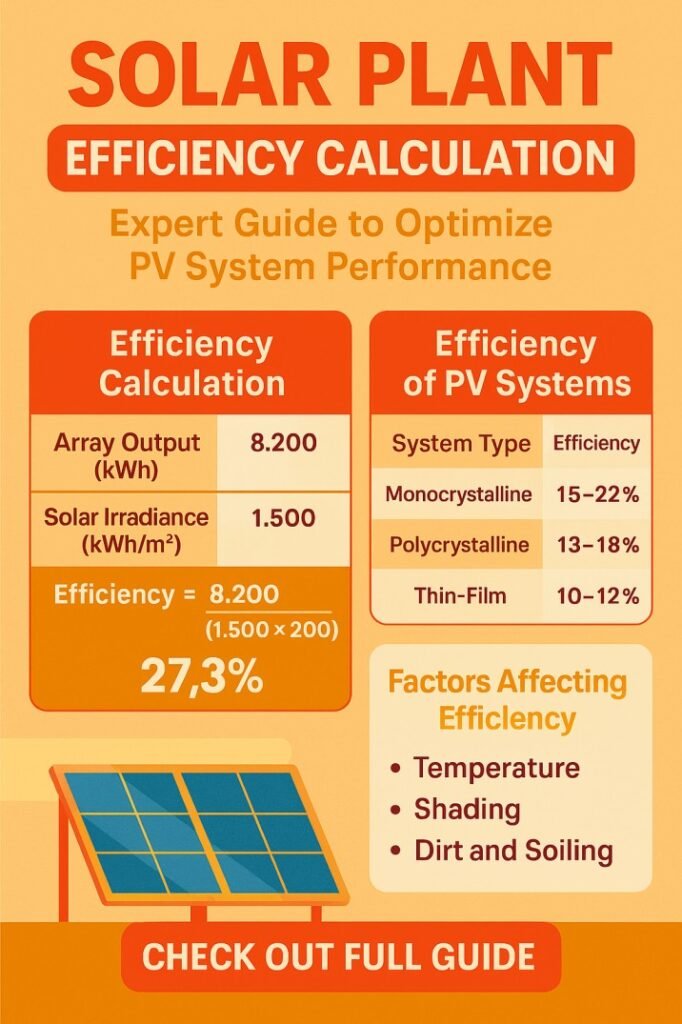
Table of Contents
Understanding Solar Plant Efficiency
Solar plant efficiency refers to the ratio of electrical energy output from a solar power system to the total solar energy incident on the panels. In simpler terms, it measures how effectively a solar plant converts sunlight into usable electricity. Accurate solar plant efficiency calculation helps in identifying underperforming components, optimizing system design, and predicting energy yield over time.
The general formula used is:
Solar Plant Efficiency (%) = (Actual AC Energy Output / Total Solar Energy Incident) × 100
Where:
- Actual AC Energy Output is measured in kilowatt-hours (kWh) or megawatt-hours (MWh) over a given period.
- Total Solar Energy Incident is the energy received by the solar panels, calculated using irradiance (kWh/m²) and the total area of the solar panels.
Know more about Top 15 Solar Companies in Dubai | Trusted UAE Solar Installers & Experts
Key Factors Affecting Solar Plant Efficiency
Several factors influence the efficiency of a solar plant. Accurate solar plant efficiency calculation must account for these variables to provide a realistic performance metric.
- Solar Irradiance: The intensity of sunlight striking the solar panels directly impacts energy production. Average daily and seasonal irradiance must be considered.
- Module Efficiency: Different photovoltaic (PV) panels have varying efficiency ratings, usually between 15% and 22%.
- Temperature Effects: Higher temperatures reduce panel efficiency. Temperature coefficients must be included in calculations.
- System Losses: Inverters, transformers, and wiring introduce losses that reduce overall efficiency.
- Shading and Soiling: Partial shading, dust, and dirt accumulation decrease energy output.
- Orientation and Tilt: Panels angled optimally to capture sunlight maximize efficiency, whereas suboptimal tilt reduces performance.
Know more about DEWA Approved Solar Contractors List UAE
Step-by-Step Solar Plant Efficiency Calculation
Performing an accurate solar plant efficiency calculation involves several steps. The following method is widely used by engineers:
Step 1: Collect Solar Irradiance Data
Use a pyranometer or solar data from meteorological stations to measure the incident solar energy. For example, a 1 MW plant may receive an average irradiance of 5 kWh/m²/day.
Step 2: Determine the Total Solar Energy Incident
Calculate the total energy incident on the panels:
Total Energy Incident (kWh) = Panel Area (m²) × Irradiance (kWh/m²)
This tool can help you get the job done more efficiently Solar Wire Size Calculator (DC): Best Solar Cable Sizing Tool
| Parameter | Value |
|---|---|
| Total Panel Area | 6,000 m² |
| Average Daily Irradiance | 5 kWh/m²/day |
| Total Energy Incident | 30,000 kWh/day |
Step 3: Measure Actual Energy Output
Obtain the actual energy output from the plant’s SCADA system or energy meters. Assume the 1 MW plant produces 24,000 kWh/day.
Step 4: Apply the Efficiency Formula
Using the formula:
Solar Plant Efficiency (%) = (24,000 / 30,000) × 100 = 80%
This indicates the plant converts 80% of the incident solar energy into usable electricity, considering losses and real-world operating conditions.
This tool is perfect for achieving better results in solar system design. Try here Wire Size Calculator for Solar Panels – Avoid Power Loss in Off-Grid and Hybrid Systems
Accounting for System Losses
System losses significantly impact solar plant efficiency calculation. Typical losses include:
| Loss Type | Average Impact (%) |
|---|---|
| Inverter Losses | 2–4 |
| Wiring and Connection Losses | 1–2 |
| Temperature Loss | 2–5 |
| Soiling and Dust | 1–3 |
| Mismatch Losses | 1–2 |
After accounting for losses, the net plant efficiency might drop from 80% to approximately 70–75%, which is common for commercial solar plants.
Dive deeper into off grid solar system design
Performance Ratio vs. Efficiency
While solar plant efficiency calculation provides the absolute conversion rate, the performance ratio (PR) is another metric often used in industry. PR compares actual energy output to theoretical maximum output and helps normalize efficiency across locations and conditions.
PR (%) = (Actual Energy Output / Theoretical Energy Output) × 100
This metric complements efficiency calculations by highlighting operational performance independent of irradiance variability.
Use our online tool for free Solar Performance Ratio Calculator – Measure Solar System Efficiency Accurately
Practical Considerations for Accurate Calculation
- Data Logging: Use accurate SCADA systems and sensors to monitor energy output and environmental conditions.
- Temperature Correction: Apply temperature coefficients to module efficiency for realistic calculations.
- Time Frame: Calculate efficiency over days, months, or years to capture seasonal variations.
- Maintenance Impact: Factor in downtime during cleaning, inverter maintenance, or other operational interruptions. Use our online tool for free Solar Panel Tilt Angle Calculator – Find the Perfect Angle for Maximum Solar Power
Example: Annual Solar Plant Efficiency Calculation
Consider a 5 MW solar plant with the following characteristics:
| Parameter | Value |
|---|---|
| Total Panel Area | 30,000 m² |
| Average Daily Irradiance | 5 kWh/m²/day |
| Annual Energy Output | 8,000,000 kWh/year |
Step 1: Total Annual Energy Incident
Total Energy Incident = Panel Area × Daily Irradiance × 365
= 30,000 × 5 × 365 = 54,750,000 kWh/year
Step 2: Efficiency Calculation
Efficiency = (8,000,000 / 54,750,000) × 100 ≈ 14.6%
This plant achieves 14.6% efficiency after considering real-world losses, slightly lower than ideal module efficiency but realistic for large-scale installations.
Use our online tool for free Solar Panel Size Calculator by Load – Find the Right System for Your Power Needs
Improving Solar Plant Efficiency
Accurate solar plant efficiency calculation not only measures performance but also highlights opportunities for improvement:
- Panel Cleaning: Regular cleaning reduces soiling losses.
- Inverter Optimization: Ensure inverters operate within recommended voltage and load ranges.
- Shading Analysis: Use trackers or adjust panel layout to minimize shading.
- Temperature Management: Adequate airflow under panels helps reduce temperature-related losses.
- Monitoring Systems: Continuous monitoring detects underperforming strings or modules promptly. Use our online tool for free Solar Panels kWh Calculator UK: Instantly Estimate Output, Savings & Payback
Conclusion
A precise solar plant efficiency calculation is essential for maximizing energy production and operational profitability. By considering irradiance, panel characteristics, system losses, and environmental factors, plant operators can make informed decisions about design, maintenance, and upgrades.
Tables, metrics, and real-world examples ensure that the calculation is both practical and actionable. Continuous monitoring and performance optimization are key to achieving the highest possible efficiency, making solar energy a reliable and sustainable solution for long-term electricity generation.
Find more Electrical Engineering Tools for easy electrical calculations and estimations.
Follow Us on Social:
Subscribe our Newsletter on Electrical Insights for latest updates from Electrical Engineering Hub
#SolarPlantEfficiency, #SolarEnergyCalculation, #RenewableEnergy, #SolarPowerOptimization, #PVSystemEfficiency, #SolarEngineering, #EnergyManagement, #SustainableEnergy, #SolarTech, #CleanEnergy