Cable Size Resistance Chart Explained: Accurate Wire Selection for Safe & Efficient Electrical Design
Electrical design is not only about delivering power. It is about delivering power safely, efficiently, and with minimal losses. One of the most practical tools engineers and technicians rely on is a cable size resistance chart. This chart connects wire cross-sectional area with electrical resistance, helping professionals choose conductors that meet voltage drop, heating, and efficiency requirements.
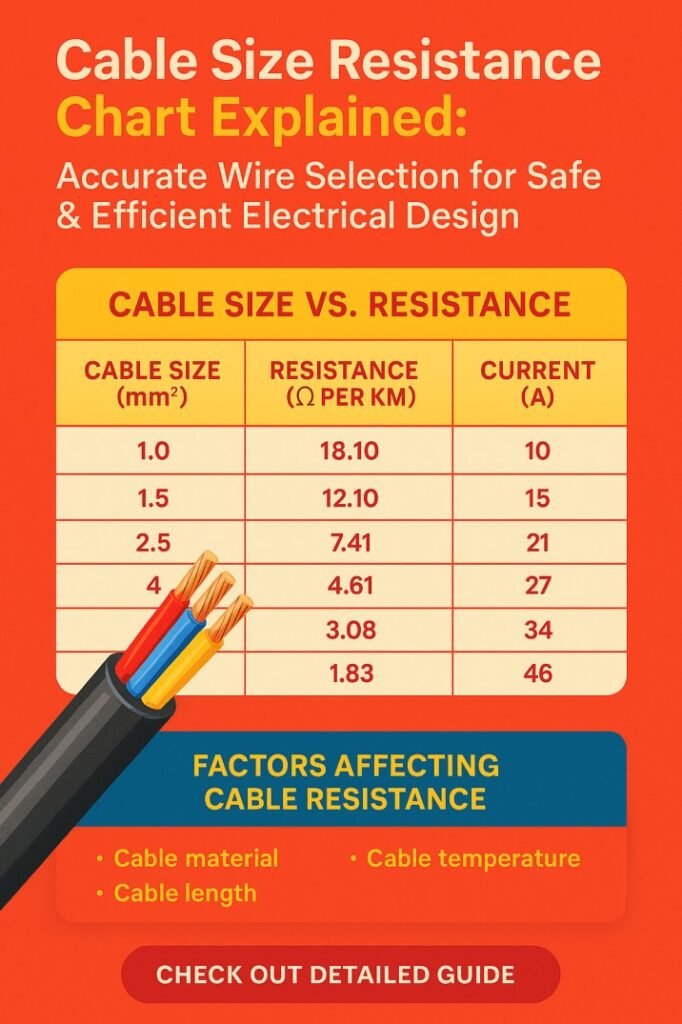
Table of Contents
A cable size resistance chart is especially useful in low-voltage installations, industrial feeders, control panels, and renewable energy systems. When current flows through a conductor, resistance causes heat and voltage drop. If the cable is too small, losses increase and equipment performance suffers. If it is oversized, project cost rises unnecessarily. The correct balance begins with understanding resistance values linked to cable size.
Make your task simple with our online tool electrical cable size calculator
Why Resistance Matters in Cable Selection
Every conductor has resistance, even high-quality copper or aluminum. Resistance is measured in ohms and depends on three main factors: material, length, and cross-sectional area. A cable size resistance chart simplifies this by listing standard conductor sizes and their resistance per unit length.
Higher resistance leads to
- Increased voltage drop
- Excessive heat generation
- Reduced system efficiency
- Potential insulation damage over time
In power distribution, even a small voltage drop can affect motors, lighting performance, and sensitive electronics. That is why engineers consult a cable size resistance chart early in the design stage rather than after installation problems appear.
Understanding the Relationship Between Cable Size and Resistance
The relationship between conductor size and resistance is inverse. Larger conductors have lower resistance because electrons have more area to flow through. This principle is derived from the resistance formula:
R = ρ × L / A
Where
R = Resistance (ohms)
ρ = Resistivity of the material
L = Length of conductor
A = Cross-sectional area
A cable size resistance chart removes the need to calculate this every time. Instead, it provides ready values that can be quickly applied during design and site work.
Access our powerful online calculator now Electrical Diversity Calculator for accurate Load Estimation and efficient electrical Design.
Typical Copper Cable Resistance Values
Below is a reference table showing approximate resistance values for copper conductors at 20°C. These values are commonly used when reading a cable size resistance chart.
| Cable Size (mm²) | Resistance (Ω/km) | Resistance (Ω/100m) |
|---|---|---|
| 1.5 | 12.10 | 1.21 |
| 2.5 | 7.41 | 0.741 |
| 4 | 4.61 | 0.461 |
| 6 | 3.08 | 0.308 |
| 10 | 1.83 | 0.183 |
| 16 | 1.15 | 0.115 |
| 25 | 0.727 | 0.0727 |
| 35 | 0.524 | 0.0524 |
| 50 | 0.387 | 0.0387 |
| 70 | 0.268 | 0.0268 |
This type of table forms the foundation of a cable size resistance chart used in practical field calculations.
Use our online tool for free Wire Size Calculator for Motors – Accurate Motor Cable Sizing Tool for Electric Loads
How to Use a Cable Size Resistance Chart for Voltage Drop
Voltage drop is one of the most common reasons to consult a cable size resistance chart. The basic voltage drop formula for single-phase circuits is:
Voltage Drop = Current × Resistance × 2 × Length
The factor of 2 accounts for the outgoing and return path. By taking resistance values directly from a cable size resistance chart, engineers can quickly test different conductor sizes before finalizing a design.
Example
If a load draws 20 A and is 40 meters from the supply using a 2.5 mm² copper cable:
Resistance per meter = 0.741 Ω / 100 m = 0.00741 Ω/m
Total loop resistance = 0.00741 × 40 × 2 = 0.5928 Ω
Voltage drop = 20 × 0.5928 = 11.86 V
If the system voltage is 230 V, this drop may be too high. The cable size resistance chart would then guide selection of the next larger conductor.
Check out this tool that makes the process much easier and faster MM to AWG Wire Size Calculator According to IEC and NEC
Comparing Copper and Aluminum Conductors
Material also plays a big role in any cable size resistance chart. Aluminum has higher resistance than copper for the same cross-sectional area. That means a larger aluminum conductor is required to achieve the same performance.
| Cable Size (mm²) | Copper Resistance (Ω/km) | Aluminum Resistance (Ω/km) |
|---|---|---|
| 16 | 1.15 | 1.91 |
| 25 | 0.727 | 1.20 |
| 35 | 0.524 | 0.868 |
| 50 | 0.387 | 0.641 |
A cable size resistance chart that includes both materials helps designers balance weight, cost, and performance in large installations.
Temperature Impact on Resistance
Resistance values in a cable size resistance chart are usually given at 20°C. In real installations, conductors operate at higher temperatures, which increases resistance.
Approximate correction factors
| Conductor Temp (°C) | Resistance Increase |
|---|---|
| 40 | +8% |
| 60 | +16% |
| 80 | +24% |
When circuits carry high current continuously, using temperature-adjusted values from a cable size resistance chart ensures voltage drop and heating are not underestimated.
Explore this tool here to simplify your work instantly Neutral Conductor Sizing Calculator – Accurate Neutral Wire Size for Electrical Circuits
Role in Energy Efficiency
Energy loss in cables appears as heat due to resistance. Over long distances, undersized conductors waste significant power. A cable size resistance chart supports energy-efficient design by helping reduce I²R losses.
Lower resistance leads to
- Reduced operating costs
- Improved voltage regulation
- Longer equipment life
- Better performance of motors and drives
In solar and battery systems, where efficiency is critical, a cable size resistance chart becomes even more important.
Integration with Current Carrying Capacity
Resistance alone does not determine cable size. Current carrying capacity, installation method, grouping, and ambient temperature must also be considered. However, a cable size resistance chart works together with ampacity tables to reach a safe and economical choice.
For example, a cable may safely carry the required current but still fail voltage drop limits due to high resistance. In that case, the cable size resistance chart indicates the need for a larger conductor even though thermal limits are not exceeded.
Take a look at this tool for a smarter way to handle feeder wire sizing Feeder Wire Size Calculator – Accurate Guide for Electricians and Homeowners
Practical Tips for Field Engineers
Using a cable size resistance chart in real projects becomes easier with a few habits
- Always calculate voltage drop for the full route length
- Consider future load increases
- Apply temperature correction when cables run hot
- Use manufacturer data for long critical feeders
- Recheck values when switching between copper and aluminum
Keeping a printed or digital cable size resistance chart on site speeds up decision making during installation and troubleshooting.
Conclusion
Accurate conductor selection is a balance between safety, efficiency, and cost. A cable size resistance chart provides the resistance values needed to control voltage drop, limit heating, and improve overall system performance. By understanding how resistance changes with cable size, length, material, and temperature, electrical professionals can design installations that operate reliably for decades. Whether working on residential wiring or industrial power systems, consistent use of a cable size resistance chart leads to smarter and safer electrical design.
Try this tool out to save time and effort for easy conversions Amps to Wire Size Calculator – Choose the Right Cable for 10A, 20A, 40A Loads
Follow Us on Social:
Subscribe our Newsletter on Electrical Insights for latest updates from Electrical Engineering Hub
#CableSizeResistanceChart, #CableResistance, #ElectricalCableSizing, #VoltageDropCalculation, #WireResistanceChart, #ElectricalDesignTools, #PowerCableSelection, #ElectricalStandards, #EngineeringReference, #CableSizingGuide