
Coincidence Factor vs Diversity Factor: The Load Calculation Mistake Engineers Still Make
In electrical design, accurate load calculation is the backbone of safe, economical, and code-compliant systems. Yet even experienced engineers continue to confuse two closely related electrical concepts, leading to oversized equipment or, worse, under designed networks. This article explains coincidence factor vs diversity factor in a practical, engineering-focused way, highlighting why this confusion still exists and how it affects real-world projects. By the end, you will clearly understand when to use each factor, how they differ, and how to avoid the load calculation mistake engineers still make.
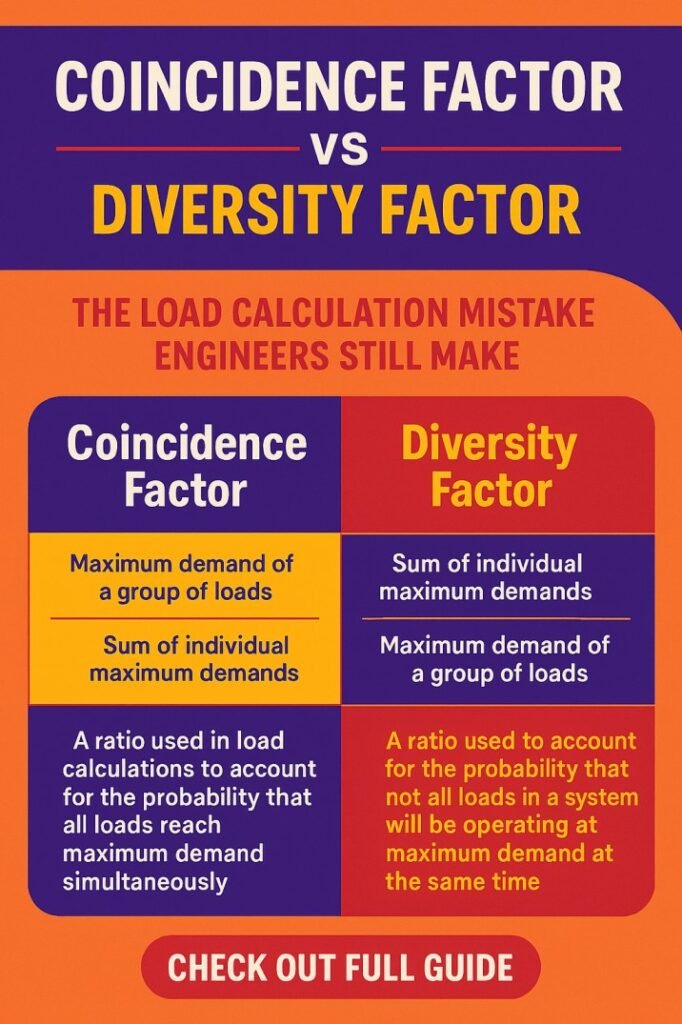
Table of Contents
Electrical loads rarely operate at their maximum rating all at once. Homes, offices, industries, and utilities depend on probability and usage patterns. That is exactly where coincidence factor and diversity factor come into play. Understanding coincidence factor vs diversity factor is not just a theory topic from textbooks; it directly impacts transformer sizing, feeder design, protection coordination, and capital cost optimization.
Why Load Calculation Errors Still Happen
Despite modern software and standards, confusion persists because both factors deal with non-simultaneous loading. Many engineers incorrectly treat them as interchangeable or apply both at the same stage of calculation. This misunderstanding of coincidence factor vs diversity factor often results in conservative designs that inflate costs or aggressive designs that compromise reliability.
Some common reasons behind this mistake include:
- Similar definitions used in different standards
- Inconsistent terminology across countries
- Overreliance on rules of thumb
- Lack of clarity between connected load and maximum demand
Before diving deeper into coincidence factor vs diversity factor, it is essential to define each term clearly.
Know more about Difference Between 11kV and 33kV Substation: Best Guide on Design, Cost, Capacity & Applications
What Is Coincidence Factor?
Coincidence factor represents the probability that individual loads will operate at the same time. It is defined as the ratio of the maximum simultaneous demand of a group of loads to the sum of their individual maximum demands.
In simple terms, it answers one question: how many loads are likely to be ON together?
Coincidence factor is always less than or equal to 1. A value of 1 means all loads operate at the same time, which is rare in real installations.
This concept is widely used in:
- Distribution systems
- Residential and commercial buildings
- Feeder and transformer sizing
Understanding coincidence factor vs diversity factor starts with recognizing that coincidence factor focuses on simultaneity.
What Is Diversity Factor?
Diversity factor looks at the same behavior but from the opposite angle. It is defined as the ratio of the sum of individual maximum demands to the maximum demand of the entire system.
In other words, diversity factor measures how spread out the load usage is over time.
Diversity factor is always greater than or equal to 1. The more varied the usage pattern, the higher the diversity factor.
Diversity factor is commonly applied in:
- Utility planning
- Main busbar sizing
- Substation load studies
When engineers compare coincidence factor vs diversity factor, they often miss that both describe the same phenomenon but with inverse mathematical expressions.
Know more about Coincidence Factor vs Demand Factor
Mathematical Comparison of Coincidence Factor vs Diversity Factor
The easiest way to understand coincidence factor vs diversity factor is through their formulas.
| Parameter | Coincidence Factor | Diversity Factor |
|---|---|---|
| Definition | Ratio of simultaneous demand to sum of individual demands | Ratio of sum of individual demands to system maximum demand |
| Formula | Maximum simultaneous load / Sum of individual maximum loads | Sum of individual maximum loads / Maximum system demand |
| Typical Value | ≤ 1 | ≥ 1 |
| Focus | Simultaneous usage | Load spreading |
From the table, it is clear that coincidence factor is mathematically the inverse of diversity factor. However, their application points in load calculations are different, which is where the confusion arises.
Know more about 11kV to 415V Transformer Design & Specification – Ratings, Losses, Cooling and Practical Selection Guide
Practical Example Engineers Often Misjudge
Consider a small commercial building with five air conditioning units, each rated at 10 kW.
- Total connected load = 50 kW
- Based on usage data, only three units are likely to operate simultaneously
Maximum simultaneous demand = 30 kW
Now calculate both factors.
| Calculation Item | Value |
|---|---|
| Coincidence Factor | 30 / 50 = 0.6 |
| Diversity Factor | 50 / 30 = 1.67 |
If an engineer misunderstands coincidence factor vs diversity factor and applies the diversity factor where coincidence factor is required, the feeder or transformer may be oversized significantly.
Know more about What is Demand Factor and Diversity Factor? Quick Concepts
Where Engineers Commonly Make the Mistake
The most frequent mistake in coincidence factor vs diversity factor occurs during system-level calculations. Engineers sometimes apply diversity at the load level and coincidence at the system level, which reverses their intended purpose.
Common errors include:
- Applying diversity factor to individual branch circuits
- Using coincidence factor for long-term utility planning
- Multiplying both factors together without justification
- Ignoring actual usage data and relying on generic values
Such errors directly affect demand factor calculations, maximum demand estimation, and power system efficiency.
Relationship with Demand Factor and Load Factor
To fully grasp coincidence factor vs diversity factor, it helps to see how they relate to other load terms.
- Demand factor compares maximum demand to connected load
- Load factor compares average load to peak load
- Coincidence factor focuses on simultaneity
- Diversity factor focuses on non-simultaneity
These terms are interconnected but not interchangeable. Confusing one with another leads to incorrect assumptions during design.
Know more about Power Factor vs Crest Factor: Important Differences & Comparison
Impact on Equipment Sizing and Cost
Misapplication of coincidence factor vs diversity factor has real financial consequences. Oversized transformers operate at low efficiency, increasing losses and reducing lifespan. Oversized cables raise installation costs and space requirements.
On the other hand, underestimating simultaneity can lead to:
- Overloaded feeders
- Nuisance tripping
- Voltage drops
- Reduced reliability
Correct use of coincidence factor ensures equipment is sized for realistic peak demand, while diversity factor supports economical system planning.
Typical Values Used in Practice
While actual values depend on usage patterns, engineers often use typical ranges during preliminary design.
| Load Type | Coincidence Factor Range | Diversity Factor Range |
|---|---|---|
| Residential | 0.3 – 0.6 | 1.7 – 3.3 |
| Commercial | 0.5 – 0.8 | 1.25 – 2 |
| Industrial | 0.7 – 0.9 | 1.1 – 1.4 |
| Utilities | 0.6 – 0.9 | 1.1 – 1.7 |
Using these values without understanding coincidence factor vs diversity factor can be risky. They should always be adjusted based on actual demand data.
Use our online tool Kirchhoffs Law Calculator: Instantly Solve KCL & KVL Circuits Online
Standards and Codes Perspective
Electrical standards recognize both factors but use them in different contexts. Load calculation sections in codes often imply diversity without explicitly naming it, while utility standards frequently reference coincidence.
Engineers should read standards carefully and identify whether the calculation stage requires coincidence or diversity. This awareness reduces the risk of repeating the coincidence factor vs diversity factor mistake.
How to Apply Them Correctly in Load Calculations
A practical approach to avoid confusion includes:
- Use coincidence factor when combining similar loads at the same level
- Use diversity factor when evaluating aggregated system demand
- Never apply both factors blindly to the same load group
- Validate assumptions with historical or measured data
This structured method keeps coincidence factor vs diversity factor clear and avoids unnecessary conservatism.
Why This Topic Still Matters Today
With the rise of electric vehicles, distributed generation, and smart loads, load profiles are becoming more dynamic. Incorrect interpretation of coincidence factor vs diversity factor in modern systems can lead to either stranded assets or reliability challenges.
Engineers who understand the subtle difference gain an edge in designing efficient, future-ready systems.
Know more about Difference Between Relay and Contactor: 7 Powerful Reasons This Guide Makes It Easy
Final Thoughts
The debate around coincidence factor vs diversity factor is not about which one is better. It is about knowing where and how to apply each correctly. Both factors describe the same load behavior from different viewpoints, but confusing them remains one of the most persistent load calculation mistakes engineers still make.
By clearly distinguishing their definitions, formulas, and applications, engineers can design safer, more economical, and more reliable electrical systems. Accurate load estimation is not just good engineering practice; it is the foundation of every successful power system design.
Know more about How to Wire a 480/277 Lighting System: Step-By-Step Guide for Safe Commercial Installation
Follow Us on Social:
Subscribe our Newsletter on Electrical Insights for latest updates from Electrical Engineering Hub
#coincidencefactorvsdiversityfactor, #coincidencefactor, #diversityfactor, #electricalengineering, #powerdistribution, #loadcalculation, #demandfactor, #powerengineering, #electricaldesign, #substationdesign
