
Parallel Circuit Current Calculator: Instantly Calculate Branch & Total Current Online
A parallel circuit current calculator is one of the most practical tools for anyone working with electrical and electronic systems. From students learning basic circuit theory to technicians designing real-world installations, understanding how current behaves in parallel circuits is essential. In a parallel connection, voltage remains the same across all branches, while current divides according to the resistance of each path. This simple rule becomes powerful when paired with a reliable calculation method.
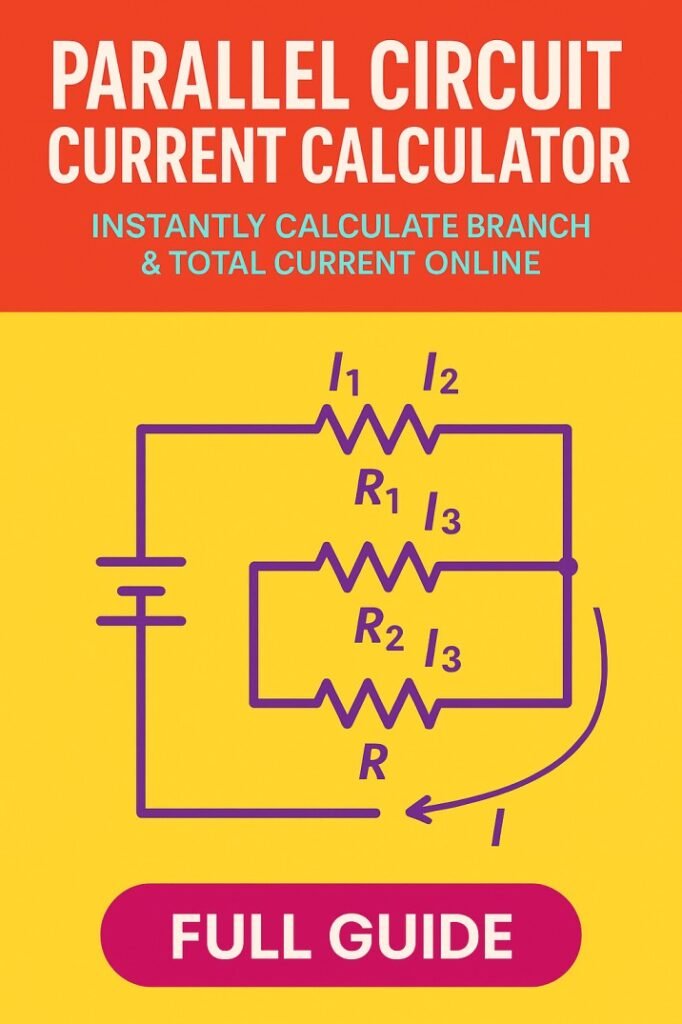
Table of Contents
In this article, you will learn how a parallel circuit current calculator works, why it is important, and how to use it correctly for accurate results. The explanation is practical, clear, and focused on real applications so you can apply it with confidence.
Understanding Parallel Circuits
A parallel circuit is a circuit configuration where components are connected across the same voltage source. Each branch has its own path for current flow. Because of this structure, failure in one branch does not stop current in the others.
Key characteristics of parallel circuits include:
- Same voltage across all branches
- Total current equals the sum of branch currents
- Equivalent resistance is always lower than the smallest branch resistance
These properties make parallel circuits common in household wiring, industrial panels, and electronic systems where reliability is critical.
Discover everything about cable bending radius iec standard
Why Current Calculation Matters in Parallel Circuits
Calculating current in parallel circuits is not just an academic exercise. It directly affects safety, efficiency, and component selection. Incorrect current values can lead to overheating, breaker tripping, or equipment damage.
A parallel circuit current calculator helps you:
- Size conductors correctly to avoid excessive heating
- Select proper fuses and circuit breakers
- Estimate power consumption accurately
- Troubleshoot uneven load distribution
In professional environments, accurate current calculation also improves compliance with electrical standards and reduces downtime.
Basic Principle Behind Current Calculation
The calculation of current in a parallel circuit is based on Ohm’s law. Since voltage remains constant, current in each branch depends on the resistance of that branch.
The basic relationship is:
- Branch current = Voltage ÷ Branch resistance
The total circuit current is found by adding all individual branch currents. A parallel circuit current calculator automates this process, especially when multiple branches are involved.
Parallel Circuit Current Calculator
Parallel Circuit Current Calculator
How to Use
- Enter the supply voltage of the parallel circuit.
- Click “Add branch” to insert rows for each resistor or load branch.
- For each branch, enter its resistance in ohms (Ω).
- Click Calculate to see branch currents, total current, and equivalent resistance.
- Use results to analyze load distribution and ensure wiring and protection are sized correctly.
Find more Electrical Engineering Tools for easy electrical calculations and estimations.
Step by Step Working of a Parallel Circuit Current Calculator
A parallel circuit current calculator follows a simple logical flow. Understanding this flow helps you verify results and avoid input errors.
- Enter the supply voltage
- Enter the resistance of each parallel branch
- Calculate individual branch currents
- Sum all branch currents to get total current
This approach eliminates manual mistakes and speeds up design and analysis work.
Example Calculation for Better Clarity
Consider a parallel circuit with a 12 V supply and three resistors connected in parallel: 6 Ω, 12 Ω, and 24 Ω.
| Branch | Resistance (Ω) | Voltage (V) | Current (A) |
|---|---|---|---|
| R1 | 6 | 12 | 2.00 |
| R2 | 12 | 12 | 1.00 |
| R3 | 24 | 12 | 0.50 |
| Total | — | — | 3.50 |
A parallel circuit current calculator instantly provides these values, saving time and reducing calculation errors.
Use our online tool for free Current in Parallel Calculator – Accurate Tool for Parallel Circuit Analysis
Applications in Real Life Electrical Systems
Parallel circuits are everywhere, and accurate current calculation supports safe operation.
Common applications include:
- Residential lighting and socket circuits
- Automotive electrical systems
- Power distribution panels
- Electronic device power rails
In all these cases, a parallel circuit current calculator allows engineers and technicians to plan loads and prevent overload conditions.
Importance in Power and Energy Calculations
Current calculation directly affects power estimation. Power in each branch is calculated using voltage and current, so incorrect current values lead to wrong power figures.
Using a parallel circuit current calculator helps in:
- Estimating total power consumption
- Calculating energy costs
- Selecting energy-efficient components
This is particularly valuable in commercial and industrial settings where power usage directly impacts operating costs.
Use our online tool for free Electrical Contact Resistance Calculator – Accurate Tool for Engineers and Technicians
Parallel Circuits vs Series Circuits
Understanding the difference between series and parallel circuits improves your grasp of current behavior.
| Feature | Series Circuit | Parallel Circuit |
|---|---|---|
| Voltage | Divides across components | Same across all branches |
| Current | Same everywhere | Divides among branches |
| Reliability | One fault stops all | Other branches keep working |
| Resistance | Adds directly | Decreases overall |
Because current division is unique to parallel circuits, a dedicated parallel circuit current calculator is more effective than general-purpose tools.
Common Mistakes in Current Calculation
Even with tools available, mistakes can happen if fundamentals are ignored.
Avoid these common errors:
- Mixing series and parallel formulas
- Using incorrect voltage values
- Forgetting to sum branch currents
- Ignoring tolerance of resistors
A parallel circuit current calculator reduces these risks, but understanding the theory remains essential.
Know more about Phase to Phase Clearance as per IEC 61439: Best Guide
Benefits of Using an Online Calculator
Manual calculations are useful for learning, but online tools are better for real projects.
Benefits include:
- Faster results
- Higher accuracy
- Support for multiple branches
- Easy comparison of design options
A well-designed parallel circuit current calculator becomes an everyday companion for electrical work.
Choosing the Right Calculator for Your Needs
Not all calculators offer the same features. Some are basic, while others include advanced options.
Look for calculators that provide:
- Unlimited branch inputs
- Clear unit handling
- Instant result updates
- Mobile and desktop compatibility
These features improve usability and help maintain accuracy across different projects.
Educational Value for Students and Learners
For students, understanding current division is a major milestone in circuit analysis. A parallel circuit current calculator supports learning by allowing instant verification of manual work.
It helps students:
- Visualize current distribution
- Check homework and lab results
- Build confidence in circuit analysis
When combined with theory, it becomes a powerful learning aid.
Know more about 7 Common Mistakes in Electrical Outlet Height
Final Thoughts
A parallel circuit current calculator is more than just a convenience tool. It is a practical solution that improves safety, efficiency, and accuracy in electrical work. By understanding how current divides and how calculations are performed, you gain better control over circuit design and troubleshooting.
Whether you are a student, hobbyist, or professional, mastering the use of a parallel circuit current calculator will strengthen your electrical knowledge and help you make better design decisions every time.
Use our online tool EMT Conduit Fill Calculator for Accurate Electrical Wiring and conduits selection
Follow Us on Social:
Subscribe our Newsletter on Electrical Insights for latest updates from Electrical Engineering Hub
#ParallelCircuitCurrentCalculator, #ParallelCircuitCalculator, #ElectricalEngineeringTools, #CircuitCurrentCalculation, #OnlineElectricalCalculator, #ParallelCircuits, #ElectricalCalculations, #EEStudents, #EngineeringTools, #CircuitAnalysis