Variable Torque vs Constant Torque VFD: Which Drive Type Delivers Better Performance?
Choosing the right variable frequency drive has a direct impact on energy efficiency, equipment life, and operating cost. Many engineers and plant managers struggle when comparing Variable Torque vs Constant Torque VFD because both drive types look similar at first glance. In reality, their performance depends heavily on the load profile and application demands.
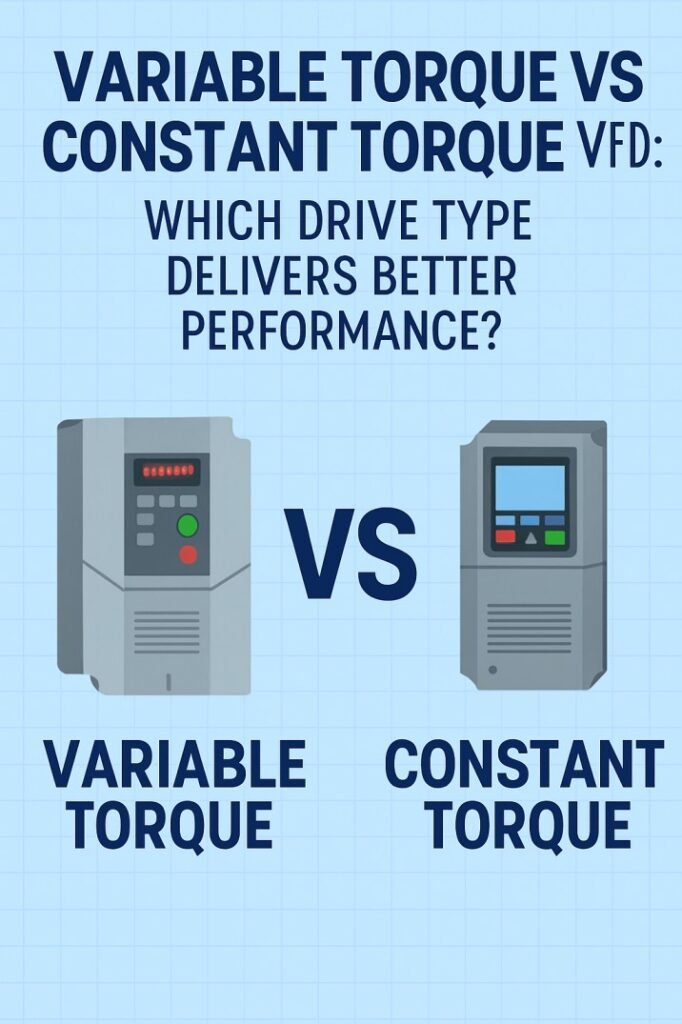
Table of Contents
Understanding how each drive behaves under real operating conditions helps you avoid oversizing, reduce power bills, and improve system reliability. This guide explains the differences in a practical and easy way, focusing on performance, efficiency, and long-term value.
Understanding VFD Basics and Load Behavior
A variable frequency drive controls motor speed by adjusting voltage and frequency. The way torque changes with speed defines the load type. This distinction is the foundation of Variable Torque vs Constant Torque VFD selection.
Constant torque loads require the same torque from zero speed to rated speed. Conveyors, crushers, extruders, positive displacement pumps, and hoists fall into this category. The motor must deliver full torque even at low speed, which places higher electrical and thermal stress on the drive.
Know more about How to Size a VFD for a Motor: Important Expert Guide for Accurate Selection
Variable torque loads behave differently. Torque demand rises with the square of speed. At low speed, torque and power demand are low. Fans, centrifugal pumps, and blowers are typical examples. This difference creates a large efficiency gap when comparing Variable Torque vs Constant Torque VFD in real installations.
What Is a Constant Torque VFD?
A constant torque VFD is designed to supply rated torque across the entire speed range. It maintains a fixed volts-per-hertz ratio so the motor can handle heavy loads even during acceleration or slow-speed operation. This makes it suitable for applications where load resistance does not reduce at lower speeds.
Key characteristics include:
- High current capability at low speed
- Robust thermal design
- Strong overload capacity
- Stable torque under varying mechanical stress
In Variable Torque vs Constant Torque VFD analysis, constant torque drives are often larger and more expensive due to higher current ratings.
What Is a Variable Torque VFD?
A variable torque VFD is optimized for loads where torque demand drops rapidly as speed decreases. The drive reduces output voltage more aggressively at lower frequencies, which lowers current and losses. This design improves efficiency and reduces stress on both the motor and the drive.
Typical characteristics include:
- Lower current draw at reduced speeds
- High energy savings potential
- Smaller drive size for the same motor rating
- Reduced heat generation
When discussing Variable Torque vs Constant Torque VFD, variable torque drives usually deliver better performance for HVAC and fluid-handling systems.
Know more about Variable Frequency Drive Repairing Services in USA
Performance Comparison in Real Applications
Performance is not just about torque capability. It includes energy use, motor heating, acceleration control, and system stability. The table below highlights the core performance differences.
Table: Performance Comparison
| Parameter | Variable Torque VFD | Constant Torque VFD |
|---|---|---|
| Torque at Low Speed | Low | High |
| Energy Efficiency | Very High | Moderate |
| Drive Size | Smaller | Larger |
| Overload Capacity | Limited | High |
| Best Applications | Fans, pumps, blowers | Conveyors, mixers, lifts |
This comparison shows why Variable Torque vs Constant Torque VFD decisions should always be application-specific.
Energy Efficiency and Operating Cost
Energy consumption is a major factor in drive selection, especially for facilities running motors for long hours. Variable torque loads benefit greatly from speed reduction because power drops with the cube of speed. Even a small speed reduction can result in large energy savings.
Constant torque applications do not offer the same savings. Power consumption changes linearly with speed, so efficiency gains are limited. In Variable Torque vs Constant Torque VFD evaluation, this difference explains why variable torque drives dominate HVAC and water systems.
Lower energy use also means:
- Reduced electricity bills
- Lower cooling requirements
- Longer component life
Know more about Variable Frequency Drive Repairing Services Cost
Motor Protection and Thermal Stress
Motor heating is closely tied to current draw. Constant torque operation at low speed can cause overheating because the motor’s cooling fan is less effective. Drives often need external blowers or derating.
Variable torque drives naturally limit current at low speed, which reduces thermal stress. This is a major advantage in Variable Torque vs Constant Torque VFD discussions, especially for older motors or continuous-duty systems.
Control Features and Flexibility
Modern drives offer advanced control modes such as V/f control, sensorless vector control, and closed-loop vector control. Constant torque applications often require vector control to maintain torque accuracy. Variable torque applications usually perform well with simpler control modes.
Step-by-step approach for selecting control mode:
- Step 1: Identify load type and torque profile
- Step 2: Determine speed range and starting requirements
- Step 3: Choose control mode based on torque accuracy needs
- Step 4: Validate motor thermal limits
- Step 5: Optimize parameters for efficiency and stability
This structured method simplifies Variable Torque vs Constant Torque VFD selection and commissioning.
Know more about What are Common VFD Troubleshooting Tips?
Impact on Drive Sizing and Capital Cost
Drive sizing directly affects upfront investment. Constant torque drives must be sized for full-load current at all speeds, which increases cost. Variable torque drives can often be sized closer to average operating current, reducing initial expense.
In Variable Torque vs Constant Torque VFD cost analysis, variable torque solutions usually deliver a faster return on investment due to lower capital and operating costs.
Reliability and Maintenance Considerations
Reliability depends on thermal management and electrical stress. Constant torque drives operate closer to their limits, especially during frequent starts and stops. This can increase wear on power electronics.
Variable torque drives operate under lighter electrical stress most of the time. Benefits include:
- Longer drive lifespan
- Fewer nuisance trips
- Lower maintenance frequency
These factors are often overlooked in Variable Torque vs Constant Torque VFD comparisons but matter greatly in long-term operation.
Application-Based Selection Guide
Selecting the correct drive becomes easier when matched to common applications.
Table: Application Guide
| Application | Recommended Drive Type |
|---|---|
| Centrifugal Pump | Variable Torque VFD |
| Cooling Tower Fan | Variable Torque VFD |
| Conveyor Belt | Constant Torque VFD |
| Screw Compressor | Constant Torque VFD |
| HVAC Air Handler | Variable Torque VFD |
This practical mapping helps clarify Variable Torque vs Constant Torque VFD decisions without overcomplication.
Know more about Top 15 Variable Frequency Drive Manufacturers in USA
Which Drive Type Delivers Better Performance?
There is no universal winner. Better performance means the drive matches the load behavior. Variable torque drives deliver superior efficiency, lower cost, and smoother operation for speed-variable loads. Constant torque drives deliver consistent force and control for heavy, load-dependent processes.
In Variable Torque vs Constant Torque VFD evaluation, the best-performing drive is the one that aligns with torque demand, duty cycle, and energy goals.
Final Thoughts
Understanding the real difference between variable and constant torque drives helps avoid costly mistakes. The debate around Variable Torque vs Constant Torque VFD is not about which is technically superior, but which is technically appropriate. By analyzing load characteristics, efficiency targets, and operating conditions, you can select a drive that improves performance, reduces downtime, and maximizes return on investment. This approach ensures reliable operation and long-term savings across industrial and commercial systems.
Follow Us on Social:
Subscribe our Newsletter on Electrical Insights for latest updates from Electrical Engineering Hub
#VariableTorqueVFD, #ConstantTorqueVFD, #VFDSelection, #MotorDriveSystems, #IndustrialAutomation, #EnergyEfficientDrives, #VFDApplications, #ElectricMotors, #HVACDrives, #DriveTechnology