
How to Check Motor Winding With Test Lamp: 7 Powerful Tips for Easy and Accurate Testing
Understanding How to Check Motor Winding With Test Lamp is essential for technicians, electricians, and students who work with electric motors. The method is simple. It is also one of the oldest and most reliable ways to test motor windings without advanced tools. A test lamp helps you identify faults like open circuits, shorted turns, and grounding issues. The technique works well on single-phase and three-phase motors. It only requires basic tools and clear steps.
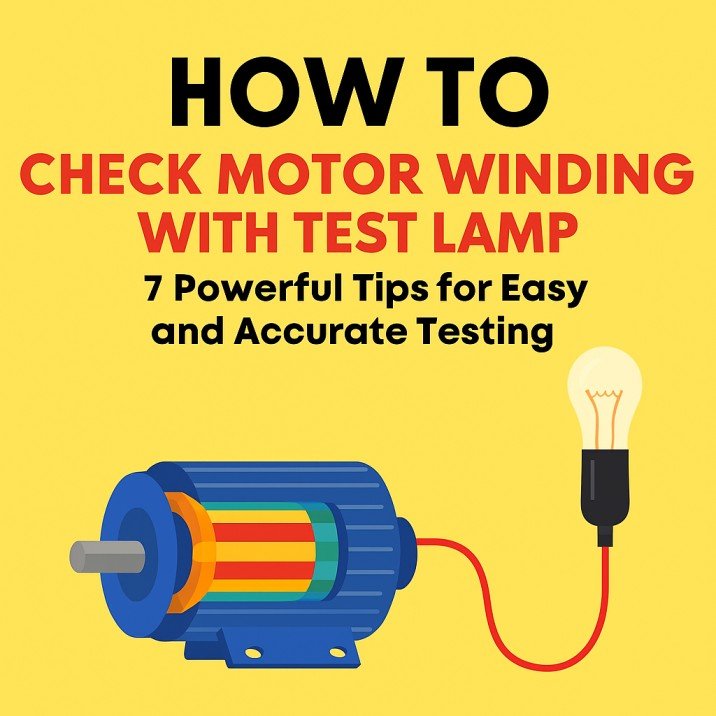
Table of Contents
Testing motor windings with a lamp ensures quick troubleshooting. It helps you make correct repair decisions. It also prevents motor failure, downtime, and financial loss. This guide explains How to Check Motor Winding With Test Lamp with easy steps, clear tips, and tables for better understanding. Each tip is simple. You can apply them in workshop conditions or on site.
Know more about How to Check 3 Phase Motor Winding with Multimeter: A Simple Guide for Beginners
Why Knowing How to Check Motor Winding With Test Lamp Matters
Every electrician must know How to Check Motor Winding With Test Lamp because motors fail often due to winding issues. Dust, heat, moisture, overloading, and poor maintenance cause insulation breakdown. A test lamp highlights these problems quickly. It removes guesswork. It also works well when you do not have a multimeter or insulation tester available.
A lamp test also gives visual confirmation. When the bulb glows, you know there is continuity. When it does not glow, you know something is open or damaged. This clarity makes fault-finding faster.
Required Tools for the Test
Before learning How to Check Motor Winding With Test Lamp, gather the basic tools shown in the table below.
Tools Checklist
| Tool | Purpose |
|---|---|
| Test Lamp | Checks continuity and connections |
| Motor Terminal Plate | Access to motor windings |
| Insulation Tape | Safety for open wire ends |
| Marker Pen | Labelling leads |
| Screwdrivers | Opening terminal cover |
| Gloves | Electrical safety |
These simple tools allow you to perform the procedure safely and effectively.
Know more about DIY Electric Motor Repair: 8 Quick Solutions You Can Try Now
7 Powerful Tips for Easy and Accurate Testing
The following seven tips make How to Check Motor Winding With Test Lamp more accurate, safe, and reliable. Each tip is designed to reduce confusion and avoid common mistakes.
Tip 1: Disconnect All Power Before You Start
Always isolate the supply before testing. Do not rely on the switch alone. Remove the wires from the motor terminal block. This ensures the lamp test remains safe. It also prevents false readings that happen when the motor is still connected to the circuit.
Knowing How to Check Motor Winding With Test Lamp starts with safety. Never ignore this step.
Tip 2: Identify All Motor Leads Clearly
Motor leads are often confusing, especially in older motors. Label them before testing. Good identification reduces errors. It also helps you connect windings correctly after repair.
Here is a simple identification table for a three-phase motor.
Know more about IEC Standards for Transformer Testing – Complete Guide to IEC 60076 and Testing Procedures
Motor Lead Identification Table
| Lead Name | Meaning |
|---|---|
| U1, U2 | Phase-1 |
| V1, V2 | Phase-2 |
| W1, W2 | Phase-3 |
Clear identification improves your accuracy while applying How to Check Motor Winding With Test Lamp on any type of motor.
Tip 3: Use the Lamp Test for Continuity Checking
This is the heart of the method. Connect one lamp lead to U1 and the other to U2. The bulb should glow. Repeat the same for V1-V2 and W1-W2. If your lamp glows for each winding, continuity is confirmed.
If the lamp does not glow, the winding is open. This means the motor needs rewinding or repair.
This test is the simplest way to understand How to Check Motor Winding With Test Lamp without complex tools.
Tip 4: Check for Shorting Between Windings
A winding-to-winding short is dangerous. It causes overheating and high current. To test this, connect the lamp between U1 and V1. The lamp should not glow. Repeat the test between U1-W1 and V1-W1. No glow means the windings are isolated.
If the lamp glows between any two windings, you have an internal short. This is a serious problem. The motor needs complete winding repair.
Know more about IEC Standard for XLPE Cables – Complete Guide to IEC 60502 and Electrical Cable Specifications
Knowing How to Check Motor Winding With Test Lamp helps you detect these internal faults quickly.
Tip 5: Test for Ground Faults
A ground fault occurs when the winding touches the motor body. This is one of the most common causes of motor tripping. To check this, connect the lamp between motor body and U1. The lamp should not glow. Repeat for all terminals.
Glow means the winding is touching the frame. This is a dangerous condition. You should never energize such a motor.
Every technician who understands How to Check Motor Winding With Test Lamp must know this ground-test method.
Tip 6: Compare Winding Resistance and Glow Intensity
All three motor phases must show equal brightness in the test lamp. Brightness differences indicate unbalanced windings. This imbalance reduces efficiency and causes vibration.
Here is a simple comparison table:
Lamp Glow Comparison Table
| Winding Pair | Lamp Glow Result | Interpretation |
|---|---|---|
| U1-U2 | Medium and equal | Good |
| V1-V2 | Medium and equal | Good |
| W1-W2 | Medium and equal | Good |
| Any phase brighter or dimmer | Unequal | Winding imbalance |
Using this technique improves your understanding of How to Check Motor Winding With Test Lamp in real situations.
Know more about IEC Standard for Relay Coordination – Complete Guide to Protection and Coordination Studies
Tip 7: Confirm Results Before Final Decision
The final step in How to Check Motor Winding With Test Lamp is verification. Double-check all windings again. Re-test continuity. Re-test ground. Cross-check lead identification.
This prevents misdiagnosis. It also ensures you take the right repair decision.
A second verification is important because motor windings age over time. Some faults are intermittent. Retesting makes your result accurate.
Common Mistakes to Avoid
Understanding How to Check Motor Winding With Test Lamp requires avoiding common errors. Many technicians make these mistakes:
- Shorting lamp wires accidentally
- Testing with motor still connected to supply
- Skipping ground test
- Mixing winding leads
- Using a faulty test lamp
Avoid these mistakes for reliable results.
When to Use a Test Lamp and When to Use a Multimeter
A test lamp is simple and effective. But a multimeter gives exact values. The comparison table below helps you choose.
Lamp vs Multimeter Table
| Method | Advantage | Limitation |
|---|---|---|
| Test Lamp | Quick, visual, easy | No numeric reading |
| Multimeter | Gives resistance value | Slower and requires more skill |
Use a lamp for quick field tests. Use a multimeter for detailed analysis.
Know more about IEC Standard for Vibration Testing – IEC 60068 Explained with Procedures and Requirements
Final Thoughts
Knowing How to Check Motor Winding With Test Lamp gives you confidence in motor troubleshooting. It is simple. It is fast. It works without advanced equipment. These seven tips make the process even easier.
By using the lamp test properly, you can detect open circuits, phase issues, ground faults, and shorted turns. You can make confident repair decisions. You can prevent breakdowns and increase motor life.
Know more about IEC Standard for Vacuum Circuit Breaker – IEC 62271 Guidelines, Ratings & Testing Explained
Follow Us on Social:
Subscribe our Newsletter on Electrical Insights for latest updates from Electrical Engineering Hub
#motorwindingtest, #testlampmethod, #motortestingguide, #electricalmaintenance, #motordiagnostics, #windingcheck, #electricmotorrepair, #industrialmaintenance, #electricalsafety, #motorfaultfinding