Types of HVDC System Explained: Monopolar, Bipolar & Back-to-Back
High Voltage Direct Current transmission has become a backbone technology for modern power systems where long-distance, bulk, and interconnection power transfer is required. Engineers and utilities increasingly prefer HVDC because of its controllability, lower losses over long distances, and ability to connect asynchronous grids. To fully understand how HVDC works in practice, it is important to clearly explain the types of hvdc system used worldwide and the real-world conditions where each configuration performs best.
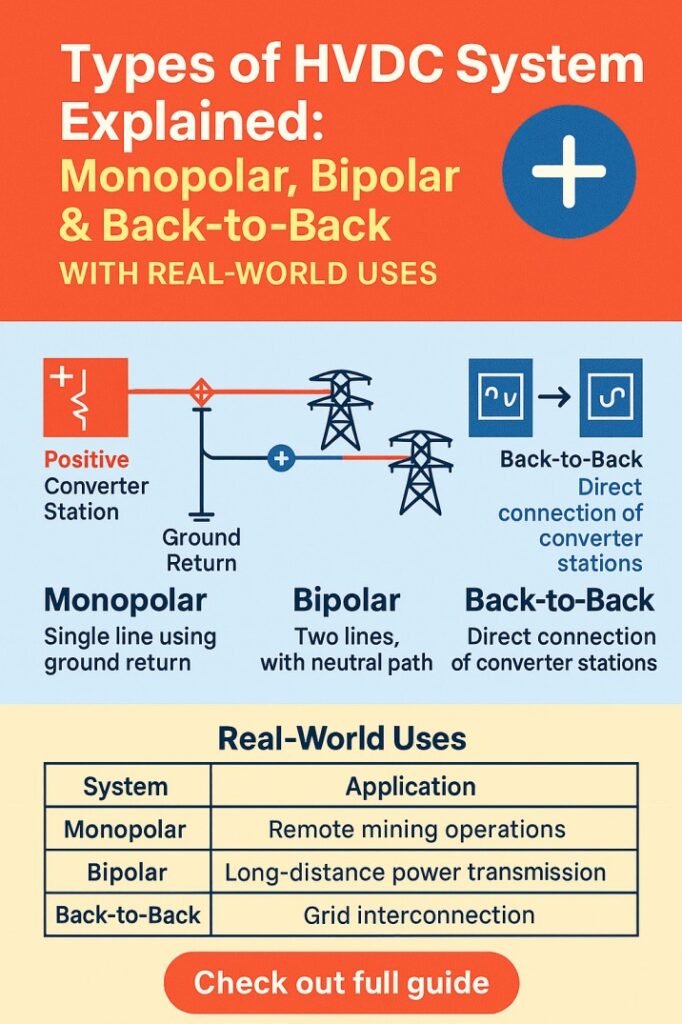
Table of Contents
This guide explains the types of hvdc system focusing on monopolar, bipolar, and back-to-back HVDC systems. Each type is discussed with operating principles, advantages, limitations, and actual project applications.
Understanding HVDC Transmission Basics
HVDC transmission converts AC power into DC at the sending end using converter stations and converts it back to AC at the receiving end. Compared to HVAC, HVDC offers better voltage control, lower line losses for long distances, and no reactive power flow in transmission lines.
The selection of a specific configuration depends on factors such as:
- Transmission distance
- Power rating
- Grid stability requirements
- Environmental and economic constraints
These factors directly influence the choice among the main types of hvdc system deployed by utilities.
Know more about HVDC Transformer Working Principle Explained – How Converter Transformers Handle Extreme DC Power
Overview of Types of HVDC System
Before diving into each configuration, the table below provides a quick comparison of the three major HVDC system types.
| HVDC System Type | Number of Poles | Typical Voltage Level | Common Applications |
|---|---|---|---|
| Monopolar | One | ±250 kV to ±600 kV | Submarine cables, initial project stages |
| Bipolar | Two | ±500 kV to ±1100 kV | Long-distance bulk power transmission |
| Back-to-Back | Two (very short link) | ±80 kV to ±500 kV | Grid interconnections, frequency mismatch |
This classification forms the foundation for understanding the types of hvdc system used globally.
Monopolar HVDC System
A monopolar HVDC system uses a single high-voltage conductor, typically operating at negative polarity. The return path for current is provided either through the earth or a metallic return conductor.
This configuration is often the simplest among the types of hvdc system and is widely used for submarine cable links where installing two conductors is costly or impractical.
Know more about HVDC Converter: Best Guide to HVDC Transmission System
Key Characteristics of Monopolar HVDC
- Uses one high-voltage conductor
- Earth or metallic return path
- Lower initial cost compared to bipolar systems
- Suitable for moderate power levels
Advantages
- Reduced cable and tower cost
- Easier installation, especially for undersea links
- Can later be upgraded to bipolar operation
Limitations
- Earth return can cause corrosion issues
- Lower reliability compared to bipolar systems
- Limited power capacity
Real-World Applications
Monopolar systems are commonly used in:
- Offshore wind farm connections
- Island power supplies
- Pilot HVDC projects before full-scale expansion
A well-known example is early submarine HVDC links where monopolar operation minimized cable costs.
Know more about HVDC Converter Efficiency: 3 Important Formulas
Bipolar HVDC System
The bipolar configuration is the most widely adopted and technically advanced among the types of hvdc system. It uses two conductors, one positive and one negative, with a grounded neutral point.
Under normal operation, currents in both poles are equal and opposite, resulting in minimal ground current. If one pole fails, the system can continue operating in monopolar mode at reduced capacity.
Key Characteristics of Bipolar HVDC
- Two conductors with opposite polarity
- Grounded neutral point
- High transmission capacity
- Superior reliability
Advantages
- High power transfer capability
- Improved system availability
- Reduced earth current during normal operation
- Lower losses per MW transmitted
Limitations
- Higher initial investment
- More complex converter station design
Real-World Applications
Bipolar systems dominate long-distance and high-capacity projects such as:
- Bulk power transmission from hydro plants
- Renewable energy evacuation corridors
- Cross-border interconnections
Know more about 7 Important HVDC Operating Modes
Examples include ultra-high voltage DC links transmitting thousands of megawatts over distances exceeding 1000 km. These projects clearly demonstrate why bipolar design is preferred among the types of hvdc system for large-scale power transfer.
Back-to-Back HVDC System
A back-to-back HVDC system is unique because it does not involve a long transmission line. Both converter stations are located in the same facility and directly connected through a short DC link.
This configuration is mainly used to connect two AC systems that are not synchronized or operate at different frequencies.
Key Characteristics of Back-to-Back HVDC
- Very short or no DC transmission line
- Compact layout
- High controllability
- Independent AC system operation
Advantages
- Allows interconnection of asynchronous grids
- Improves grid stability and power quality
- Precise power flow control
- Compact footprint
Limitations
- Not suitable for long-distance transmission
- Converter station cost per MW is relatively high
Know more about HVDC Transmission Explained: Key Components, Working & Real-World Applications
Real-World Applications
Back-to-back systems are widely used in:
- National grid interconnections
- Regional power exchanges
- Linking 50 Hz and 60 Hz networks
These installations play a crucial role in modern interconnected power markets and represent a specialized but essential category among the types of hvdc system.
Comparative Analysis of Types of HVDC System
The table below summarizes the practical differences among the main HVDC configurations.
| Feature | Monopolar | Bipolar | Back-to-Back |
|---|---|---|---|
| Reliability | Moderate | High | High |
| Power Capacity | Low to Medium | Very High | Medium |
| Distance Suitability | Medium | Very Long | Very Short |
| Typical Use Case | Submarine cables | Bulk transmission | Grid interconnection |
This comparison helps engineers select the most suitable option when evaluating different types of hvdc system.
Know more about Applications of HVDC Transmission: Where High-Voltage DC Outperforms AC in Modern Power Grids
How Utilities Choose the Right HVDC Configuration
Selecting the correct HVDC system involves a balance of technical and economic considerations. Utilities typically evaluate:
- Load growth projections
- Environmental restrictions
- Grid stability requirements
- Future expansion capability
For example, a utility planning a long-distance renewable energy corridor will almost always select a bipolar system, while a cross-border grid tie may rely on a back-to-back solution.
Future Trends in HVDC Systems
Advancements in power electronics, especially voltage source converters, are expanding the application range of all types of hvdc system. Multi-terminal HVDC networks and offshore DC grids are becoming more common as renewable integration increases.
These developments are pushing HVDC beyond traditional point-to-point links and reinforcing its role in future smart grids.
Final Thoughts
Understanding the types of hvdc system is essential for anyone involved in power transmission planning, grid operation, or renewable energy integration. Monopolar systems offer simplicity and cost advantages, bipolar systems provide unmatched capacity and reliability, and back-to-back systems enable seamless grid interconnections.
Know more about HVDC Transformer Working Principle Explained – How Converter Transformers Handle Extreme DC Power
Each configuration serves a specific purpose, and their real-world applications highlight why HVDC technology continues to expand globally. By selecting the appropriate HVDC system type, utilities can ensure efficient, reliable, and future-ready power transmission.
Follow Us on Social:
Subscribe our Newsletter on Electrical Insights for latest updates from Electrical Engineering Hub
#TypesOfHVDCSystem, #HVDCTransmission, #HVDCSystems, #PowerTransmission, #ElectricalEngineering, #HVDCLinks, #HighVoltageDC, #PowerEngineering, #GridTechnology, #HVDCBasics