Transformer Vector Group Test Procedure – Complete Step-by-Step Guide for Accurate Phase & Polarity Verification
The transformer vector group test procedure is a critical commissioning and maintenance activity that verifies the phase relationship, polarity, and winding configuration of a power transformer. Whether you are working on a distribution transformer or a large power transformer in a substation, correct vector group verification ensures proper parallel operation, fault-free synchronization, and system stability.
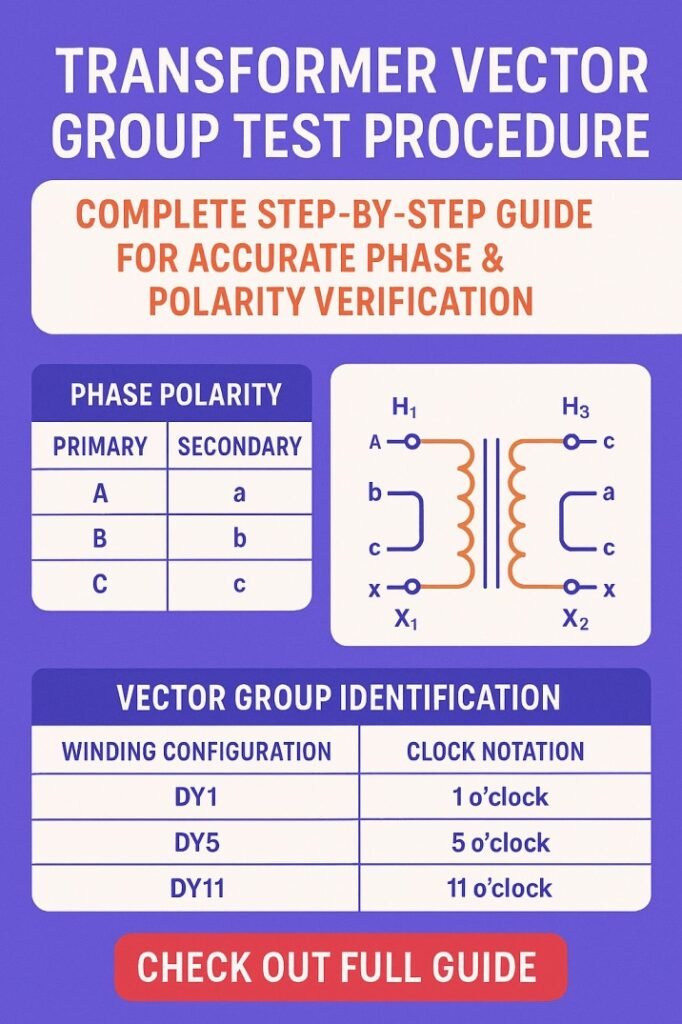
Table of Contents
Incorrect vector group connections can result in circulating currents, severe damage, and protection maloperation. This detailed guide explains the transformer vector group test procedure step by step, using practical field methods followed by engineers during factory acceptance tests (FAT), site acceptance tests (SAT), and routine maintenance inspections.
Why Transformer Vector Group Testing Is Important
A transformer’s vector group defines:
- Primary and secondary winding configuration (Star, Delta, Zigzag)
- Phase displacement angle between HV and LV windings
- Polarity relationship
- Neutral availability
If two transformers operate in parallel, they must have:
- Same voltage ratio
- Same percentage impedance
- Same phase sequence
- Same vector group
Failure to verify these parameters may cause heavy circulating currents even under no-load conditions.
Know more about Transformer Oil Testing: 9 Important Tests for Healthiness
Understanding Transformer Vector Groups
Before performing the transformer vector group test procedure, it is important to understand vector group notation.
Example: Dyn11
- D = Primary Delta connection
- y = Secondary Star connection
- n = Neutral brought out
- 11 = 330° phase displacement (or -30°)
Common Transformer Vector Groups
| Vector Group | Primary | Secondary | Phase Displacement | Typical Application |
|---|---|---|---|---|
| Dyn11 | Delta | Star + Neutral | 30° | Distribution transformers |
| Dyn1 | Delta | Star + Neutral | -30° | Industrial applications |
| Yyn0 | Star | Star | 0° | Earthing transformers |
| Yd1 | Star | Delta | -30° | Power transformers |
| Dd0 | Delta | Delta | 0° | Special industrial loads |
Understanding the clock notation helps interpret test results during the transformer vector group test procedure.
Find all about Transformer Disconnect Sizing
Equipment Required for Transformer Vector Group Test
The following instruments are typically required:
- Three-phase AC supply (415 V)
- Voltmeter (Digital or analog)
- Multimeter
- Test leads
- Transformer nameplate details
- Phase sequence indicator
- Insulation resistance tester (pre-check)
Before starting, ensure isolation from the grid and confirm proper earthing.
Pre-Test Checks Before Starting
Before executing the transformer vector group test procedure, complete the following checks:
- Verify transformer nameplate data.
- Confirm winding terminals (H1, H2, H3 / X1, X2, X3).
- Check insulation resistance between windings and earth.
- Confirm correct tap position.
- Ensure transformer is de-energized and isolated.
These steps prevent misinterpretation and ensure safety.
Know all about Transformer Sizing for EV Charger
Step-by-Step Transformer Vector Group Test Procedure
The transformer vector group test procedure can be performed using the voltmeter method, which is widely used in the field.
Step 1: Identify Terminals
Identify HV side terminals as H1, H2, H3 and LV side as X1, X2, X3, X0 (if neutral exists).
Cross-check terminal markings physically with schematic diagrams.
Step 2: Apply Three-Phase Supply to HV Side
Apply a low voltage three-phase supply (usually 415 V) to the HV winding. Keep LV winding open-circuited.
Measure and record line voltages on HV side:
- V(H1-H2)
- V(H2-H3)
- V(H3-H1)
Step 3: Measure Induced Voltages on LV Side
Measure the line voltages on LV side:
- V(X1-X2)
- V(X2-X3)
- V(X3-X1)
Explore all about Transformer Bond Sizing
This confirms correct transformation ratio.
Step 4: Perform Cross Voltage Measurements
This is the most critical step in the transformer vector group test procedure.
Connect one probe to H1 and measure voltage between:
- H1 and X1
- H1 and X2
- H1 and X3
Record all readings carefully.
Repeat for H2 and H3 if required.
Step 5: Analyze the Voltage Pattern
The pattern of measured voltages determines the clock number and vector group.
Know more about Transformer Cooling Methods: ONAN, ONAF, OFAF & More
Example Observation Table:
| Measurement | Observed Voltage | Interpretation |
|---|---|---|
| H1–X1 | Low | Same phase |
| H1–X2 | Medium | 120° shift |
| H1–X3 | High | 240° shift |
Compare readings with theoretical phase displacement values.
Step 6: Confirm Phase Displacement
For Dyn11:
- Secondary lags primary by 30°
- Cross voltage between certain terminals will show minimum value
For Dyn1:
- Secondary leads by 30°
- Minimum voltage appears at different terminal combination
This completes the transformer vector group test procedure using the voltmeter method. Know more about Transformer Sizing for Residential Building
Alternative Method: Vector Group Test Using Phase Angle Meter
In modern substations, digital transformer test kits are used.
Advantages:
- Automatic vector group detection
- Direct clock number display
- Reduced human error
- Faster testing
However, understanding the manual transformer vector group test procedure is essential for troubleshooting.
Typical Test Results Interpretation
| Expected Vector Group | Key Voltage Observation | Conclusion |
|---|---|---|
| Dyn11 | Minimum voltage at H1-X2 | Correct connection |
| Dyn1 | Minimum voltage at H1-X3 | 30° lead |
| Yyn0 | Equal phase alignment | Zero displacement |
Always compare results with manufacturer documentation.
Use our online tool for free Transformer Neutral Current Calculator – Accurate Neutral Current Estimation
Common Mistakes During Testing
During the transformer vector group test procedure, avoid these common errors:
- Wrong terminal identification
- Testing on incorrect tap position
- Ignoring phase sequence
- Loose test connections
- Measuring without proper reference
These mistakes may lead to false vector group interpretation.
Access our online tool completely free Transformer Vector Group Calculation Tool | Easy & Accurate Vector Group Calculator
Safety Precautions
Safety must never be compromised.
- Ensure transformer is isolated from grid
- Use PPE including insulated gloves
- Use properly rated test leads
- Avoid applying full rated voltage
- Confirm earthing before and after test
Following proper safety practice ensures reliable results and protects personnel.
Field Example: Practical Case Study
Consider a 11/0.415 kV Dyn11 distribution transformer installed in an industrial facility. Before energization, the transformer vector group test procedure was performed.
Measured results:
- HV line voltage: 415 V
- LV line voltage: 15.1 V (proportional reduced value)
- Minimum cross voltage observed at H1-X2
Result confirmed Dyn11 vector group, allowing safe synchronization with existing transformer.
Without this verification, parallel operation could have resulted in severe circulating currents.
Test our online tool for free Transformer Full Load Current Calculator – Accurate Load & Current Calculation Tool for Transformers
How Vector Group Affects Protection and System Performance
Vector group directly influences:
- Differential protection settings
- Zero sequence current path
- Neutral grounding
- Harmonic performance
- Fault level calculation
Protection engineers must know confirmed vector group before configuring relays.
Therefore, the transformer vector group test procedure plays a vital role beyond commissioning.
Documentation and Reporting Format
A professional test report should include:
- Transformer details (Make, Rating, Serial No.)
- Vector group as per nameplate
- Applied test voltage
- Measured HV and LV voltages
- Cross voltage readings
- Final conclusion
- Engineer signature
Start using our online tool today — it’s free Transformer Short Circuit Calculator – Accurate Fault Current & Transformer Protection Tool
Sample Summary Table:
| Parameter | Value |
|---|---|
| Transformer Rating | 1000 kVA |
| HV/LV | 11/0.415 kV |
| Nameplate Vector Group | Dyn11 |
| Tested Vector Group | Dyn11 |
| Status | Satisfactory |
Proper documentation ensures traceability and audit compliance.
Use our tool online at no cost Transformer Losses Calculation Tool – Accurate & Easy Energy Loss Analysis
Final Thoughts
The transformer vector group test procedure is an essential verification process that ensures correct phase displacement, polarity, and winding configuration before energizing a transformer. It prevents operational failures, protects equipment, and ensures safe parallel operation.
By following a structured step-by-step method, carefully recording cross voltages, and analyzing phase displacement accurately, engineers can confidently confirm transformer vector group correctness.
Every commissioning engineer, maintenance professional, and protection specialist should be well-versed in the transformer vector group test procedure to ensure reliable and safe power system performance.
Try our free online tool Transformer Temperature Rise Calculator: Accurate and Easy Guide
Follow Us on Social:
Subscribe our Newsletter on Electrical Insights for latest updates from Electrical Engineering Hub
#TransformerVectorGroupTestProcedure, #TransformerTesting, #VectorGroupTest, #PowerTransformerTesting, #ElectricalTestingGuide, #TransformerCommissioning, #PolarityAndPhaseTest, #ElectricalEngineers, #SubstationTesting, #PowerSystemMaintenance