Transformer OCPD Sizing Chart – Accurate Breaker & Fuse Selection Guide as per NEC
Selecting the correct overcurrent protection device for a transformer is critical for safety, compliance, and long-term reliability. A properly designed transformer ocpd sizing chart helps engineers and electricians choose the right breaker or fuse rating based on NEC requirements. Without correct sizing, transformers can suffer nuisance tripping, overheating, or even catastrophic failure.
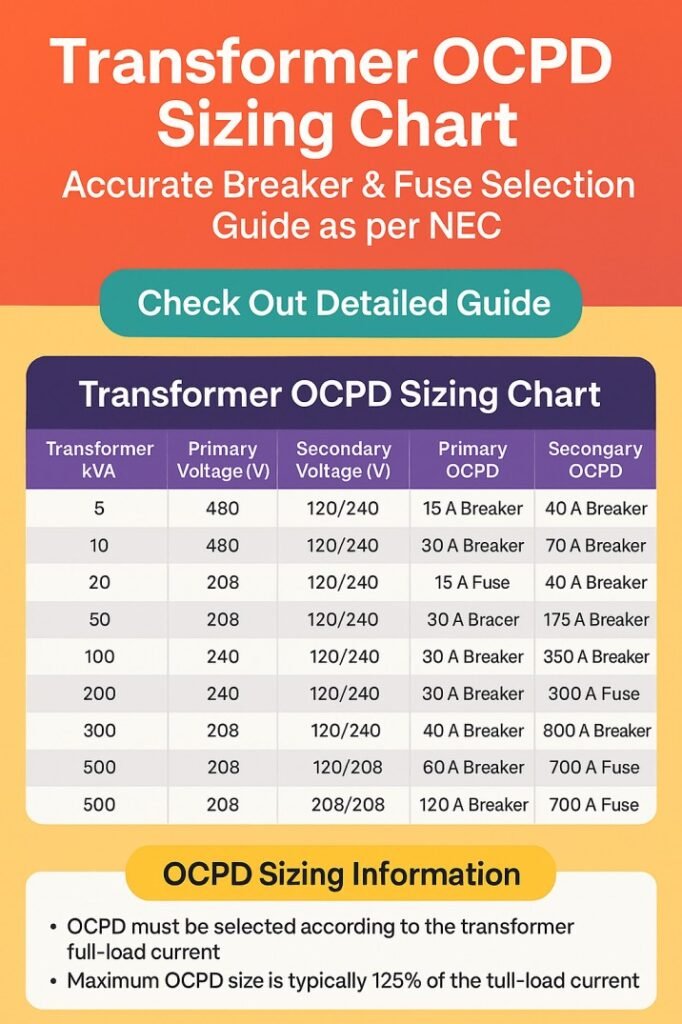
Table of Contents
This guide explains how to use a transformer ocpd sizing chart for accurate breaker and fuse selection as per NEC. It also covers primary and secondary protection rules, key NEC articles, calculation methods, and practical design tips used in real projects.
Understanding Transformer Overcurrent Protection
Overcurrent protection devices safeguard transformers against short circuits and overloads. These devices include molded case circuit breakers, power breakers, and current-limiting fuses.
Read in detail about types of transformer protection relays
The main objectives of transformer protection are:
- Protect transformer windings from thermal damage
- Prevent fire hazards
- Isolate faults quickly
- Ensure compliance with NEC Article 450
- Coordinate with downstream protection
A transformer ocpd sizing chart simplifies this process by translating NEC percentage rules into ready-to-use breaker or fuse ratings.
NEC Requirements for Transformer OCPD
Transformer overcurrent protection is governed mainly by NEC Article 450. Key sections include:
- NEC 450.3(B) for transformers 600V and below
- NEC 450.3(A) for transformers above 600V
- NEC 240 for general overcurrent protection rules
For most commercial and industrial low-voltage transformers, NEC 450.3(B) is applied. It specifies maximum percentages of transformer full-load current (FLC) allowed for primary and secondary protection.
The transformer ocpd sizing chart is built directly from these NEC percentage limits.
Uncover insights on high impedance protection
Step 1: Calculate Transformer Full Load Current
Before using any transformer ocpd sizing chart, calculate the full-load current.
For single-phase transformers:
FLC = kVA × 1000 ÷ Voltage
For three-phase transformers:
FLC = kVA × 1000 ÷ (1.732 × Voltage)
Example:
For a 75 kVA, 480V, three-phase transformer:
- FLC = 75,000 ÷ (1.732 × 480)
- FLC ≈ 90 amps
This full-load current becomes the base value for OCPD selection.
Primary-Only Protection as per NEC
When only primary protection is provided, NEC 450.3(B) allows:
- 125% of FLC for primary breaker
- 250% of FLC for primary fuse
Find out more about transformer differential protection
These values are used to prepare a transformer ocpd sizing chart for quick reference.
Transformer OCPD Sizing Chart – Primary Only Protection (600V and Below)
| Transformer kVA | Voltage (3Ø) | FLC (A) | 125% Breaker (A) | 250% Fuse (A) |
|---|---|---|---|---|
| 15 kVA | 480V | 18A | 22.5A → 25A | 45A → 50A |
| 30 kVA | 480V | 36A | 45A | 90A |
| 45 kVA | 480V | 54A | 70A | 135A → 150A |
| 75 kVA | 480V | 90A | 112.5A → 125A | 225A |
| 112.5 kVA | 480V | 135A | 168A → 175A | 337A → 350A |
| 150 kVA | 480V | 180A | 225A | 450A |
Values are rounded up to the next standard breaker or fuse size as per NEC 240.6.
This transformer ocpd sizing chart allows quick and code-compliant device selection without repeating manual calculations.
Primary and Secondary Protection
When both primary and secondary protection are provided, NEC permits smaller primary protection values.
Explore details on IEC Standard for Differential Protection
For primary breaker:
- Maximum 250% of primary FLC
For secondary breaker:
- Maximum 125% of secondary FLC
This approach improves coordination and reduces transformer stress.
Transformer OCPD Sizing Chart – Primary and Secondary Protection
Example: 75 kVA, 480V to 208Y/120V transformer.
Primary FLC ≈ 90A
Secondary FLC ≈ 208A
| Side | FLC (A) | NEC % | Calculated OCPD | Standard Size |
|---|---|---|---|---|
| Primary | 90A | 250% | 225A | 225A |
| Secondary | 208A | 125% | 260A | 300A |
Using this transformer ocpd sizing chart ensures both sides meet NEC limits while improving system protection.
Breaker vs Fuse Selection
Choosing between a breaker and fuse depends on system requirements.
Circuit Breakers
- Resettable
- Adjustable trip settings
- Easier maintenance
- Better for coordination studies
Know more about alternator protection scheme
Fuses
- Faster fault clearing
- Current-limiting properties
- Lower let-through energy
- Often used for transformer primary protection
A transformer ocpd sizing chart typically includes both breaker and fuse options to support flexible design decisions.
Standard OCPD Size Rounding Rules
NEC 240.6 provides standard ampere ratings. When calculated OCPD does not match a standard value:
- Round up to the next standard size
- Ensure it does not exceed NEC maximum percentage
For example:
If 125% of FLC equals 112.5A, the next standard size is 125A.
The transformer ocpd sizing chart already incorporates this rounding logic to reduce field errors.
Secondary Conductor Protection Considerations
Transformer protection is not only about protecting the transformer. Secondary conductors must also comply with NEC 240.21(C), known as the transformer secondary conductor rule. Get complete information about protection of alternator
Common configurations include:
- Secondary conductors not over 10 feet
- Secondary conductors not over 25 feet
- Fully rated secondary protection
When preparing a transformer ocpd sizing chart for design documentation, always verify conductor protection rules along with OCPD selection.
High Inrush Current Consideration
Transformers experience magnetizing inrush current during energization. This inrush can be 8 to 12 times full-load current for a short duration.
Oversized breakers within NEC limits help prevent nuisance tripping. This is one reason the transformer ocpd sizing chart allows up to 250% for fuses and higher percentages under certain configurations.
Time-delay fuses and inverse-time breakers are preferred for transformer applications.
Sample Design Workflow Using Transformer OCPD Sizing Chart
A practical step-by-step method:
- Determine transformer kVA rating
- Calculate full-load current
- Identify voltage level
- Decide protection scheme (primary only or both sides)
- Apply NEC percentage
- Round up to standard OCPD size
- Verify conductor ampacity
- Confirm coordination with downstream devices
Learn more about types of generator protection relays
This structured approach ensures accurate use of the transformer ocpd sizing chart in real-world installations.
Common Design Mistakes to Avoid
Even experienced engineers can make errors if they skip NEC details.
Common mistakes include:
- Using 125% when 250% is allowed
- Forgetting to round up to standard sizes
- Ignoring secondary conductor protection rules
- Not considering inrush current
- Oversizing beyond NEC limits
Using a verified transformer ocpd sizing chart minimizes these risks.
Three-Phase vs Single-Phase Transformer Protection
For single-phase transformers, percentage rules remain similar, but FLC values differ.
Example: 25 kVA, 240V single-phase transformer.
FLC = 25,000 ÷ 240 = 104A
125% breaker = 130A → 150A standard size
Including single-phase values in your transformer ocpd sizing chart makes it more comprehensive and field-friendly.
Quick Reference Transformer OCPD Sizing Chart Summary
| Protection Type | Breaker Max % | Fuse Max % |
|---|---|---|
| Primary Only | 125% | 250% |
| Primary with Secondary OCPD | 250% | 250% |
| Secondary Protection | 125% | 125% |
Always verify the latest NEC edition adopted in your jurisdiction before finalizing equipment ratings.
Dive deeper into differential protection of alternator
Coordination with Downstream Devices
Proper coordination ensures that only the closest device to the fault trips.
Best practices include:
- Using time-current characteristic curves
- Selecting inverse-time breakers
- Applying current-limiting fuses
- Avoiding excessive oversizing
Know all about Transformer Sizing for EV Charger
A well-prepared transformer ocpd sizing chart supports coordination studies by clearly identifying maximum allowable ratings.
Final Thoughts
Accurate transformer protection requires more than simple multiplication. It demands understanding NEC rules, inrush characteristics, conductor protection, and system coordination. A properly developed transformer ocpd sizing chart transforms complex code requirements into an easy-to-use design reference.
Know more about bus differential protection
Whether you are working on commercial panels, industrial distribution systems, or utility substations under 600V, correct OCPD selection ensures safety, compliance, and reliable operation. By applying the calculation methods and tables shown above, you can confidently size breakers and fuses according to NEC standards.
A carefully structured transformer ocpd sizing chart not only saves time during design but also prevents costly installation errors and inspection failures.
Follow Us on Social:
Subscribe our Newsletter on Electrical Insights for latest updates from Electrical Engineering Hub
#TransformerOCPDSizingChart, #TransformerBreakerSizing, #OCPDSelection, #ElectricalDesignGuide, #NECTransformerSizing, #OvercurrentProtection, #PowerSystemDesign, #ElectricalCalculations, #TransformerProtection, #ElectricalEngineeringHub