IEEE Standard for Dry Type Transformers: Important Guide to Design, Testing & Compliance
The ieee standard for dry type transformers plays a critical role in ensuring safety, efficiency, and long-term reliability in electrical systems. Dry type transformers are widely used in commercial buildings, industrial facilities, and renewable energy projects where fire safety and low maintenance are priorities. Understanding how IEEE standards guide their design, testing, and compliance helps engineers, contractors, and investors make better decisions.
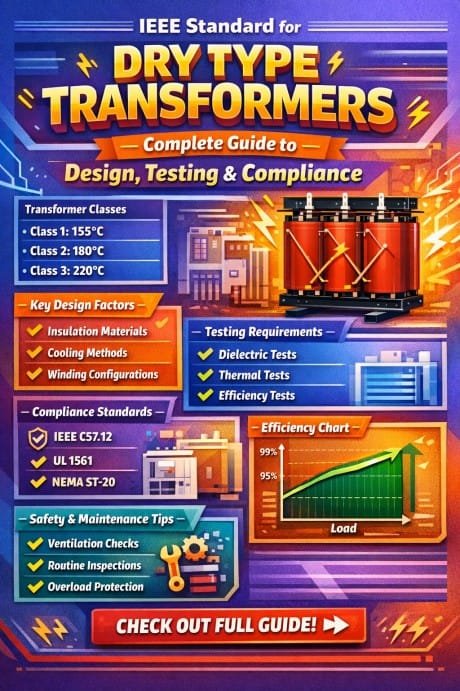
Table of Contents
This guide explains the key IEEE standards, design principles, testing requirements, and compliance practices in a practical and easy-to-understand way.
What Are Dry Type Transformers and Why Standards Matter
Dry type transformers use air instead of oil as a cooling medium. This eliminates the risk of oil leakage and reduces fire hazards, making them ideal for indoor installations such as hospitals, malls, and data centers.
Read in detail about iec 61439 busbar calculation
The ieee standard for dry type transformers ensures that these units meet defined performance benchmarks. Without standards, there would be inconsistencies in insulation systems, temperature limits, and safety features.
Key benefits of following IEEE standards include:
- Improved operational safety
- Consistent performance under load conditions
- Longer service life
- Easier interoperability across systems
- Regulatory acceptance in international projects
Key IEEE Standards for Dry Type Transformers
Several IEEE standards apply to dry type transformers. Each addresses a specific aspect such as testing, insulation, or performance.
Important IEEE Standards Overview
| Standard Number | Title | Application |
|---|---|---|
| IEEE C57.12.01 | General Requirements for Dry-Type Transformers | Design and construction |
| IEEE C57.12.91 | Test Code for Dry-Type Transformers | Testing procedures |
| IEEE C57.94 | Installation and Application Guide | Installation practices |
| IEEE C57.96 | Loading Guide | Loading limits and thermal performance |
The ieee standard for dry type transformers framework ensures that manufacturers and engineers follow a unified approach throughout the transformer lifecycle.
Uncover insights on iec standard for lighting lux level
Design Requirements Under IEEE Standards
Design is the foundation of transformer performance. IEEE standards define strict guidelines for materials, insulation, temperature rise, and cooling methods.
Core Design Considerations
- Insulation System
Dry type transformers typically use Class F or Class H insulation. The choice affects temperature limits and lifespan. - Temperature Rise Limits
IEEE standards define permissible temperature rise values to avoid insulation degradation. - Cooling Methods
Air Natural (AN) and Air Forced (AF) cooling are common. The design must ensure efficient heat dissipation. - Core Material
High-grade silicon steel or amorphous cores are used to reduce losses.
Typical Temperature Rise Limits
| Insulation Class | Max Temperature Rise (°C) |
|---|---|
| Class A | 60 |
| Class B | 80 |
| Class F | 100 |
| Class H | 125 |
By adhering to the ieee standard for dry type transformers, manufacturers ensure that thermal performance remains within safe limits.
Use our online tool electricity load calculator in kw for home
Testing Procedures as per IEEE Standards
Testing is essential to validate the design and ensure reliability. IEEE provides detailed testing protocols to verify performance under different conditions.
Types of Tests
- Routine Tests
Performed on every transformer before delivery.
- Winding resistance test
- Turns ratio test
- Insulation resistance test
- Type Tests
Conducted on representative units to validate design.
- Temperature rise test
- Lightning impulse test
- Short circuit test
- Special Tests
Performed based on customer requirements.
- Partial discharge test
- Sound level measurement
- Harmonic analysis
Dive deeper into complete guide to iec 61508
Key Testing Parameters
| Test Type | Purpose | Importance |
|---|---|---|
| Temperature Rise | Thermal performance | Prevent overheating |
| Insulation Test | Dielectric strength | Avoid breakdown |
| Short Circuit | Mechanical strength | Fault tolerance |
| Partial Discharge | Insulation quality | Long-term reliability |
The ieee standard for dry type transformers ensures that all critical performance aspects are tested before installation.
Compliance Requirements and Certifications
Compliance is not only about meeting technical specifications. It also involves documentation, certification, and adherence to safety regulations.
Compliance Checklist
- Design verification according to IEEE standards
- Factory test reports
- Material certification
- Installation guidelines compliance
- Maintenance documentation
Many projects also require alignment with IEC standards, especially in international environments. However, IEEE standards are widely accepted in North America and many industrial projects globally.
Learn more about Arc Flash Risk Assessment According to NFPA 70E
Installation Guidelines as per IEEE
Proper installation is just as important as design and testing. Poor installation can lead to performance issues even if the transformer meets all standards.
Best Practices
- Ensure proper ventilation for heat dissipation
- Maintain minimum clearance distances
- Avoid dusty or humid environments
- Use vibration isolation pads if required
- Follow grounding and earthing standards
Recommended Clearances
| Voltage Level | Minimum Clearance |
|---|---|
| Low Voltage | 0.5 meters |
| Medium Voltage | 1.0 meters |
Following the ieee standard for dry type transformers during installation helps prevent overheating and ensures safe operation. Learn more in detail on NEMA 250 Enclosures – Electrical Enclosure Standards | Best Manufacturing Companies in USA
Maintenance and Lifecycle Management
Dry type transformers require less maintenance compared to oil-filled units, but periodic checks are still necessary.
Routine Maintenance Activities
- Visual inspection for dust accumulation
- Cleaning of cooling ducts
- Checking insulation resistance
- Monitoring temperature levels
- Tightening electrical connections
Maintenance Schedule
| Activity | Frequency |
|---|---|
| Visual Inspection | Monthly |
| Cleaning | Quarterly |
| Electrical Testing | Annually |
Consistent maintenance aligned with the ieee standard for dry type transformers improves efficiency and extends service life.
Know more about Phase to Phase Clearance as per IEC 61439: Best Guide
Advantages of IEEE-Compliant Dry Type Transformers
Choosing a transformer designed and tested according to IEEE standards provides several operational benefits.
- Enhanced fire safety due to non-flammable insulation
- Reduced environmental impact
- Lower maintenance costs
- High reliability in critical applications
- Better performance under fluctuating loads
These advantages make dry type transformers a preferred choice in modern electrical systems. Know all about ieee and iec standards
Common Challenges and How IEEE Standards Address Them
Dry type transformers face several operational challenges. IEEE standards provide solutions to mitigate these risks.
Challenges and Solutions
| Challenge | IEEE-Based Solution |
|---|---|
| Overheating | Defined temperature limits |
| Insulation failure | Rigorous dielectric testing |
| Noise issues | Sound level testing |
| Mechanical stress | Short circuit testing |
The ieee standard for dry type transformers ensures that these issues are addressed during design and testing phases.
Know more about IEC Standard for Busbar Clearance
Practical Applications Across Industries
Dry type transformers are used in a wide range of sectors due to their safety and efficiency.
Key Application Areas
- Commercial buildings
- Hospitals and healthcare facilities
- Renewable energy systems
- Industrial plants
- Data centers
Their compliance with IEEE standards makes them suitable for critical environments where reliability is essential.
Conclusion
The ieee standard for dry type transformers provides a comprehensive framework covering design, testing, installation, and maintenance. It ensures that transformers operate safely, efficiently, and reliably throughout their lifecycle.
Find all about IEC Standard for Relay Testing: Best Guide
By understanding these standards, engineers and decision-makers can select the right transformer, ensure compliance, and avoid costly failures. Whether you are planning a new project or upgrading an existing system, following IEEE guidelines is a smart and practical approach.
Follow Us on Social:
Subscribe our Newsletter on Electrical Insights for latest updates from Electrical Engineering Hub
IEEEStandard, #DryTypeTransformers, #ElectricalEngineering, #TransformerDesign, #PowerSystems, #EnergyEfficiency, #ElectricalStandards, #TransformerTesting, #IndustrialPower, #EngineeringGuide