IEC Standard for Motor Frame Sizes: Complete Guide to Dimensions, Mounting & Global Motor Compatibility
Electric motors are used in almost every industrial process, from pumps and compressors to conveyors and fans. For manufacturers, engineers, and maintenance teams, standardization is critical to ensure that motors from different brands can be installed without mechanical compatibility issues. This is where the IEC standard for motor frame sizes becomes essential.
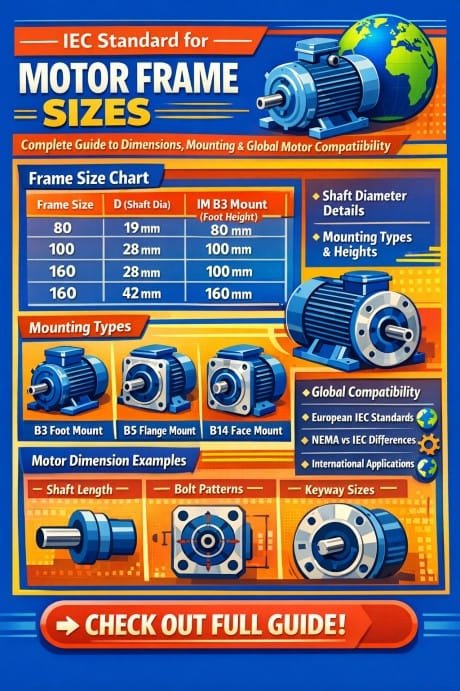
Table of Contents
The International Electrotechnical Commission (IEC) introduced standardized frame dimensions so that electric motors follow the same mounting, shaft height, and footprint requirements. Because of this global standardization, engineers can replace or upgrade motors without redesigning the mechanical layout of equipment.
This guide explains the IEC standard for motor frame sizes, including frame number meaning, mounting dimensions, common frame charts, and how IEC motors differ from NEMA motors.
Find more about Best Megger Insulation Tester for Industrial Motors
What is the IEC Standard for Motor Frame Sizes
The IEC standard for motor frame sizes defines the mechanical dimensions of electric motors. These dimensions include the shaft center height, mounting hole spacing, shaft diameter, and overall motor frame structure.
Instead of specifying electrical performance, the standard focuses on mechanical interchangeability. This ensures that motors from different manufacturers can fit the same mounting base and drive system.
The IEC frame size system is widely used across:
- Europe
- Asia
- Middle East
- Africa
- Most international industrial markets
Common IEC standards governing motor frames include:
- IEC 60072 – Dimensions and output series for rotating electrical machines
- IEC 60034 series – General motor performance and design requirements
Because of the IEC standard for motor frame sizes, engineers can replace a failed motor with another brand while maintaining the same mounting arrangement.
Use our online tool Short Circuit Current Calculator for Motors: Best Tool
Understanding IEC Motor Frame Numbers
In the IEC standard for motor frame sizes, the frame number primarily represents the shaft center height in millimeters measured from the mounting base to the shaft centerline.
For example:
| Frame Size | Shaft Height (mm) | Typical Power Range |
|---|---|---|
| 63 | 63 mm | 0.12 – 0.25 kW |
| 71 | 71 mm | 0.25 – 0.55 kW |
| 80 | 80 mm | 0.55 – 1.1 kW |
| 90 | 90 mm | 1.1 – 2.2 kW |
| 100 | 100 mm | 2.2 – 3 kW |
| 112 | 112 mm | 3 – 4 kW |
| 132 | 132 mm | 5.5 – 7.5 kW |
| 160 | 160 mm | 11 – 18.5 kW |
| 180 | 180 mm | 18.5 – 22 kW |
| 200 | 200 mm | 30 kW |
| 225 | 225 mm | 37 – 45 kW |
| 250 | 250 mm | 55 kW |
| 280 | 280 mm | 75 kW |
| 315 | 315 mm | 110 kW |
Sometimes letters such as S, M, or L are added after the frame number. These letters indicate different frame lengths while keeping the same shaft height.
Use our free online tool Generator Sizing Calculator for VFD Motors
Examples:
- 132S – Short frame
- 132M – Medium frame
- 132L – Long frame
These variations allow manufacturers to adjust motor power without changing the mounting dimensions.
Standard Mounting Types in IEC Motors
The IEC standard for motor frame sizes also defines standardized mounting arrangements. This ensures motors can be installed in different orientations without changing the mechanical base.
The most common IEC mounting types are listed below.
| Mounting Code | Description |
|---|---|
| B3 | Foot mounted motor |
| B5 | Flange mounted motor |
| B14 | Face mounted motor |
| B35 | Foot + flange mounted |
| B34 | Foot + face mounted |
Foot Mounted Motors (B3)
Foot mounted motors are the most common configuration used in industrial equipment such as pumps and compressors. The motor sits on a base plate and is secured using mounting bolts.
Flange Mounted Motors (B5)
Flange mounted motors are used where the motor is directly attached to the driven equipment. These are common in gearboxes and vertical pump systems.
Use our online tool for free Wire Size Calculator for Motors – Accurate Motor Cable Sizing Tool for Electric Loads
Face Mounted Motors (B14)
Face mounted motors use smaller mounting flanges and are often used in compact machinery.
Because the IEC standard for motor frame sizes specifies bolt spacing and shaft height, these motors can easily replace one another.
Key Dimensions Defined by IEC Motor Frames
The IEC standard for motor frame sizes defines several important mechanical parameters. Understanding these helps engineers ensure proper installation and alignment.
| Dimension | Description |
|---|---|
| H | Shaft center height |
| A | Distance between mounting holes (width) |
| B | Distance between mounting holes (length) |
| D | Shaft diameter |
| E | Shaft extension length |
| F | Keyway width |
These standardized dimensions allow mechanical engineers to design equipment with confidence that motors from different brands will fit correctly. Know more about low cost servomotors
For example, a 132 frame motor from one manufacturer will have the same shaft height and mounting hole pattern as another manufacturer’s 132 frame motor.
IEC Motor Frame Size Chart with Dimensions
Below is a simplified reference chart used in the IEC standard for motor frame sizes.
| Frame | Shaft Height (mm) | Shaft Diameter (mm) | Mounting Bolt Spacing (mm) |
|---|---|---|---|
| 63 | 63 | 11 | 100 × 80 |
| 71 | 71 | 14 | 112 × 90 |
| 80 | 80 | 19 | 125 × 100 |
| 90 | 90 | 24 | 140 × 125 |
| 100 | 100 | 28 | 160 × 140 |
| 112 | 112 | 28 | 190 × 140 |
| 132 | 132 | 38 | 216 × 178 |
| 160 | 160 | 42 | 254 × 210 |
| 180 | 180 | 48 | 279 × 241 |
| 200 | 200 | 55 | 318 × 267 |
This chart demonstrates how the IEC standard for motor frame sizes ensures uniform mechanical interfaces. Learn more about difference between servo motor and induction motor
IEC vs NEMA Motor Frame Standards
In global industries, two main motor frame standards exist: IEC and NEMA.
IEC motors are widely used in international markets, while NEMA motors are commonly used in North America.
The major differences include:
| Feature | IEC Motors | NEMA Motors |
|---|---|---|
| Standard Body | IEC 60072 | NEMA MG1 |
| Frame Size Units | Metric (mm) | Imperial (inches) |
| Design Style | Compact | Larger frame sizes |
| Global Use | Europe, Asia, Middle East | USA, Canada |
Because the IEC standard for motor frame sizes follows metric dimensions, these motors are generally more compact compared to NEMA motors.
Adapters are sometimes required when replacing a NEMA motor with an IEC motor. Know more about Motor Starter Size Chart: 7 Essential Insights for Better Selection
Benefits of IEC Motor Frame Standardization
The IEC standard for motor frame sizes provides several advantages for manufacturers and industrial users.
Easy Motor Replacement
Standardized mounting dimensions allow quick replacement of motors without modifying machine bases.
Interchangeability Between Brands
Motors from Siemens, ABB, WEG, and other manufacturers follow the same frame dimensions.
Simplified Equipment Design
Machine designers can create equipment layouts based on known motor dimensions.
Global Compatibility
Industrial plants operating internationally benefit from consistent motor sizing across suppliers.
These advantages make the IEC standard for motor frame sizes an essential part of modern industrial motor design.
Practical Example of IEC Motor Selection
Consider a pump system designed for a 132M frame motor. If the original motor fails, engineers can install another 132M frame motor from a different manufacturer. Know more about Motor Starter Types: A Powerful Guide with 7 Key Options You’ll Appreciate
Because the IEC standard for motor frame sizes ensures identical shaft height and mounting hole spacing, the new motor will fit the same base without mechanical changes.
The only factors that need verification are:
- Power rating
- Voltage and frequency
- Efficiency class (IE2, IE3, IE4)
- Protection rating (IP55, IP65)
This interchangeability significantly reduces downtime in industrial operations.
Conclusion
The IEC standard for motor frame sizes plays a vital role in global motor manufacturing and industrial equipment design. By standardizing shaft height, mounting dimensions, and mechanical interfaces, IEC ensures that electric motors remain interchangeable across different manufacturers and applications. Know more about Motor Overload Protection Chart: Important Concepts
For engineers and maintenance teams, understanding the IEC standard for motor frame sizes simplifies motor selection, replacement, and equipment design. Whether installing a new motor or upgrading an existing system, these standardized dimensions guarantee compatibility, reliability, and reduced installation effort.
As industries continue to expand globally, the IEC standard for motor frame sizes will remain a key factor in maintaining consistent and efficient electric motor integration across equipment and manufacturers.
Know everything about 3 Phase Motor Overload Relay Setting – Accurate Protection for Your Motor
Follow Us on Social:
Subscribe our Newsletter on Electrical Insights for latest updates from Electrical Engineering Hub
#IECStandardForMotorFrameSizes, #MotorFrameSizes, #IECMotorStandards, #ElectricMotorDimensions, #MotorMountingStandards, #IndustrialElectricMotors, #MotorEngineering, #IECMotorFrames, #MotorSpecifications, #ElectricalEngineering