IEC 61000 Harmonic Limits: Complete Guide to Compliance, Standards & Power Quality Control
Power quality has become a critical concern in modern electrical systems. With the growing use of nonlinear loads such as variable frequency drives, UPS systems, and LED lighting, harmonic distortion is now a common issue across industrial and commercial networks. IEC 61000 harmonic limits provide a structured framework to control these distortions and maintain system stability. Understanding these limits is essential for engineers, facility managers, and businesses that rely on efficient and reliable power systems.
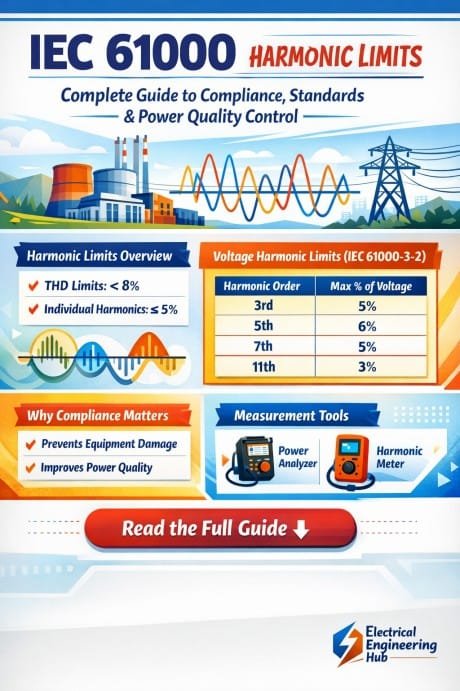
Table of Contents
What Are Harmonics in Electrical Systems
Harmonics are voltage or current distortions that occur when nonlinear devices draw power from the grid. Instead of a smooth sinusoidal waveform, the current becomes distorted due to switching operations and electronic components.
Find more about Best Megger Insulation Tester for Industrial Motors
These distortions can lead to several issues:
- Overheating of transformers and cables
- Malfunction of sensitive equipment
- Increased losses in the system
- Reduced power factor
- Nuisance tripping of protection devices
IEC 61000 harmonic limits are designed to keep these distortions within acceptable levels, ensuring system reliability and efficiency.
Overview of IEC 61000 Standards
The IEC 61000 series is an international set of standards developed by the International Electrotechnical Commission. It focuses on electromagnetic compatibility and power quality.
The harmonic-related parts of the standard include:
| Standard | Description |
|---|---|
| IEC 61000-3-2 | Limits for harmonic current emissions for equipment ≤16A per phase |
| IEC 61000-3-12 | Limits for equipment >16A and ≤75A |
| IEC 61000-2-2 | Compatibility levels for low-voltage systems |
| IEC 61000-2-4 | Compatibility levels for industrial environments |
Each of these plays a role in defining IEC 61000 harmonic limits depending on the application and system type.
Find more about Fluke 1507 Insulation Tester Megger Working
Classification of Equipment Under IEC 61000
To apply IEC 61000 harmonic limits correctly, equipment is divided into categories based on usage and load characteristics.
| Class | Equipment Type |
|---|---|
| Class A | Balanced three-phase equipment and general devices |
| Class B | Portable tools |
| Class C | Lighting equipment |
| Class D | Devices with specific waveform characteristics such as computers and TVs |
Each class has different harmonic current limits to ensure fair distribution of distortion across the grid.
Harmonic Current Limits Explained
IEC 61000 harmonic limits specify the maximum permissible harmonic current levels for each order of harmonic. These limits vary depending on the class of equipment.
For example, Class A equipment has the following limits:
| Harmonic Order | Limit (A) |
|---|---|
| 3rd | 2.30 |
| 5th | 1.14 |
| 7th | 0.77 |
| 9th | 0.40 |
| 11th | 0.33 |
These values ensure that individual devices do not inject excessive distortion into the system.
Know more about Insulation Resistance Testing: Step-by-Step Process
For lighting equipment under Class C, the limits are stricter because of their widespread use and cumulative effect on power systems.
Importance of IEC 61000 Harmonic Limits
Maintaining compliance with IEC 61000 harmonic limits is not just about meeting regulations. It directly impacts system performance and operational costs.
Key benefits include:
- Improved energy efficiency
- Longer lifespan of electrical equipment
- Reduced maintenance costs
- Stable voltage levels
- Better power factor performance
Ignoring harmonic limits can result in penalties, equipment failure, and increased downtime.
Measurement and Testing Procedures
To ensure compliance with IEC 61000 harmonic limits, proper testing and measurement techniques are required. Harmonic analysis is typically performed using power quality analyzers.
Know more about Power Quality Analyzer Buying Guide for Engineers
The process includes:
- Measuring total harmonic distortion (THD)
- Identifying individual harmonic components
- Comparing results with standard limits
- Recording data over a specific time period
| Parameter | Description |
|---|---|
| THD | Total harmonic distortion percentage |
| Individual Harmonics | Magnitude of each harmonic order |
| Crest Factor | Peak to RMS ratio |
| Power Factor | Real vs apparent power ratio |
Testing should be done under normal operating conditions to get accurate results.
Common Sources of Harmonics
Understanding the sources of harmonics helps in better compliance with IEC 61000 harmonic limits.
Typical sources include:
- Variable frequency drives
- Switch mode power supplies
- LED lighting systems
- Uninterruptible power supplies
- Arc furnaces and welding machines
These devices introduce nonlinearity into the system, leading to waveform distortion.
Explore details on High Voltage Cable Testing Procedure: Step-by-Step Guide for Safe & Accurate HV Cable Testing
Methods for Harmonic Mitigation
To meet IEC 61000 harmonic limits, several mitigation techniques can be applied. The choice depends on system size, load type, and budget.
Passive Filters
Passive filters use inductors and capacitors to block or divert harmonic currents.
Advantages:
- Cost-effective
- Simple design
Limitations:
- Fixed compensation
- Risk of resonance
Active Harmonic Filters
Active filters dynamically cancel harmonic currents by injecting opposite waveforms.
Advantages:
- Real-time correction
- Suitable for varying loads
Limitations:
- Higher cost
Explore all about vlf testing procedure
Multi-Pulse Converters
Using 12-pulse or 18-pulse rectifiers can significantly reduce harmonic generation.
Isolation Transformers
These help in reducing harmonic propagation and improving power quality.
Compliance Strategy for Industries
Industries must adopt a structured approach to comply with IEC 61000 harmonic limits. A reactive approach often leads to higher costs and operational issues.
A practical strategy includes:
- Conducting initial power quality audits
- Identifying major harmonic sources
- Selecting appropriate mitigation techniques
- Continuous monitoring using smart meters
- Regular maintenance and system upgrades
| Step | Action |
|---|---|
| 1 | Perform harmonic analysis |
| 2 | Compare with IEC limits |
| 3 | Install mitigation solutions |
| 4 | Validate performance |
| 5 | Monitor continuously |
This approach ensures long-term compliance and system stability.
Know more about VLF Testing vs Hipot: Best Guide on Key Differences and Applications
Role of Power Quality Monitoring
Modern electrical systems require continuous monitoring to maintain compliance with IEC 61000 harmonic limits. Smart monitoring systems provide real-time insights and alerts.
Benefits include:
- Early detection of harmonic issues
- Data-driven decision making
- Reduced downtime
- Improved system efficiency
With the integration of IoT-based solutions, monitoring has become more accessible and accurate.
Challenges in Meeting Harmonic Limits
Despite clear guidelines, achieving compliance with IEC 61000 harmonic limits can be challenging.
Common issues include:
- Rapid increase in nonlinear loads
- Lack of awareness in smaller facilities
- Improper system design
- Inadequate testing equipment
Addressing these challenges requires both technical expertise and proper planning.
Know more about HT Motor Tan Delta Testing – Best Guide for High Voltage Motor Insulation Diagnostic & Preventive Maintenance
Future Trends in Harmonic Control
As electrical systems evolve, the importance of IEC 61000 harmonic limits will continue to grow. The rise of renewable energy, electric vehicles, and smart grids is changing load behavior.
Future developments may include:
- Advanced filtering technologies
- AI-based power quality analysis
- Stricter compliance requirements
- Integration with energy management systems
These trends will make harmonic control more efficient and proactive.
Conclusion
IEC 61000 harmonic limits play a vital role in maintaining power quality and ensuring reliable operation of electrical systems. By understanding the standards, identifying sources of harmonics, and applying effective mitigation techniques, industries can achieve compliance and improve overall efficiency. A well-planned strategy combined with continuous monitoring helps in minimizing risks and optimizing performance in today’s complex power environments.
Find all about Partial Discharge vs Tan Delta Cable Testing: Important Key Differences Every Engineer Must Know
Get new guides in your feed. Follow Electrical Insights on LinkedIn for new electrical standards guides, calculators and design tips from Azad Circuit Hub.
#IEC61000, #HarmonicLimits, #PowerQuality, #ElectricalStandards, #EMCCompliance, #HarmonicDistortion, #PowerSystems, #ElectricalEngineering, #GridCompliance, #IECStandards
