
Ground Fault Protection vs Earth Leakage Protection: Key Differences, Uses & Safety Benefits
Electrical safety is a critical requirement in residential, commercial, and industrial installations. Among the most discussed protection methods are ground fault protection and earth leakage protection. Many engineers, electricians, and even facility managers often confuse these two systems or use the terms interchangeably. However, they serve different purposes, operate on different principles, and are applied at different levels of an electrical system.
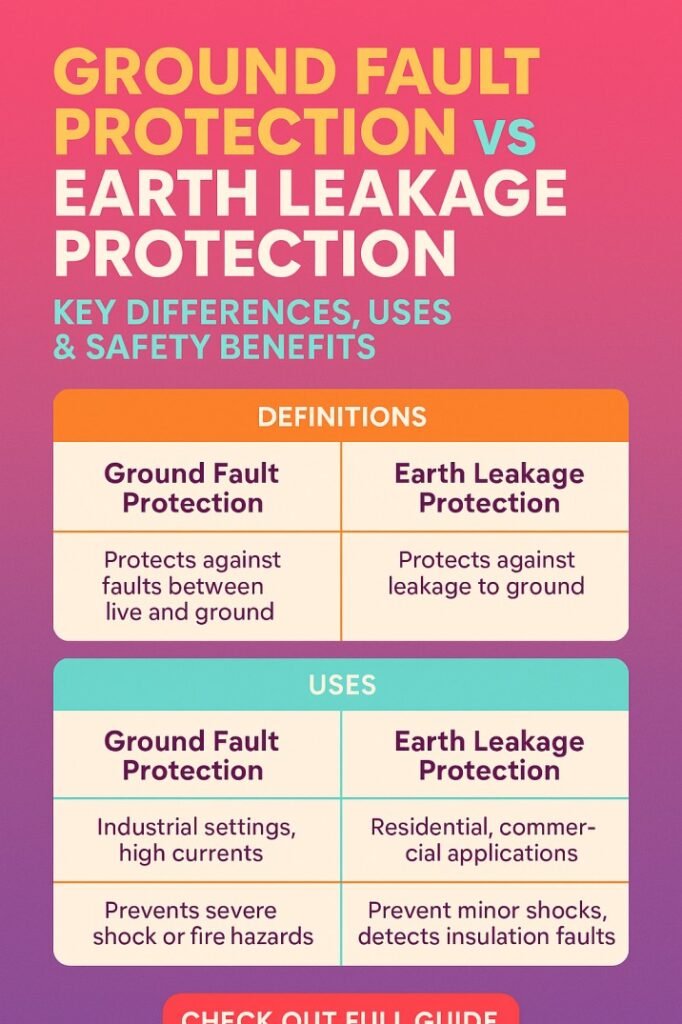
Table of Contents
This detailed guide explains ground fault protection vs earth leakage protection in a clear and practical way, helping you choose the right protection for safety, compliance, and system reliability.
Understanding the Basics of Electrical Faults
Before comparing protection methods, it is important to understand what electrical faults are. A fault occurs when current flows through an unintended path. This may happen due to insulation failure, damaged cables, moisture ingress, or equipment malfunction. If not detected early, such faults can lead to electric shock, fire hazards, or severe equipment damage.
Two common fault-related phenomena are ground faults and earth leakage currents. While they sound similar, their behavior and impact on electrical systems differ significantly. This difference is the foundation of ground fault protection vs earth leakage protection.
Know more about Residual vs Zero Sequence Ground Fault Protection; Important Differences which every Engineer Must Know
What Is Ground Fault Protection
Ground fault protection is designed to detect high-magnitude fault currents flowing from a phase conductor to ground. These faults typically occur in medium and high-power systems, especially in industrial and commercial environments.
Ground fault protection usually operates at current levels much higher than normal load currents. Its main objective is to protect equipment, cables, and transformers from severe damage rather than providing personal shock protection.
Key characteristics of ground fault protection include:
- Detection of phase-to-ground faults
- Operation at higher current thresholds
- Focus on equipment and system protection
- Common use in MCCs, switchgear, and feeders
In the context of ground fault protection vs earth leakage protection, ground fault protection is more about system integrity than human safety.
What Is Earth Leakage Protection
Earth leakage protection is designed to detect small leakage currents flowing from live conductors to earth. These leakage currents may be too small to trigger conventional circuit breakers or fuses, yet they are dangerous enough to cause electric shock or fire.
Earth leakage protection devices continuously monitor the balance between phase and neutral currents. Any imbalance indicates leakage to earth, prompting the device to trip quickly.
Know more about Earth Fault Relay Sensitivity Setting: 5 Proven Tips for Better Protection
Key characteristics of earth leakage protection include:
- Detection of low-level leakage currents
- Rapid disconnection to prevent electric shock
- Focus on personal safety and fire prevention
- Common use in homes, offices, and light commercial sites
This distinction plays a major role when evaluating ground fault protection vs earth leakage protection for different applications.
Operating Principle Comparison
The operating principles of both protections differ significantly, which explains their unique applications.
Ground fault protection relies on current transformers or residual sensing in protective relays. These systems detect abnormal ground currents exceeding preset limits, usually in amperes.
Earth leakage protection uses a core balance transformer that compares phase and neutral currents. Even a leakage as low as 30 mA can trigger a trip, making it highly sensitive.
Know more about Earth Fault Relay Testing Procedure
Key Differences Between Ground Fault Protection and Earth Leakage Protection
The table below clearly explains the technical and practical differences between the two systems.
| Parameter | Ground Fault Protection | Earth Leakage Protection |
|---|---|---|
| Typical Trip Current | High (amps to kiloamps) | Low (mA range) |
| Primary Purpose | Equipment and system protection | Human safety and fire prevention |
| Sensitivity | Low | Very high |
| Response Time | Selective and time-delayed | Instantaneous or very fast |
| Common Devices | Ground fault relays, protection modules | RCCB, ELCB, RCD |
| Application Level | Feeders, switchgear, transformers | Final circuits, sockets, appliances |
This comparison highlights why ground fault protection vs earth leakage protection cannot be treated as interchangeable solutions.
Applications in Real-World Installations
Understanding where each protection is used helps in selecting the correct device.
Ground fault protection is commonly applied in:
- Industrial power distribution systems
- Large motors and drives
- Transformers and generators
- Main incomers and sub-distribution panels
Earth leakage protection is typically used in:
- Residential wiring
- Commercial buildings
- Portable tools and appliances
- Wet and hazardous locations
Know more about NEC Grounding Table 250.122 Explained: Correct Equipment Grounding Conductor Size
In many modern installations, both protections are used together. This layered approach ensures comprehensive safety, reinforcing the importance of understanding ground fault protection vs earth leakage protection.
Safety Benefits Explained
Both protection systems contribute to safety, but in different ways.
Ground fault protection minimizes the risk of:
- Extensive cable damage
- Switchgear failure
- Arc flash incidents
- Prolonged outages
Earth leakage protection reduces the risk of:
- Electric shock to humans
- Fire due to insulation leakage
- Fatal accidents in wet environments
When combined properly, they offer a balanced safety strategy. This is one of the strongest arguments in favor of correctly implementing ground fault protection vs earth leakage protection rather than relying on a single method.
Know more about Benshaw Soft Starter Problems
Compliance With Electrical Standards
Electrical standards and codes often specify where each type of protection is mandatory.
- Industrial standards emphasize ground fault protection for high-capacity systems
- Residential and commercial codes mandate earth leakage protection for socket outlets and wet areas
- Healthcare and data centers may require both protections for enhanced safety
Compliance is not only a legal requirement but also a practical necessity for safe operation. Knowing the difference between ground fault protection vs earth leakage protection helps engineers meet code requirements accurately.
Common Misconceptions and Practical Clarifications
One common misconception is that earth leakage protection can replace ground fault protection. In reality, earth leakage devices are not designed to handle large fault currents.
Another misunderstanding is assuming ground fault protection provides shock protection. It does not, as its sensitivity is too low to detect dangerous leakage currents.
Clear understanding of ground fault protection vs earth leakage protection avoids improper device selection and enhances overall system safety.
Know more about IEC Standard for Earthing System
How to Choose the Right Protection
Selecting the right protection depends on several factors:
- System voltage and current rating
- Nature of connected loads
- Environment and moisture exposure
- Safety requirements for personnel
A simple rule is to use earth leakage protection where human contact is likely and ground fault protection where equipment damage is a concern. In many cases, a coordinated approach using both is the safest option.
Know more about How Does Earth Fault Relay Protect Electrical Circuits? Complete Guide to Ground Fault Protection
Final Thoughts
Electrical protection is not a one-size-fits-all solution. Ground fault protection and earth leakage protection serve distinct yet complementary roles in modern electrical systems. Understanding ground fault protection vs earth leakage protection helps engineers, electricians, and decision-makers design safer, more reliable installations.
By applying each protection where it is most effective, you reduce risk, improve compliance, and enhance overall system performance. Proper selection and coordination of these protections is not just good practice, it is essential for long-term electrical safety.
Know more about IEC Standard for Ground Fault Protection Explained: Compliance, Requirements & Best Practices
Follow Us on Social:
Subscribe our Newsletter on Electrical Insights for latest updates from Electrical Engineering Hub
#GroundFaultProtection, #EarthLeakageProtection, #ElectricalSafety, #GFPvsELP, #PowerSystemProtection, #IndustrialElectrical, #ElectricalEngineering, #FaultProtection, #ELCB, #RCD

Excellent approach to explaining this.