
ESD Testing Procedure: Step-by-Step Guide for Accurate Electrostatic Discharge Testing
Electrostatic discharge can silently damage sensitive electronic components and reduce product reliability. A well-defined ESD testing procedure helps manufacturers identify weaknesses, ensure compliance, and protect devices from unexpected failures. Whether you are working in electronics manufacturing, quality control, or product design, understanding how to carry out a proper ESD testing procedure is essential for long-term performance and safety.
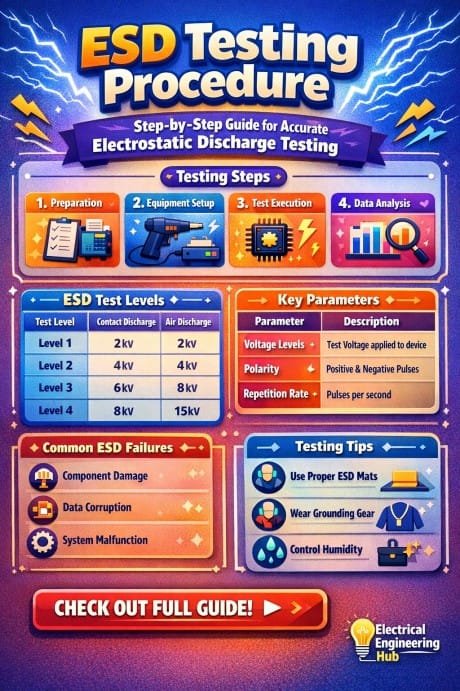
Table of Contents
Understanding Electrostatic Discharge and Its Impact
Electrostatic discharge occurs when two objects with different electrical potentials come into contact or close proximity. This sudden transfer of charge can damage microchips, circuit boards, and semiconductor devices.
Know more about Earth Fault Relay Testing Procedure
Modern electronics are becoming more compact and sensitive, which increases their vulnerability. Even a small discharge that is not visible or felt can degrade performance over time. This is why following a structured ESD testing procedure is important for maintaining product integrity.
Standards and Compliance Requirements
Before performing any test, it is important to understand the relevant standards. These guidelines define the testing methods, voltage levels, and acceptable limits.
Common ESD standards include:
| Standard | Description | Application |
|---|---|---|
| IEC 61000-4-2 | International standard for ESD immunity testing | Consumer electronics, industrial devices |
| ANSI/ESDA/JEDEC JS-001 | Human Body Model testing | Semiconductor devices |
| ANSI/ESDA/JEDEC JS-002 | Charged Device Model testing | Handling and manufacturing environments |
Following these standards ensures consistency and allows comparison across different products and environments.
Equipment Required for ESD Testing
A reliable ESD testing procedure depends on accurate and calibrated equipment. Using the right tools ensures consistent results and reduces testing errors.
| Equipment | Purpose |
|---|---|
| ESD Simulator Gun | Generates controlled electrostatic discharge |
| Ground Reference Plane | Provides a stable grounding surface |
| Horizontal and Vertical Coupling Planes | Simulate real-world discharge conditions |
| Oscilloscope | Measures waveform and discharge characteristics |
| Environmental Monitoring Tools | Track humidity and temperature |
Each component plays a role in creating a controlled testing environment that mimics real-life conditions.
Know more about Top 20 Electrical Testing Tools Which You Must Have
Pre-Test Preparation
Preparation is a critical step in any ESD testing procedure. Skipping this stage often leads to inaccurate results or repeated testing.
Start by setting up the test environment. Ensure that the room has controlled humidity levels, typically between 30% and 60%, as dry air increases static buildup. Verify that all equipment is calibrated and functioning properly.
Next, place the device under test (DUT) on an insulating surface. Connect grounding cables correctly to avoid unintended discharge paths. Review the product specifications to determine the appropriate voltage levels and test points.
Step-by-Step ESD Testing Procedure
A structured approach ensures consistency and reliability. Below is a practical ESD testing procedure used in most laboratories and production facilities.
Step 1: Define Test Parameters
Identify the discharge method, whether contact discharge or air discharge. Set the voltage levels according to the applicable standard. Common levels range from 2 kV to 15 kV.
Know more about Best Megger Testers for Industrial Use
Step 2: Select Test Points
Choose critical نقاط on the device such as connectors, buttons, seams, and exposed metal parts. These areas are more prone to electrostatic discharge.
Step 3: Perform Contact Discharge
Place the ESD simulator tip directly on the test point. Apply the discharge at the defined voltage. Repeat the process multiple times to ensure consistent results.
Step 4: Perform Air Discharge
Hold the simulator near the test point and allow the discharge to occur through air. This method is useful for non-conductive surfaces.
Step 5: Monitor Device Behavior
Observe the device during and after each discharge. Look for resets, malfunctions, or permanent damage. Record all observations carefully.
Know more about How to Use Megger Insulation Tester 1000V
Step 6: Repeat Tests
Perform multiple discharges at each test point. Rotate the polarity between positive and negative charges to simulate real-world conditions.
Step 7: Document Results
Record voltage levels, test points, and device responses. Proper documentation helps in troubleshooting and future improvements.
Common Test Levels and Conditions
| Test Type | Voltage Range | Application |
|---|---|---|
| Contact Discharge | 2 kV to 8 kV | Direct contact surfaces |
| Air Discharge | 2 kV to 15 kV | Insulating materials |
| Human Body Model | 500 V to 4000 V | Component-level testing |
| Charged Device Model | 125 V to 1000 V | Manufacturing handling |
Understanding these levels helps in selecting the right conditions for your ESD testing procedure.
Explore all about How to Test a 3 Phase Motor With a Megger
Interpreting Test Results
Results from an ESD testing procedure are generally categorized into different performance criteria:
| Criteria | Description |
|---|---|
| A | Normal performance within limits |
| B | Temporary degradation but self-recovery |
| C | Temporary loss requiring operator intervention |
| D | Permanent damage |
The goal is to achieve Criteria A or B for most applications. If the device falls into Criteria C or D, design improvements or protective measures are required.
Best Practices for Accurate Testing
Consistency is key when performing an ESD testing procedure. Small variations in setup or environment can lead to different outcomes.
Maintain proper grounding throughout the test setup. Ensure that cables and connections are secure. Avoid unnecessary movement during testing, as it can introduce variations.
Know more about Difference Between VLF and Megger
Regular calibration of equipment is also important. Using outdated or uncalibrated tools can produce misleading results. Always follow the same sequence of steps to maintain repeatability.
Common Mistakes to Avoid
Even experienced professionals can make errors during testing. Avoiding these mistakes improves accuracy and efficiency.
Do not ignore environmental conditions. Low humidity can exaggerate results, while high humidity may hide potential issues. Always test under controlled conditions.
Avoid applying incorrect voltage levels. Exceeding the specified limits can damage the device unnecessarily. On the other hand, using lower levels may fail to identify weaknesses.
Incomplete documentation is another common issue. Without proper records, it becomes difficult to analyze trends or improve designs.
Importance of ESD Protection Design
Testing alone is not enough. A good ESD testing procedure should be complemented by strong design practices.
Incorporate protective components such as transient voltage suppressors and resistors. Use proper grounding techniques in circuit design. Shield sensitive areas to reduce exposure to electrostatic discharge.
Know more about How to Use Megger Insulation Tester MIT2500
Design improvements not only help pass testing but also enhance product durability in real-world use.
Final Thoughts
A well-executed ESD testing procedure ensures that electronic devices can withstand real-world electrostatic events without failure. From preparation to documentation, each step plays a role in achieving accurate and reliable results.
By following standardized methods, using proper equipment, and maintaining consistency, you can identify vulnerabilities early and improve product quality. As electronics continue to evolve, the importance of a precise and repeatable ESD testing procedure will only grow.
Find more about Best Megger Insulation Tester for Industrial Motors
Get new guides in your feed. Follow Electrical Insights on LinkedIn for new electrical standards guides, calculators and design tips from Azad Circuit Hub.
ESDTestingProcedure, #ElectrostaticDischarge, #ESDCompliance, #EMCTesting, #ElectronicsTesting, #QualityAssurance, #TestingStandards, #ProductReliability, #EngineeringTesting, #ESDSafety
