What is Time Current Characteristic Curve in Overcurrent Relay? Best Guide
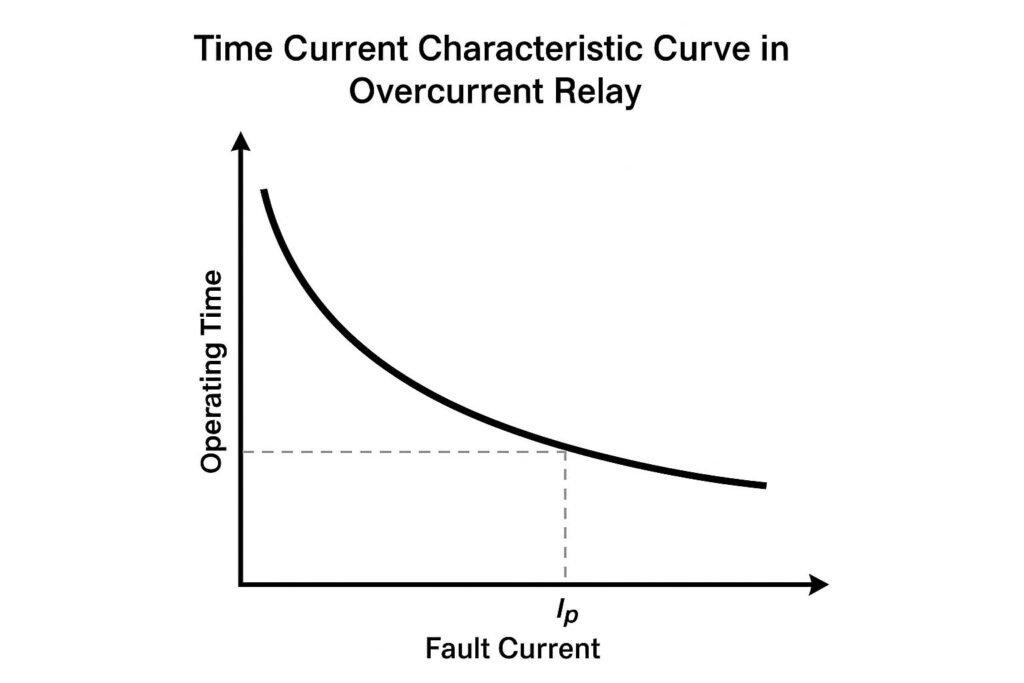
The time current characteristic curve in overcurrent relay is one of the most important tools used to understand how a protection relay behaves when fault current flows through a power system. This curve shows the relationship between the magnitude of current and the operating time of the relay. In simple terms, it explains how quickly the relay will trip when the current exceeds its set value.

Table of Contents
The curve ensures that faults are cleared at the right time without unnecessary tripping. It also helps engineers coordinate relays across feeders, transformers and other protective devices. When you analyze this curve, you understand how protection systems maintain stability, reliability and safety of electrical networks.
Why the Time Current Characteristic Curve Matters
An overcurrent relay works by detecting when the current goes beyond the preset limit. But it does not always trip instantly. Instead, its operating time depends on how much the current exceeds the pickup value. This behaviour is defined by the time current characteristic curve.
Power systems are complex. Multiple relays are installed across different parts of the network. They must work in harmony. If one relay operates too fast, it can isolate healthy parts of the system. If it operates too slow, faults may damage equipment. The curve helps engineers set proper delays to avoid these issues.
The curve also supports discrimination, where the relay closest to the fault operates first. This ensures only the faulty section is isolated and the rest of the network continues to operate. Learn in detail on vfd overload current setting
How the Curve Works
The horizontal axis of the curve shows the fault current. The vertical axis shows the operating time of the relay. As the current increases, the operating time decreases. This is known as inverse time operation.
If the current is only slightly above the pickup value, the relay trips slowly. If the current is very high, the relay trips quickly. This behaviour is ideal for protecting a system from both minor overloads and severe short circuits.
Below is the basic aesthetic form of an equation used for inverse time relays.
Inverse Time Formula
t = k × (1 / (I / Ip − 1))
Where:
t = operating time
I = actual current
Ip = pickup current
k = time multiplier constant
This expression shows that when I is much larger than Ip, the operating time becomes very small.
Explore details on IEC Standard for Differential Protection
Types of Time Current Characteristic Curves
Overcurrent relays use different characteristic curves depending on the application. Each curve has a unique shape and response time. The most common types include:
Normal Inverse Curve
This curve provides moderate speed at high fault currents and slower operation at low fault currents. It is widely used in distribution systems.
Very Inverse Curve
This curve responds extremely fast to high currents and slower to moderate overloads. It is suitable for networks where large short circuit levels exist.
Extremely Inverse Curve
This curve offers even faster operation for very high currents. It is used for transformer protection and areas where short circuits can rise sharply.
Definite Time Curve
This curve operates after a fixed time once the current exceeds the pickup value. It does not decrease with increasing current. It is used where coordination with other relays requires strict time delay.
Dive deeper into differential protection of alternator
Comparison Table for Curve Types
| Curve Type | Operating Speed | Ideal Application | Behaviour |
|---|---|---|---|
| Normal Inverse | Medium | Distribution networks | Balanced response |
| Very Inverse | Fast | Networks with high fault current levels | Very steep drop in time with rising current |
| Extremely Inverse | Very Fast | Transformer feeders and high inrush areas | Quick tripping at high currents |
| Definite Time | Fixed | Backup protection and simple coordination | Constant delay after pickup |
This table helps visualize how each curve differs in performance and application.
Importance of Proper Settings
The performance of a relay depends not only on the curve but also on proper parameter settings. Two of the most critical settings are the pickup current and the time multiplier setting.
Pickup Current
This is the current at which the relay begins to sense the abnormal condition. It must be high enough to avoid false tripping during load increase, yet low enough to detect real faults.
Time Multiplier Setting
This setting shifts the curve up or down. A higher setting leads to longer operating times. This setting helps coordinate relays in the network.
Proper coordination ensures that only the nearest protection device clears the fault. Engineers often create coordination graphs where multiple time current characteristic curves are plotted together.
Know more about alternator protection scheme
Practical Example of Relay Coordination
Consider a simple system with two relays. Relay A protects a feeder section where a fault is more likely to occur. Relay B provides backup protection for the same section. To ensure proper coordination, Relay A must operate faster than Relay B for all expected fault currents.
Engineers select curve types and adjust time multiplier settings. Then they plot both curves on the time current characteristic graph. When the curves do not overlap, it indicates correct discrimination.
This method prevents unwanted outages and ensures system reliability.
Learn more about types of generator protection relays
Real World Use in Power Networks
Power utilities rely heavily on these curves for distribution and transmission systems. Industrial plants also use them to protect motors, cables, and switchgear. The curve ensures that faults are cleared without exposing equipment to damage.
For example, a fault current of ten times the rated current might require the relay to operate in less than a second. The curve helps determine the appropriate tripping time for such cases.
Additional Technical Considerations
Current transformers must be carefully selected because they supply input current to the relay. If they saturate during fault conditions, the relay may not receive accurate current information. This may affect the operation time predicted by the time current characteristic curve.
Modern numerical relays come with multiple curve options. They allow fine tuning, better accuracy, and event recording. Engineers can analyze fault records and verify if the relay followed its characteristic curve correctly.
Get complete information about protection of alternator
Conclusion
The time current characteristic curve in overcurrent relay is a crucial element in designing a reliable protection system for electrical networks. It shows how the relay responds to different current levels over time. By understanding this curve, engineers make better decisions about settings, coordination and equipment protection.
Its correct application ensures that faults are cleared quickly, equipment remains safe and the entire system continues to operate smoothly. This makes the curve a foundation of modern power system protection engineering.
Follow Us on Social:
Subscribe our Newsletter on Electrical Insights for latest updates from Electrical Engineering Hub
#OvercurrentRelay, #TCCCurve, #TimeCurrentCharacteristic, #ProtectionRelay, #ElectricalEngineering, #PowerSystemProtection, #RelayCoordination, #FaultCurrent, #IndustrialSafety, #ElectricalProtection