Busbar Losses Calculation: Accurate Method to Calculate Busbar Power Loss & Efficiency
Busbars are a critical component of electrical power distribution systems. They are widely used in switchgear panels, substations, distribution boards, and industrial power systems to carry large currents safely and efficiently. Despite their high conductivity, busbars still experience power losses due to electrical resistance, temperature rise, and current flow. Understanding busbar losses calculation is therefore essential for electrical engineers when designing efficient power distribution systems.
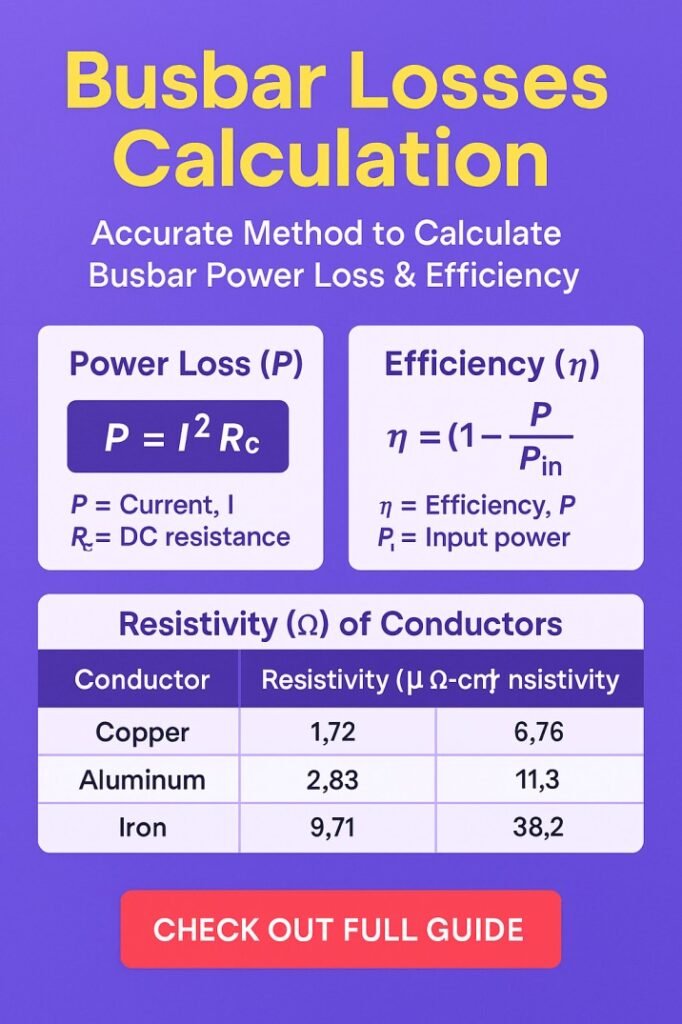
Table of Contents
Accurate busbar losses calculation helps engineers estimate heat generation, determine efficiency, and select the correct busbar size for safe operation. Poorly designed busbars can lead to overheating, voltage drop, and unnecessary energy loss, which directly affects system reliability and operating cost.
This guide explains the principles behind busbar losses calculation, the formulas used, influencing factors, and practical examples so engineers can calculate busbar power loss accurately.
Find out more about contact resistance test acceptable value for busbar
Understanding Busbar Power Loss
In electrical systems, busbars are usually made from copper or aluminum because of their high electrical conductivity. However, even highly conductive materials have some resistance. When current flows through a conductor, electrical energy is converted into heat due to this resistance.
The power loss in a busbar is mainly known as I²R loss, where current flowing through resistance generates heat.
The basic relationship used in busbar losses calculation is:
Power Loss = I² × R
Where:
| Symbol | Description |
|---|---|
| I | Current flowing through busbar (Amperes) |
| R | Resistance of busbar (Ohms) |
| P | Power loss (Watts) |
The higher the current or resistance, the higher the power loss. That is why electrical busbar sizing is critical in high-current systems.
Know more about IEC Standard for Busbar Clearance
Why Busbar Losses Calculation is Important
Performing busbar losses calculation is necessary for several engineering reasons. It ensures that the electrical distribution system operates safely and efficiently.
Key benefits include:
• Preventing overheating in switchgear panels
• Improving power distribution efficiency
• Reducing energy losses in industrial plants
• Selecting proper busbar cross-section area
• Improving equipment lifespan
• Ensuring compliance with electrical standards
In large facilities where current levels can exceed several thousand amperes, even small resistance values can result in significant power loss. Accurate busbar losses calculation helps engineers minimize these losses during the design stage. Read in detail about iec 61439 busbar calculation
Factors Affecting Busbar Power Loss
Several parameters influence the result of busbar losses calculation. Engineers must consider these factors before performing calculations.
1. Busbar Material
Copper and aluminum are the most common materials used.
| Material | Resistivity (Ω·mm²/m) | Conductivity |
|---|---|---|
| Copper | 0.017 | Very High |
| Aluminum | 0.028 | Moderate |
Copper busbars produce lower losses compared to aluminum because of their lower resistivity.
2. Length of Busbar
Resistance increases directly with conductor length. Longer busbars produce higher voltage drop and higher power loss.
3. Cross-Sectional Area
Larger cross-sectional area reduces resistance and therefore reduces power loss.
4. Operating Current
Power loss increases rapidly with current because the relationship is proportional to the square of current. Get complete information about iec standard for busbar sizing
5. Temperature Rise
Resistance increases with temperature. If the busbar operates at a higher temperature, the calculated losses will increase.
Considering these parameters is essential for reliable busbar losses calculation in industrial power systems.
Formula Used for Busbar Resistance
Before performing busbar losses calculation, the resistance of the busbar must be determined. Resistance depends on material resistivity, length, and cross-sectional area.
The resistance formula is:
R = (ρ × L) / A
Where:
| Parameter | Description |
|---|---|
| R | Resistance (Ohms) |
| ρ | Resistivity of material |
| L | Length of busbar (meters) |
| A | Cross sectional area (mm²) |
Once resistance is calculated, it can be used in the busbar losses calculation formula. Find out more about iec 61439 busbar clearance
Step-by-Step Busbar Losses Calculation
Let us understand busbar losses calculation through a practical example.
Assume the following values:
| Parameter | Value |
|---|---|
| Busbar material | Copper |
| Length | 2 m |
| Cross section | 50 mm × 10 mm |
| Current | 800 A |
Step 1: Calculate Cross-Sectional Area
Area = Width × Thickness
Area = 50 × 10
Area = 500 mm²
Find out more about Busbar Size Calculator – Accurate Sizing According to IEC and NEC Standards
Step 2: Calculate Busbar Resistance
R = (ρ × L) / A
R = (0.017 × 2) / 500
R = 0.000068 Ohm
Step 3: Perform Busbar Losses Calculation
Power Loss = I² × R
Power Loss = 800² × 0.000068
Power Loss = 43.52 Watts
This means the busbar will generate approximately 43.5 W of heat due to electrical resistance.
This example demonstrates how straightforward busbar losses calculation can help engineers estimate heating effects in electrical panels.
Busbar Efficiency Calculation
In addition to power loss, engineers often evaluate busbar efficiency.
Efficiency is defined as the ratio of output power to input power.
Efficiency Formula:
Efficiency (%) = Output Power / Input Power × 100
Find out more about High Impedance Busbar Protection Explained with Example Calculations
Example:
If the input power is 100 kW and busbar loss is 0.043 kW:
| Parameter | Value |
|---|---|
| Input Power | 100 kW |
| Busbar Loss | 0.043 kW |
| Output Power | 99.957 kW |
Efficiency = (99.957 / 100) × 100
Efficiency = 99.96%
This shows that although busbars are highly efficient conductors, performing busbar losses calculation still helps optimize system performance.
Typical Busbar Power Loss Values
In practical installations, the percentage loss in busbars is usually very small. However, large industrial systems can still experience measurable energy losses.
| System Type | Typical Busbar Loss |
|---|---|
| Small distribution panels | 0.1 – 0.3 % |
| Industrial switchgear | 0.2 – 0.5 % |
| High current bus duct systems | 0.5 – 1 % |
Regular busbar losses calculation ensures these values remain within acceptable limits.
Find out more about Busbar Stability Test Procedure – Step-by-Step Method to Ensure Safe and Reliable Busbars
Methods to Reduce Busbar Power Loss
Engineers can minimize losses by improving system design. Below are practical methods used in industry.
Increase Busbar Size
A larger cross-section reduces electrical resistance and lowers power loss.
Use Copper Instead of Aluminum
Copper offers better conductivity and lower resistive losses.
Reduce Busbar Length
Shorter power distribution paths reduce resistance and improve efficiency.
Improve Cooling and Ventilation
Lower operating temperature reduces resistance and helps minimize losses.
Use Proper Busbar Spacing
Correct spacing improves heat dissipation and reduces thermal stress.
Applying these practices alongside proper busbar losses calculation significantly improves power distribution efficiency. Find all about Busbar Bending Calculation
Busbar Losses in Three Phase Systems
Most industrial systems operate on three-phase power. In such systems, each phase busbar carries current, and the total loss is calculated by summing the losses of all phases.
Total Loss = 3 × I²R
Example:
If each phase busbar loss is 40 W:
| Phase | Power Loss |
|---|---|
| Phase R | 40 W |
| Phase Y | 40 W |
| Phase B | 40 W |
Total Busbar Loss = 120 W
Accurate busbar losses calculation in three-phase systems is especially important in substations, solar plants, and heavy industrial facilities. Find all about Busbar Size Chart in mm
Practical Design Tips for Engineers
When designing electrical panels or switchgear systems, engineers should follow certain best practices to ensure efficient power distribution.
• Always calculate busbar resistance before estimating losses
• Maintain adequate clearance between busbars for cooling
• Consider temperature correction factors
• Follow IEC or IEEE standards for busbar design
• Verify thermal limits during load conditions
Combining these practices with proper busbar losses calculation ensures safe and reliable operation of electrical distribution systems. Know more about Busbar Distance Calculation – Complete Guide, Formula, Standards & Design Tips
Conclusion
Busbars play a vital role in carrying high currents within electrical distribution systems. Even though they are made from highly conductive materials, they still produce power losses due to electrical resistance. Performing accurate busbar losses calculation allows engineers to estimate heat generation, optimize efficiency, and select the correct busbar size for a given application.
By understanding the resistance formula, applying the I²R loss principle, and considering factors such as material, temperature, and cross-sectional area, engineers can design efficient power systems with minimal energy loss. In modern industrial facilities where power demand is high, proper busbar losses calculation is not just a design step but an essential practice for achieving safe, reliable, and energy-efficient electrical installations.
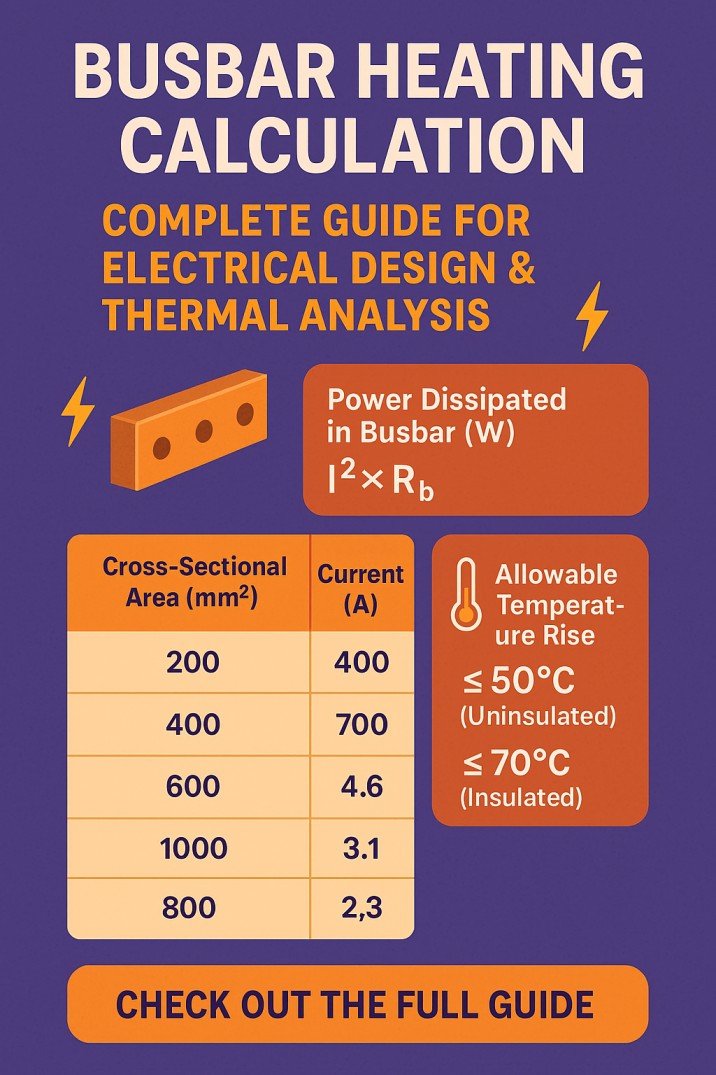
Know more about Busbar Heating Calculation | Important Guide for Electrical Design & Thermal Analysis
Follow Us on Social:
Subscribe our Newsletter on Electrical Insights for latest updates from Electrical Engineering Hub
#BusbarLossesCalculation, #BusbarDesign, #ElectricalEngineering, #PowerDistribution, #ElectricalCalculations, #BusbarSizing, #PowerSystemDesign, #ElectricalEfficiency, #CopperBusbar, #ElectricalDesign