IEC Standard for Impulse Withstand Voltage – Complete Guide to Lightning Impulse Testing & Insulation Coordination
Electrical power systems are constantly exposed to transient overvoltages caused by lightning strikes and switching operations. These high-energy surges can damage insulation, disrupt equipment operation, and reduce system reliability. To ensure that electrical equipment can survive such conditions, international standards define testing and insulation requirements. One of the most important among them is the IEC standard for impulse withstand voltage, which establishes how equipment insulation must be designed and tested against impulse voltages.
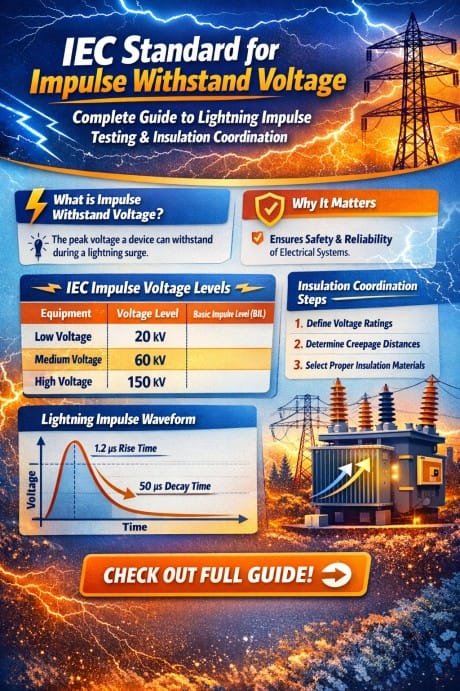
Table of Contents
The IEC standard for impulse withstand voltage plays a key role in insulation coordination, high-voltage testing, and equipment certification. Manufacturers, engineers, and testing laboratories rely on these standards to verify that transformers, switchgear, cables, and other high-voltage equipment can safely withstand lightning impulses and switching surges.
Understanding Impulse Withstand Voltage
Impulse withstand voltage refers to the maximum peak voltage that electrical insulation can tolerate for a very short duration without breakdown. These impulses typically simulate lightning strikes or switching surges that occur in real power systems.
Know more about Phase to Phase Clearance as per IEC 61439: Best Guide
Impulse voltages have extremely fast rise times and short durations, which makes them very different from power frequency voltages. The purpose of testing under the iec standard for impulse withstand voltage is to replicate these transient conditions and confirm the strength of insulation systems.
Typical characteristics of impulse voltage include:
- Very high peak voltage
- Short duration (microseconds)
- Fast rise time
- Rapid decay
Know more about How to Comply with OSHA Electrical Standards in detail
In practice, the most common waveform used in testing is the 1.2/50 µs lightning impulse waveform, meaning the voltage rises to its peak in 1.2 microseconds and falls to half its value in 50 microseconds.
Key IEC Standards Related to Impulse Withstand Voltage
Several IEC standards define testing procedures, insulation levels, and coordination methods. These standards work together to create a complete framework for impulse voltage testing.
| IEC Standard | Description | Application |
|---|---|---|
| IEC 60060 | High-voltage test techniques | General impulse and AC test procedures |
| IEC 60071 | Insulation coordination | Defines insulation levels and surge protection |
| IEC 60270 | Partial discharge measurements | Insulation condition monitoring |
| IEC 62271 | High-voltage switchgear standards | Impulse testing requirements for switchgear |
| IEC 60076 | Power transformer standards | Lightning impulse withstand testing |
These documents collectively form the backbone of the iec standard for impulse withstand voltage used across modern power systems.
Know more about OSHA Electrical Safety Standard 1910 – Workplace Electrical Safety | Safety Experts
Lightning Impulse Waveform Explained
Lightning impulse testing follows a standardized waveform so that results remain consistent worldwide. The IEC defines the shape, rise time, and decay of the impulse waveform.
| Parameter | Typical Value |
|---|---|
| Waveform | 1.2/50 µs |
| Rise Time | 1.2 microseconds |
| Time to Half Value | 50 microseconds |
| Peak Voltage | Defined by insulation level |
The waveform is generated using an impulse generator consisting of capacitors, resistors, and spark gaps. This circuit produces a sudden discharge that simulates lightning surges.
By applying this waveform during testing, engineers confirm compliance with the iec standard for impulse withstand voltage and verify insulation strength.
Know more about Electrical Standards USA – National Electrical Code | Electrical Safety Foundation
Importance of Insulation Coordination
Insulation coordination ensures that every component in a power system has insulation strength matched to expected overvoltages. The goal is to avoid insulation failure while also keeping equipment cost reasonable.
The iec standard for impulse withstand voltage provides guidance for selecting appropriate insulation levels based on system voltage and expected surge conditions.
Important factors considered in insulation coordination include:
- Maximum system voltage
- Lightning strike probability
- Surge arrester protection level
- Switching overvoltages
- Environmental conditions
Proper insulation coordination ensures that protective devices operate before equipment insulation fails.
Typical Impulse Withstand Voltage Levels
IEC standards define insulation levels for various voltage classes. These levels specify the required lightning impulse withstand voltage for equipment.
| System Voltage (kV) | Lightning Impulse Withstand Voltage (kV Peak) |
|---|---|
| 12 kV | 75 kV |
| 24 kV | 125 kV |
| 36 kV | 170 kV |
| 72.5 kV | 325 kV |
| 145 kV | 650 kV |
| 245 kV | 1050 kV |
| 420 kV | 1425 kV |
Manufacturers design insulation systems according to these requirements to comply with the iec standard for impulse withstand voltage.
Learn more in detail on NEMA 250 Enclosures – Electrical Enclosure Standards | Best Manufacturing Companies in USA
Lightning Impulse Testing Procedure
Impulse testing is conducted in specialized high-voltage laboratories equipped with impulse generators and measuring instruments.
The basic testing procedure involves the following steps:
- Preparing the test object and connecting it to the impulse generator
- Calibrating voltage measurement systems
- Applying impulse voltage at the specified level
- Observing insulation performance
- Recording waveform and breakdown behavior
Several impulse shots are applied during testing to confirm insulation reliability.
Types of Impulse Tests
IEC testing procedures generally include two main types:
- Full Wave Lightning Impulse Test – verifies insulation withstand capability under standard impulse waveform
- Chopped Wave Impulse Test – simulates flashover conditions by interrupting the impulse waveform
Both tests are defined within the iec standard for impulse withstand voltage framework.
Explore details on Electrical Compliance Testing – Safety Regulations | Best Electrical Services in USA
Equipment Tested for Impulse Withstand Voltage
Many types of electrical equipment must undergo impulse testing before being approved for service.
Common equipment tested includes:
- Power transformers
- Instrument transformers
- Circuit breakers
- Gas insulated switchgear (GIS)
- Insulators and bushings
- Power cables and accessories
- Surge arresters
Each device must meet the requirements defined in the iec standard for impulse withstand voltage to ensure safe operation under lightning conditions.
Impulse Generator Components
Impulse voltage is produced using specialized high-voltage equipment known as an impulse generator. These generators can produce extremely high voltages for short durations.
Typical impulse generator components include:
| Component | Function |
|---|---|
| Charging Capacitors | Store electrical energy |
| Spark Gaps | Trigger sudden discharge |
| Wave Shaping Resistors | Control waveform rise and decay |
| Test Object | Equipment under test |
| Measuring System | Records impulse waveform |
Modern digital measuring systems allow precise waveform analysis and compliance verification with the iec standard for impulse withstand voltage.
Learn more about NFPA 70 National Electrical Code | Electrical Safety Experts
Factors Affecting Impulse Withstand Capability
Several design and environmental factors influence the impulse withstand strength of electrical insulation.
Important factors include:
- Insulation material quality
- Electrode geometry
- Air clearance distance
- Pollution levels
- Humidity and altitude
- Surface contamination
Engineers consider these parameters when designing equipment to meet the iec standard for impulse withstand voltage requirements.
Practical Applications in Power Systems
Impulse withstand voltage ratings are essential in many practical engineering applications.
Power system engineers use these ratings when:
- Selecting transformers and switchgear
- Designing substations
- Coordinating surge protection devices
- Planning insulation clearances
- Evaluating lightning protection systems
By following the iec standard for impulse withstand voltage, utilities can significantly reduce the risk of equipment failure during lightning storms.
Learn more about Arc Flash Risk Assessment According to NFPA 70E
Future Trends in High Voltage Testing
With the expansion of renewable energy and ultra-high voltage transmission systems, impulse testing technology continues to evolve. Modern laboratories now use digital measurement systems, automated testing procedures, and advanced simulation tools.
Research is also focused on improving insulation materials and designing more efficient surge protection devices. These developments ensure that future equipment will continue to meet the requirements of the iec standard for impulse withstand voltage while supporting increasingly complex power networks.
Conclusion
Lightning and switching surges are unavoidable in modern power systems, and insulation must be designed to withstand these extreme conditions. The iec standard for impulse withstand voltage provides a globally accepted framework for testing and insulation coordination.
By defining impulse waveforms, testing methods, and insulation levels, IEC standards help ensure the safety and reliability of electrical equipment. Engineers, manufacturers, and utilities rely on these guidelines to design systems capable of operating under severe transient conditions.
Uncover insights on iec standard for lighting lux level
Understanding and applying the iec standard for impulse withstand voltage is therefore essential for anyone involved in high-voltage engineering, equipment manufacturing, or power system design.
Follow Us on Social:
Subscribe our Newsletter on Electrical Insights for latest updates from Electrical Engineering Hub
#IECStandard, #ImpulseWithstandVoltage, #LightningImpulseTest, #HighVoltageTesting, #ElectricalStandards, #InsulationCoordination, #IEC60060, #PowerSystemProtection, #ElectricalEngineering, #HVTesting