Medium Voltage Cable Insulation Resistance Test Procedure: Best Step by Step Guide
The medium voltage cable insulation resistance test is one of the most important diagnostic tests performed before energizing a power cable. It verifies the integrity of the insulation system and confirms that the cable can safely withstand operating voltage without leakage current or insulation failure.
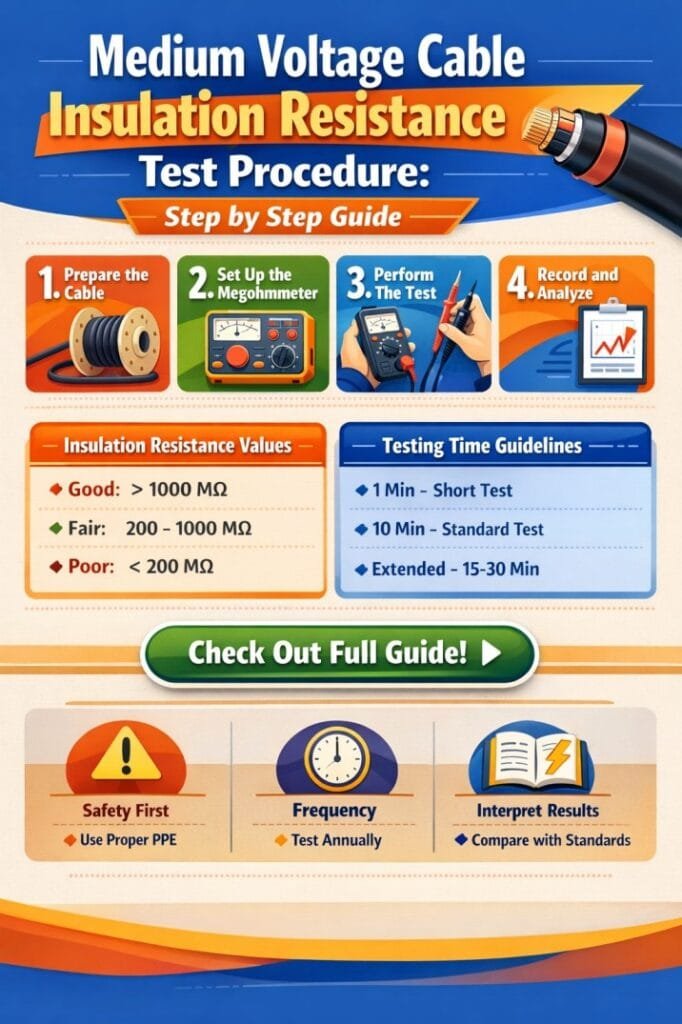
Table of Contents
Medium voltage cables are widely used in industrial power distribution, substations, renewable energy plants, and utility networks. Because these cables typically operate between 1 kV and 35 kV, insulation quality plays a critical role in system reliability and safety. Even a small insulation weakness can lead to partial discharge, cable failure, or equipment damage.
Performing a medium voltage cable insulation resistance test helps engineers detect moisture ingress, insulation deterioration, contamination, or mechanical damage before the cable is put into service. The test is simple but must be carried out using the correct procedure, voltage levels, and safety precautions.
What is Medium Voltage Cable Insulation Resistance Test
A medium voltage cable insulation resistance test measures the resistance of the cable insulation between conductors and between conductor and earth. The test is performed using a megohmmeter (Megger) that applies a high DC voltage and measures the leakage current flowing through the insulation.
Healthy cable insulation should have very high resistance, typically in the hundreds of megaohms or even gigaohms. Low insulation resistance indicates possible insulation degradation, moisture absorption, or contamination.
Know more about Insulation Resistance Testing: Step-by-Step Process
The purpose of the test includes:
- Verifying insulation health before commissioning
- Detecting moisture or contamination inside the cable
- Identifying insulation deterioration
- Ensuring electrical safety before energization
- Confirming installation quality after cable laying
The test is commonly performed during pre-commissioning testing, maintenance inspections, and troubleshooting of power cables.
Equipment Required for the Test
To perform a medium voltage cable insulation resistance test, the following equipment and tools are typically required.
| Equipment | Purpose |
|---|---|
| Megohmmeter (Megger) | Applies DC voltage and measures insulation resistance |
| Test Leads and Clips | Connects the instrument to cable conductors |
| Insulated Gloves | Personal protection during testing |
| Grounding Cable | Discharges stored cable capacitance |
| Lockout/Tagout Devices | Ensures the cable remains de-energized |
| Warning Signs | Prevents accidental energization |
Megger test sets used for medium voltage cables normally have test voltages of 1 kV, 2.5 kV, 5 kV, or 10 kV, depending on cable rating.
Know more about Top 12 Electrical Testing Equipment Suppliers in USA
Recommended Test Voltages for MV Cables
Selecting the correct voltage is important for an accurate medium voltage cable insulation resistance test.
| Cable Rated Voltage | Recommended Megger Test Voltage |
|---|---|
| Up to 1 kV | 500 V |
| 1 kV – 5 kV | 1 kV |
| 5 kV – 15 kV | 2.5 kV |
| 15 kV – 35 kV | 5 kV |
Applying excessive voltage may damage insulation, while too low voltage may not reveal insulation defects.
Know more about Power Quality Analyzer Buying Guide for Engineers
Safety Precautions Before Testing
Before performing a medium voltage cable insulation resistance test, strict safety measures must be followed.
- Ensure the cable is completely isolated from power sources
- Apply lockout and tagout procedures
- Confirm absence of voltage using a voltage detector
- Discharge the cable before connecting the megger
- Keep unauthorized personnel away from the test area
- Wear proper PPE such as insulated gloves and safety shoes
Medium voltage cables store electrical energy due to their capacitance. Therefore, proper discharge procedures must always be followed before and after testing.
Medium Voltage Cable Insulation Resistance Test Procedure
The medium voltage cable insulation resistance test should be carried out in a systematic manner to ensure reliable results.
Step 1 – Cable Isolation
First, isolate the cable from all electrical equipment such as switchgear, transformers, and busbars. Both ends of the cable must be disconnected.
This prevents parallel paths that may affect insulation resistance measurement.
Know more about High Voltage Testing Procedures for Electrical Panels: Step by Step
Step 2 – Visual Inspection
Before starting the medium voltage cable insulation resistance test, perform a visual inspection.
Check for:
- Mechanical damage
- Improper terminations
- Moisture or water ingress
- Damaged cable glands
- Contaminated surfaces
Any visible issues should be corrected before testing.
Step 3 – Cable Identification
Identify all cable cores and mark them clearly. In three-phase cables, the conductors are typically:
- Phase R
- Phase Y
- Phase B
- Metallic sheath or armor
Proper identification avoids incorrect connections during testing.
Know more about VLF Testing vs Hipot: Best Guide on Key Differences and Applications
Step 4 – Megger Connection
Connect the megohmmeter leads according to the required test.
Typical connections include:
- Phase to Phase
- Phase to Earth
- Phase to Shield or Armor
For example, when testing Phase R to Earth, connect:
- Megger positive lead → Phase R
- Megger negative lead → Earth or cable sheath
Step 5 – Apply Test Voltage
Set the megger to the recommended voltage level and begin the medium voltage cable insulation resistance test.
The test voltage is applied for at least 1 minute to allow the insulation resistance to stabilize.
The reading observed after one minute is recorded as the insulation resistance value.
Step 6 – Record Test Readings
All readings should be documented carefully for future comparison.
| Test Combination | Insulation Resistance |
|---|---|
| Phase R – Earth | Record Value |
| Phase Y – Earth | Record Value |
| Phase B – Earth | Record Value |
| Phase R – Phase Y | Record Value |
| Phase Y – Phase B | Record Value |
| Phase B – Phase R | Record Value |
Consistent readings across phases usually indicate healthy cable insulation.
Find all about High Voltage Cable Testing Standards: Complete Guide for Engineers
Step 7 – Discharge the Cable
After completing the medium voltage cable insulation resistance test, the cable must be discharged.
Medium voltage cables can retain electrical charge due to capacitance. Always connect the conductor to ground for several seconds to safely discharge stored energy.
Minimum Acceptable Insulation Resistance Values
There is no universal insulation resistance value because results depend on cable length, temperature, and insulation type. However, general guidelines are used in industry.
| Cable Voltage Rating | Minimum IR Value |
|---|---|
| 5 kV cable | 100 MΩ or higher |
| 15 kV cable | 200 MΩ or higher |
| 35 kV cable | 500 MΩ or higher |
Higher values are always preferred. Trending insulation resistance over time is more useful than a single measurement. Explore all about vlf testing procedure
Factors Affecting Insulation Resistance
Several factors can influence the result of a medium voltage cable insulation resistance test.
Temperature is one of the most important. Insulation resistance decreases as temperature increases.
Other influencing factors include:
- Cable length
- Moisture presence
- Dirt or contamination
- Insulation material
- Cable aging
- Installation conditions
Because of temperature variation, insulation resistance values are often corrected to a standard temperature of 20°C for accurate comparison.
Common Mistakes During Testing
Improper testing practices can produce misleading results. The following mistakes should be avoided when performing a medium voltage cable insulation resistance test.
- Testing without disconnecting equipment
- Using incorrect megger voltage
- Not allowing sufficient test duration
- Failing to discharge the cable after testing
- Ignoring temperature correction
Following the correct procedure ensures reliable insulation evaluation.
Explore details on High Voltage Cable Testing Procedure: Step-by-Step Guide for Safe & Accurate HV Cable Testing
Importance of Insulation Resistance Testing
The medium voltage cable insulation resistance test is essential for maintaining power system reliability. Electrical utilities, industries, and renewable energy plants rely on this test to ensure cable health before energization.
Key benefits include:
- Early detection of insulation failure
- Reduced risk of cable breakdown
- Improved safety for personnel
- Increased system reliability
- Prevention of costly downtime
Regular insulation testing also helps maintenance teams track insulation aging and plan preventive maintenance.
Conclusion
The medium voltage cable insulation resistance test is a fundamental electrical test used to evaluate the insulation integrity of medium voltage power cables. By applying a DC test voltage and measuring leakage resistance, engineers can identify insulation deterioration, moisture ingress, and installation defects.
Find all about Partial Discharge vs Tan Delta Cable Testing: Important Key Differences Every Engineer Must Know
Following the correct test procedure, safety precautions, and proper documentation ensures accurate results. When performed during commissioning and maintenance, the medium voltage cable insulation resistance test significantly improves system reliability and helps prevent unexpected cable failures.
For power engineers, technicians, and maintenance teams, understanding and correctly performing this test is essential for safe and efficient operation of medium voltage electrical networks. Explore all about Top 15 High Voltage Testing Services Indiana – Trusted Experts for Reliable Power Systems
Follow Us on Social:
Subscribe our Newsletter on Electrical Insights for latest updates from Electrical Engineering Hub
#MediumVoltageCable, #CableTesting, #InsulationResistanceTest, #ElectricalMaintenance, #PowerCableTesting, #MeggerTest, #ElectricalEngineering, #MVTesting, #CableInsulation, #SubstationMaintenance


I appreciate you sharing this blog post. Thanks Again. Cool.
Pretty! This has been a really wonderful post. Many thanks for providing these details.
Awesome! Its genuinely remarkable post, I have got much clear idea regarding from this post
I like the efforts you have put in this, regards for all the great content.
Awesome! Its genuinely remarkable post, I have got much clear idea regarding from this post