Electrical Diversity Calculator UK – Accurate Load Diversity & Demand Factor Tool
Introduction
An electrical diversity calculator UK is used to estimate the realistic maximum electrical demand of an installation by applying diversity to connected loads. In many electrical systems, not all equipment operates at full load at the same time. Diversity allows engineers and electricians to account for this behavior and determine a more practical demand value for system design.
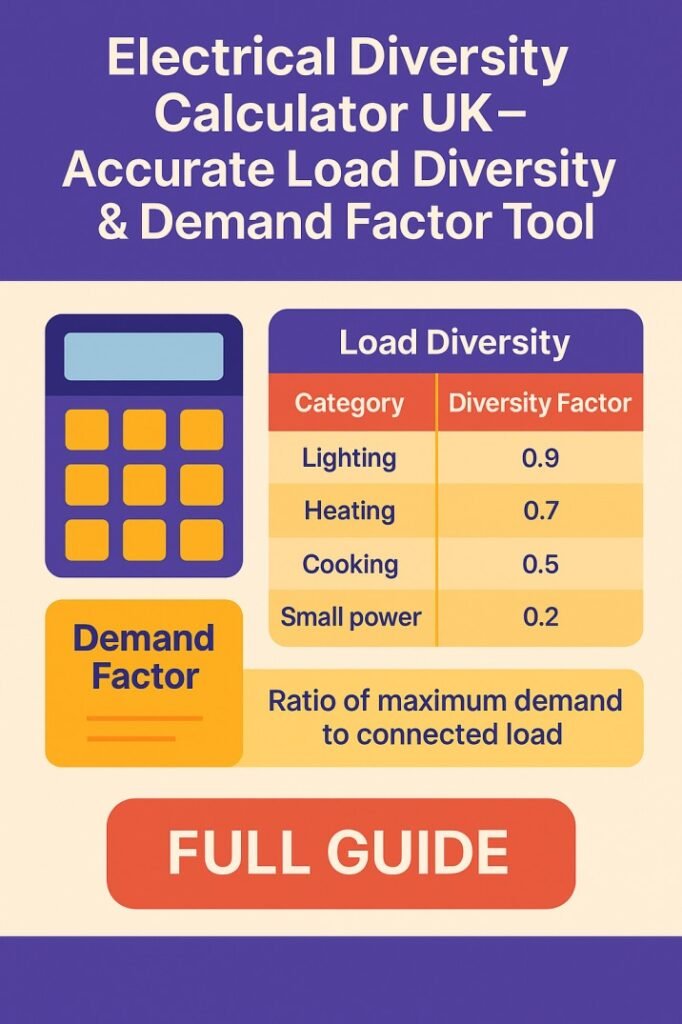
Table of Contents
In the UK, diversity calculations are commonly applied when designing distribution boards, feeders, and main supply systems in residential, commercial, and light industrial installations. Instead of sizing cables, switchgear, and transformers for the total connected load, diversity provides a more accurate estimate of simultaneous demand.
Accurate diversity calculations are important for several reasons. Oversizing electrical infrastructure increases installation costs, while undersizing can lead to overheating, voltage drop issues, and nuisance tripping. Using an electrical diversity calculator UK helps professionals quickly determine realistic load requirements during design, installation, or system assessment.
Access our powerful online calculator now Electrical Diversity Calculator for accurate Load Estimation and efficient electrical Design.
Electrical engineers, contractors, and consultants often rely on diversity calculations during load planning, panel design, building services engineering, and electrical compliance reviews.
Electrical Diversity Calculator UK
Use the electrical diversity calculator UK below to estimate the diversified load of an electrical installation.
Enter the connected load values and applicable diversity factors, then calculate the expected maximum demand.
Electrical Diversity Calculator (UK)
How to Use
1. Enter the total connected load of the system (sum of all equipment ratings).
2. Select the diversity factor based on installation type, or enter a custom value.
3. Confirm the inputs match your design assumptions.
4. Click “Calculate Maximum Demand” to determine the diversified load.
5. Use the result when sizing cables, switchgear, protective devices, or supply capacity.
This calculator follows UK electrical design practice for applying diversity to connected loads.
Find more Electrical Engineering Tools for easy electrical calculations and estimations.
How to Use Electrical Diversity Calculator UK (Step-by-Step)
- Enter the total connected load of the electrical system or circuit. This is the sum of all installed equipment ratings.
- Select or enter the diversity factor applicable to the type of installation. Different building types may have different diversity assumptions.
- Confirm the input values to ensure they match the electrical design or equipment ratings.
- Click the calculate button to determine the diversified load.
- Review the calculated maximum demand, which represents the expected simultaneous load after diversity is applied.
- Use the result when sizing cables, switchgear, protective devices, or supply capacity.
Know more about What is Demand Factor and Diversity Factor? Quick Concepts
How the Calculation Works
The electrical diversity calculator UK works by applying a diversity factor to the total connected load of an electrical installation.
Connected load represents the maximum possible demand if every electrical device operates at its full rated power simultaneously. In practice, this rarely occurs. Lighting, appliances, heating systems, and industrial equipment typically operate at different times or at varying loads.
The calculator applies a diversity assumption that reflects real operating conditions. By multiplying the connected load by the diversity factor, the tool estimates the maximum demand likely to occur during normal operation.
This diversified load becomes the practical design value used for:
- Main distribution boards
- Sub-distribution panels
- Feeder cable sizing
- Transformer capacity selection
- Generator and UPS sizing
The calculation helps ensure electrical systems are both safe and economically designed.
Know more about Coincidence Factor vs Diversity Factor: The Load Calculation Mistake Engineers Still Make
Practical Electrical Example
Consider a small commercial building with the following connected electrical loads:
- Lighting circuits: 20 kW
- HVAC equipment: 35 kW
- Office equipment and sockets: 25 kW
- Miscellaneous loads: 10 kW
The total connected load is:
90 kW
In many commercial installations, not all loads operate simultaneously at their maximum capacity. A diversity factor of 0.7 may be applied to estimate the realistic maximum demand.
Using the electrical diversity calculator UK:
Connected load input: 90 kW
Diversity factor: 0.7
The calculator determines the diversified demand as:
63 kW
This value can then be used to size the incoming feeder, main circuit breaker, and distribution system for the building. Designing for the full 90 kW load would result in unnecessarily large equipment and higher installation costs.
Explore everything about Load Calculation for Commercial Building: Pro Guide to Accurate Sizing & Cost-Smart Design
Key Factors That Affect the Result
Several technical factors influence the diversified electrical demand calculated using an electrical diversity calculator UK.
• Voltage level
System voltage affects current levels and conductor sizing. Higher voltages reduce current for the same power demand.
• Load type
Resistive loads such as heaters behave differently from inductive loads such as motors or compressors.
• Power factor
Low power factor increases current demand and may require additional capacity or correction equipment.
• Operational patterns
Some equipment operates intermittently or on duty cycles, which increases the level of diversity.
• Building occupancy
Residential buildings, offices, and industrial facilities have different load usage patterns.
Use our online tool EV Charger Load Calculation: A Comprehensive Guide
• Equipment efficiency
Higher efficiency equipment may reduce overall system demand.
• Future expansion allowance
Design engineers often include additional margin for future load growth.
Understanding these factors ensures the diversity calculation reflects realistic operating conditions.
Common Mistakes to Avoid
When using an electrical diversity calculator UK, incorrect assumptions or inputs can produce misleading results.
One common mistake is entering incorrect connected load values. If the installed equipment ratings are inaccurate, the calculated demand will also be incorrect.
Another issue occurs when an unrealistic diversity factor is used. Applying excessive diversity may lead to undersized feeders or circuit breakers, increasing the risk of overload.
Some users also overlook continuous loads such as servers, refrigeration systems, or industrial machinery. These loads may operate for long periods and should be carefully evaluated before applying diversity.
Use our online tool Electrical Panel Heat Load Calculation: Best Guide
Incorrect unit entry is another frequent problem. Mixing kilowatts, watts, or amperes without proper conversion can significantly distort results.
Accurate input data and realistic diversity assumptions are essential for reliable calculations and safe system design.
Why Use Electrical Diversity Calculator UK
The electrical diversity calculator UK provides practical benefits for electrical design and planning.
It improves calculation accuracy by quickly estimating realistic maximum demand for electrical installations.
It saves engineering time by eliminating manual calculations during early design stages or site evaluations.
It supports reliable equipment selection, helping engineers size cables, circuit breakers, and transformers based on practical load demand.
It also assists with cost optimization, preventing unnecessary oversizing of electrical infrastructure.
For contractors and consultants working on building services projects, using an electrical diversity calculator UK simplifies load planning and improves design efficiency.
Electrical Standards & Practical Considerations
Electrical diversity calculations in the UK are generally guided by national wiring regulations and electrical design practices. These standards provide recommended diversity assumptions for different types of loads, including lighting, socket outlets, cooking appliances, and heating equipment.
Following recognized international standards ensures electrical systems maintain safe operating conditions while avoiding excessive oversizing.
Use our online tool Lighting Load Calculation per Square Foot: Download Excel Sheet
Professional electrical designers also consider practical installation factors such as load growth, equipment duty cycles, and operational diversity within the building.
Proper application of diversity supports better system performance, improved energy efficiency, and reliable electrical infrastructure.
Frequently Asked Questions (FAQs)
What is electrical diversity in electrical installations?
Electrical diversity refers to the practice of reducing the total connected load when estimating the maximum demand of an installation. It accounts for the fact that not all electrical equipment operates simultaneously at full load.
Why is an electrical diversity calculator UK useful?
An electrical diversity calculator UK helps engineers and electricians quickly estimate realistic maximum demand. This supports accurate cable sizing, protective device selection, and overall electrical system design.
Does diversity reduce electrical safety margins?
No. When applied correctly using appropriate assumptions and standards, diversity improves design accuracy without compromising safety. Electrical systems must still be sized within regulatory guidelines.
Is diversity used in residential electrical design?
Yes. Diversity is commonly applied to residential installations, especially for socket circuits, cooking appliances, and lighting loads where simultaneous full operation is unlikely.
Can diversity be applied to all electrical loads?
Not always. Some loads such as emergency systems, life safety equipment, and continuous industrial processes may require full load consideration without applying diversity.
Follow Us on Social:
Subscribe our Newsletter on Electrical Insights for latest updates from Electrical Engineering Hub
#ElectricalDiversityCalculatorUK, #ElectricalLoadCalculation, #DemandFactor, #ElectricalEngineeringTools, #UKElectricalStandards, #ElectricalDesign, #PowerDistribution, #ElectricalCalculator, #ElectricianTools, #ElectricalEngineering