
Difference Power Strip and Surge Protector Explained for Safe Home and Office Use
Many people think a power strip and a surge protector are the same device. They look similar, sit on the floor behind desks, and allow multiple plugs in one place. But the difference power strip and surge protector devices offer is very important for safety, equipment lifespan, and electrical protection. Understanding this difference helps you protect valuable electronics like computers, TVs, routers, and appliances from unexpected damage.
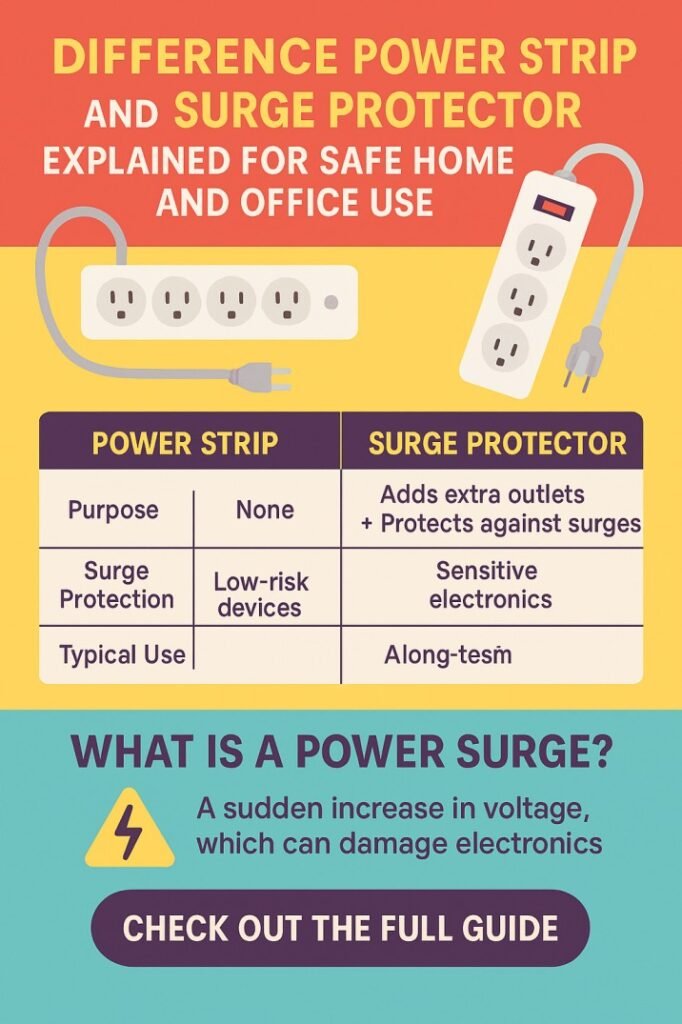
Table of Contents
A basic power strip simply expands the number of outlets available from a single wall socket. A surge protector, on the other hand, does that and also defends your devices against voltage spikes. That protection can save you from costly repairs and data loss. Let’s break down how each device works and why knowing the difference power strip and surge protector options matters for every home and workplace.
What Is a Power Strip
A power strip is an extension of a wall outlet. It provides multiple sockets and often includes a switch and sometimes a basic circuit breaker. Its main job is convenience, not protection.
Inside a standard power strip, wiring simply distributes electricity from the wall to several outlets. There is no advanced component designed to stop excess voltage. If a sudden spike travels through your wiring, the power strip passes it directly to your devices.
Power strips are useful for low-risk equipment such as lamps, phone chargers, fans, or small household gadgets. They are not designed to handle electrical surges caused by lightning, grid switching, or large appliances turning on and off.
Explore all about Best Surge Protection Extension Lead UK 2026 – Top-Rated Picks for Ultimate Device Safety
What Is a Surge Protector
A surge protector looks similar to a power strip but contains additional protective components. The most important part is usually a metal oxide varistor, often called an MOV. This component absorbs extra voltage and diverts it safely to the ground wire.
When a voltage spike occurs, the surge protector reacts in a fraction of a second. Instead of letting excess energy reach your electronics, it clamps the voltage to a safer level. This is the core difference power strip and surge protector devices offer.
Surge protectors are strongly recommended for sensitive electronics such as desktop computers, gaming consoles, televisions, networking equipment, and office machines. These devices contain microprocessors and delicate circuits that can be damaged by even small surges over time.
Difference Power Strip and Surge Protector at a Glance
The easiest way to understand the difference power strip and surge protector features is through a direct comparison.
| Feature | Power Strip | Surge Protector |
|---|---|---|
| Main Purpose | Adds extra outlets | Adds outlets and protects from voltage spikes |
| Surge Protection | No | Yes |
| Internal Components | Basic wiring and switch | MOVs, thermal fuses, sometimes filters |
| Best For | Low-risk devices | Electronics and sensitive equipment |
| Cost | Lower | Slightly higher |
| Protection Level Indicator | None | Often has a protection light |
This table shows that while both devices may look alike, their internal design and safety function are very different.
Find more about Best Surge Protection for Computers: Ultimate Guide to Safeguard Your PC from Power Spikes
How Electrical Surges Happen
To understand the difference power strip and surge protector roles, it helps to know where surges come from. Electrical surges are short bursts of excess voltage that travel through wiring.
Common causes include lightning strikes near power lines, power grid switching by utility companies, faulty wiring, and large appliances like refrigerators or air conditioners cycling on and off. Even small, repeated surges can slowly damage electronics by weakening internal components.
A power strip does nothing to stop this extra voltage. A surge protector reduces the impact, extending the life of connected devices.
Understanding Joule Rating
One key specification that highlights the difference power strip and surge protector performance is the joule rating. This number tells you how much energy the surge protector can absorb before it fails.
| Joule Rating | Level of Protection | Typical Use |
|---|---|---|
| 200–400 J | Basic | Small electronics, lamps |
| 600–1000 J | Moderate | TVs, game consoles |
| 1500+ J | High | Computers, office equipment |
A higher joule rating means better protection and longer life. Power strips do not have a joule rating because they do not provide surge absorption.
Know more about Best Surge Protector for Refrigerator – Stop Voltage Spikes Before They Destroy Your Fridge
Clamping Voltage Matters
Another factor in the difference power strip and surge protector comparison is clamping voltage. This is the voltage level at which the surge protector starts blocking excess energy.
Lower clamping voltage means better protection. Common values are 330V, 400V, or 500V. A device rated at 330V will begin protecting sooner than one rated at 500V. Again, a standard power strip has no clamping voltage because it does not limit surges.
Visual Clues to Identify Each Device
Sometimes it is hard to tell whether you have a power strip or a surge protector. Manufacturers often label surge protectors clearly, but not always.
Here are some signs to check:
| Sign | Power Strip | Surge Protector |
|---|---|---|
| Label says “Surge Protection” | No | Yes |
| Joule rating listed | No | Yes |
| Protection indicator light | Rare | Common |
| Heavier build | Light | Slightly heavier due to components |
If there is no mention of surge protection on the packaging or body, it is likely just a power strip.
Know more about Best Surge Protector Power Board Australia – Top Picks to Shield Your Devices from Costly Power Spikes
When to Use a Power Strip
Despite the limitations, power strips still have their place. They are fine for devices that are not sensitive or expensive.
Examples include table lamps, basic fans, phone chargers, and decorative lighting. In these cases, the difference power strip and surge protector protection may not justify the extra cost.
However, power strips should not be overloaded. Each strip has a maximum current rating, often 10A or 15A. Exceeding this can cause overheating and fire hazards.
When to Use a Surge Protector
Surge protectors are the safer choice for most electronics. Computers, monitors, routers, printers, and televisions all benefit from surge protection. These devices contain circuit boards that can fail instantly during a large spike.
The difference power strip and surge protector decision becomes critical in areas with unstable electricity or frequent storms. In such regions, surge protection is not a luxury but a necessity.
For even greater safety, surge protectors can be combined with an uninterruptible power supply. This adds battery backup along with surge defense.
Explore all about Best Surge Protector with USB-C Ports – Fast Charging & Total Device Protection in One Power Strip
Limitations of Surge Protectors
While surge protectors offer valuable protection, they are not permanent. Each surge they absorb reduces their remaining capacity. Over time, the MOV components wear out.
Many modern units include an indicator light that shows whether protection is still active. If that light turns off, the device may still supply power but no longer provides surge protection. This is another key point in the difference power strip and surge protector comparison.
Surge protectors also cannot stop very large events like a direct lightning strike. For whole-building safety, a main service panel surge protection device is recommended.
Safety Tips for Both Devices
Whether you use a power strip or a surge protector, safe usage is essential.
| Tip | Why It Matters |
|---|---|
| Avoid daisy chaining strips | Reduces overheating and fire risk |
| Do not exceed current rating | Prevents wire damage |
| Keep away from water | Reduces shock hazard |
| Replace damaged units | Cracked casing can expose wiring |
| Check indicator lights | Ensures protection is active |
Following these practices ensures both convenience and safety.
Know more about Best Surge Protector Made in USA – Top-Rated Reliable Power Safety for Your Devices
Final Thoughts on the Difference Power Strip and Surge Protector
The difference power strip and surge protector devices provide goes far beyond price and appearance. A power strip is simply an outlet extender, while a surge protector is a protective barrier between your electronics and harmful voltage spikes.
Choosing the right device depends on what you plan to connect. For basic household items, a power strip may be enough. For anything with sensitive electronics or high value, a surge protector is the smarter investment.
Understanding this difference helps prevent equipment damage, data loss, and unnecessary expenses. In today’s homes filled with digital devices, proper surge protection is an important part of electrical safety and long-term reliability.
Explore all about Best Surge Protector for Generator: Top Picks to Keep Your Power Safe & Appliances Protected
Follow Us on Social:
Subscribe our Newsletter on Electrical Insights for latest updates from Electrical Engineering Hub
#PowerStripVsSurgeProtector, #SurgeProtectionGuide, #ElectricalSafetyTips, #HomeElectricalBasics, #ProtectYourElectronics, #PowerStripSafety, #VoltageSpikeProtection, #ElectricalAwareness, #GadgetSafety, #HomeWiringTips
