Zero Sequence Current Transformers: Ultimate Guide to Ground Fault Detection & Safety
Zero sequence current transformers (ZSCTs) are critical devices in modern electrical systems, designed specifically for ground fault detection and protection. They play a vital role in ensuring the safety of electrical installations, preventing equipment damage, and protecting personnel from electric shocks. Understanding how these transformers work, their applications, and their benefits is essential for electrical engineers, safety professionals, and facility managers.
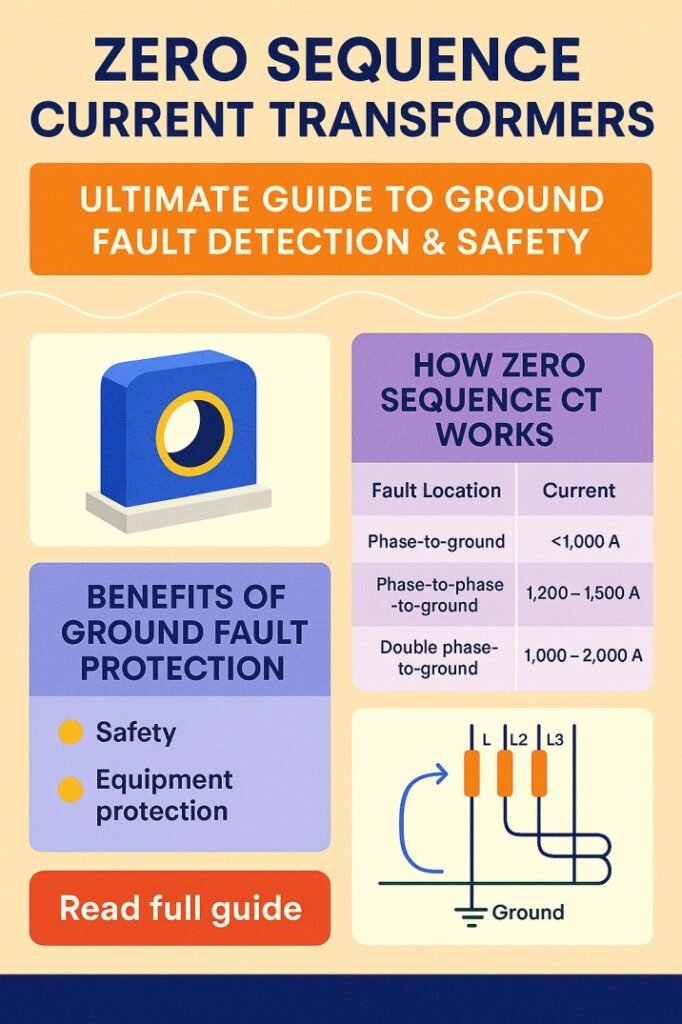
Table of Contents
Learn more about uk transformer manufacturers
What Are Zero Sequence Current Transformers?
A zero sequence current transformer is a type of current transformer that detects unbalanced currents in a three-phase system. Unlike conventional current transformers that measure phase currents individually, a ZSCT monitors the sum of all three phase currents. In an ideal balanced system, this sum equals zero. However, when a ground fault occurs, a small current flows through the ground, creating a zero sequence current. The ZSCT detects this current and sends a signal to protective relays to trigger alarms or circuit breakers.
Zero sequence current transformers are highly sensitive devices capable of detecting even minimal leakage currents, often as low as a few milliamps. This precision makes them indispensable in high-voltage substations, industrial plants, and commercial buildings.
How Zero Sequence Current Transformers Work
The operation of a ZSCT is based on the principle of summing vector currents. In a three-phase system, the currents in phases A, B, and C are represented as vectors. Under normal operating conditions, the sum of these three vectors is zero. When a fault occurs, such as insulation failure or accidental contact with the earth, the system becomes unbalanced, producing a net zero sequence current.
The ZSCT typically consists of a toroidal core through which all three phase conductors pass. The core is wound with a secondary coil connected to a ground fault relay. When zero sequence current flows, it induces a current in the secondary winding, which activates protective devices.
Key factors affecting the performance of a ZSCT include core material, turns ratio, burden, and accuracy class. Choosing the right transformer ensures reliable detection and prevents nuisance tripping.
Uncover insights on motor generator transformer manufacturers
Applications of Zero Sequence Current Transformers
Zero sequence current transformers are used in various applications across electrical networks. Some of the most common applications include:
- Ground Fault Protection: Detects earth leakage in power distribution systems to prevent equipment damage and electrical hazards.
- Substation Monitoring: Monitors high-voltage lines for insulation failures or fault currents.
- Industrial Plants: Protects sensitive equipment from damage due to insulation breakdown.
- Commercial Buildings: Ensures safety in office complexes, hospitals, and shopping malls by detecting leakage currents.
- Renewable Energy Systems: Used in solar and wind installations to monitor faults and prevent downtime.
These transformers are often integrated with residual current devices (RCDs) or ground fault relays to provide comprehensive protection. Know more about How Does Earth Fault Relay Protect Electrical Circuits? Complete Guide to Ground Fault Protection
Types of Zero Sequence Current Transformers
Zero sequence current transformers are available in different types to suit specific applications:
- Toroidal ZSCT: The most common type, designed for primary conductors to pass through a circular core.
- Bar-Type ZSCT: Incorporates a primary bar instead of conductors passing through the core, suitable for high-current systems.
- Wound-Type ZSCT: Has a dedicated primary winding, used in systems requiring high accuracy.
- Clamp-On ZSCT: Portable devices for testing and temporary monitoring without disconnecting the system.
Each type has its advantages and limitations. For example, toroidal ZSCTs are compact and easy to install, while bar-type ZSCTs handle very high currents effectively.
Learn more about best power transformer manufacturer in south africa
Benefits of Zero Sequence Current Transformers
Implementing zero sequence current transformers in electrical systems provides numerous advantages:
- Enhanced Safety: Detects leakage currents early, preventing electric shocks and fire hazards.
- Equipment Protection: Minimizes damage to transformers, motors, and generators by triggering timely shutdowns.
- System Reliability: Reduces downtime by quickly isolating faulty sections.
- Regulatory Compliance: Helps meet safety standards and electrical codes.
- Cost-Effective Maintenance: Identifies faults before they escalate, lowering repair and replacement costs.
These benefits make ZSCTs essential for both low-voltage and high-voltage systems.
Key Specifications to Consider
When selecting a zero sequence current transformer, several specifications must be considered:
| Specification | Description |
|---|---|
| Rated Primary Current | Maximum current the transformer can handle without saturation |
| Rated Secondary Current | Standard output current, usually 5A or 1A for relays |
| Accuracy Class | Defines measurement precision (e.g., 0.2, 0.5, 1.0) |
| Burden | Maximum load in VA that can be connected to the secondary |
| Insulation Level | Determines suitability for high-voltage applications |
| Frequency Range | Ensures compatibility with the system frequency (50/60 Hz) |
Selecting the appropriate specifications ensures reliable operation and avoids nuisance trips.
Explore details on largest transformer manufacturer in usa
Installation Guidelines
Proper installation of zero sequence current transformers is crucial for accurate detection and safety:
- Placement: ZSCTs should encircle all phase conductors of the circuit to be protected. Partial encirclement can lead to incorrect readings.
- Orientation: Ensure the correct polarity of the secondary connections to avoid relay malfunction.
- Grounding: Proper grounding of the secondary circuit is essential to prevent circulating currents.
- Environment: Avoid installation near strong magnetic fields or high-temperature areas that can affect accuracy.
- Routine Testing: Periodic testing of ZSCTs ensures functionality and early detection of potential failures.
Following these guidelines reduces false tripping and extends the life of protective devices.
Know more about IEC Standard for Ground Fault Protection Explained: Compliance, Requirements & Best Practices
Zero Sequence Current Transformer vs. Conventional CT
Understanding the difference between ZSCTs and conventional current transformers helps in system design:
| Feature | Conventional CT | Zero Sequence CT |
|---|---|---|
| Measurement | Measures individual phase current | Measures sum of three-phase currents |
| Fault Detection | Detects overcurrent or phase fault | Detects ground/earth faults |
| Installation | Installed on each phase separately | Encircles all three phases together |
| Sensitivity | Less sensitive to small leakage currents | Highly sensitive to minimal earth leakage |
| Application | General current monitoring | Ground fault protection and system safety |
ZSCTs complement conventional CTs in protecting electrical networks comprehensively. Know more about Benshaw Soft Starter Problems
Common Issues and Troubleshooting
Despite their robustness, zero sequence current transformers can face operational issues:
- False Tripping: Often caused by incorrect burden, improper grounding, or magnetic interference.
- Core Saturation: Occurs if primary current exceeds the rated capacity, leading to inaccurate readings.
- Loose Connections: Can cause intermittent operation or failure to detect faults.
- Environmental Effects: Moisture, dust, or high temperature can degrade performance.
Regular inspection, testing, and maintenance help mitigate these issues and ensure reliable ground fault protection.
Future Trends in Zero Sequence Current Transformers
With the growing complexity of electrical networks, ZSCT technology continues to evolve:
- Digital Integration: Smart ZSCTs with digital outputs enable real-time monitoring and remote fault detection.
- Higher Accuracy: Advanced core materials and designs improve sensitivity to very low leakage currents.
- Compact Designs: Miniaturized ZSCTs are now suitable for crowded switchgear panels.
- Renewable Energy Compatibility: Enhanced models support hybrid systems, including solar and wind installations.
Know more about NEC Grounding Table 250.122 Explained: Correct Equipment Grounding Conductor Size
These innovations enhance safety, reliability, and ease of maintenance for modern power systems.
Conclusion
Zero sequence current transformers are indispensable in today’s electrical infrastructure. They provide precise ground fault detection, protect equipment, enhance system reliability, and safeguard human life. By understanding their operation, types, applications, and installation practices, engineers can design safer and more efficient electrical systems.
Choosing the right ZSCT with appropriate specifications ensures optimal performance and compliance with safety standards. As electrical systems become more complex, investing in quality zero sequence current transformers remains a practical and essential decision for every facility manager and electrical professional.
Know more about Residual vs Zero Sequence Ground Fault Protection; Important Differences which every Engineer Must Know
Follow Us on Social:
Subscribe our Newsletter on Electrical Insights for latest updates from Electrical Engineering Hub
#ZeroSequenceCurrentTransformer, #ZCT, #ElectricalEngineering, #PowerSystems, #GroundFaultProtection, #CurrentTransformer, #IndustrialAutomation, #ElectricalSafety, #ProtectiveRelays, #EnergyManagement