
Transformer Breaker Sizing Calculator — Accurate Selection for Optimal Electrical Safety
Introduction
Selecting the correct breaker for a transformer is a critical task in electrical design and installation. The Transformer Breaker Sizing Calculator helps engineers, electricians, and contractors determine the optimal breaker rating for a given transformer, ensuring safe operation and compliance with industry standards. Accurate sizing prevents nuisance tripping, overloads, and potential damage to both the transformer and connected equipment.
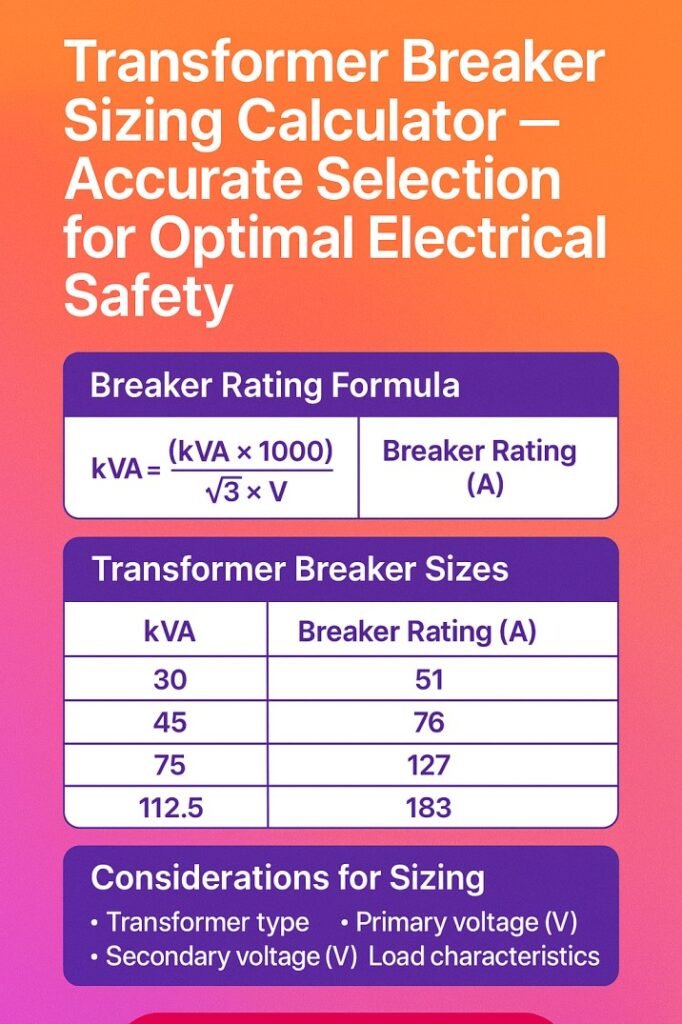
Table of Contents
Transformers are used in commercial, industrial, and utility systems to step voltage up or down. Incorrect breaker selection can lead to electrical faults, downtime, or costly maintenance. This calculator streamlines the process by taking essential transformer parameters and providing precise breaker ratings, saving time while maintaining technical reliability.
Know all about Transformer Sizing for EV Charger
Transformer Breaker Sizing Calculator
Enter the transformer specifications such as voltage, power rating, and load type, then click calculate to obtain the recommended breaker size. Ensure all values reflect your actual electrical system for accurate results.
Transformer Breaker Sizing Calculator
How to Use
1. Enter transformer kVA rating.
2. Provide the voltage for the side you are calculating (primary or secondary).
3. Select the side (HV or LV) and system phase.
4. Adjust safety factor if required (default 125%).
5. Click “Calculate Breaker Size” to get full-load current and recommended breaker rating.
This tool ensures accurate breaker sizing for transformer protection, helping engineers comply with standard practices.
Find more Electrical Engineering Tools for easy electrical calculations and estimations.
How to Use Transformer Breaker Sizing Calculator (Step-by-Step)
- Identify the transformer’s rated voltage and power capacity. This information is usually on the transformer nameplate.
- Determine the type of load connected to the transformer, such as resistive, inductive, or mixed loads.
- Enter the transformer’s efficiency and power factor if known. Default values can be used for general estimation.
- Input any environmental or operational adjustments, including ambient temperature or derating factors.
- Press the calculate button. The calculator will generate a recommended breaker size suitable for the transformer and load. Find more Transformer calculators here.
Following these steps ensures that the breaker selected aligns with the transformer’s operational requirements and safety standards.
How the Calculation Works
The calculator considers the transformer’s rated current, which is derived from its voltage and power rating. It applies safety margins to accommodate short-term overloads and adjusts for power factor and efficiency. Environmental factors, such as elevated temperature, can affect the current-carrying capacity of the breaker, so the calculator incorporates derating logic. The output represents a breaker rating that protects both the transformer and the downstream electrical network, preventing overcurrent conditions while avoiding unnecessary trips.
Find all about Transformer Disconnect Sizing
Practical Electrical Example
Suppose you have a 100 kVA, 400V transformer supplying an industrial panel with a mixed load.
- Given values: Transformer rating: 100 kVA, Voltage: 400 V, Load: 0.9 power factor, Efficiency: 98%
- Input selection: Enter the voltage, kVA rating, power factor, and efficiency into the calculator.
- Result interpretation: The calculator recommends a breaker size of approximately 160 A. This breaker will handle the normal operating current while providing adequate protection for short-term surges and potential overloads.
This practical example illustrates how the calculator simplifies transformer protection design in real-world scenarios.
Use our online tool for free Transformer Neutral Current Calculator – Accurate Neutral Current Estimation
Key Factors That Affect the Result
- Voltage level: Higher voltages reduce the current for the same power, impacting breaker size.
- Load type: Inductive or motor-heavy loads may require higher protection due to inrush currents.
- Power factor: Low power factor increases current and affects breaker selection.
- Efficiency: Transformer losses slightly increase current, influencing sizing.
- Environmental conditions: Elevated ambient temperature or poor ventilation requires derating the breaker.
- Operational considerations: Frequent switching or short-term overloads may require a higher rating to prevent nuisance trips.
Common Mistakes to Avoid
- Using incorrect transformer voltage: Leads to undersized or oversized breakers.
- Ignoring power factor or load type: Can result in nuisance tripping or insufficient protection.
- Skipping environmental adjustments: High ambient temperatures may reduce breaker capacity.
- Overreliance on nameplate ratings: Nameplate values may not account for actual load conditions.
- Entering partial or rounded data: Small inaccuracies in input can significantly affect breaker selection.
Accurate input data is critical for electrical safety, equipment reliability, and compliance with operational standards.
Test our online tool for free Transformer Full Load Current Calculator – Accurate Load & Current Calculation Tool for Transformers
Why Use Transformer Breaker Sizing Calculator
- Ensures accurate breaker selection to prevent overcurrent issues
- Reduces manual calculation errors and saves engineering time
- Supports reliable decision-making for design and installation teams
- Provides consistent results aligned with practical electrical requirements
By relying on precise calculations, the tool improves both safety and efficiency in transformer protection design.
Electrical Standards & Practical Considerations
Breaker selection must align with general electrical standards to ensure safety and system reliability. Following recommended sizing guidelines reduces risk of fire, equipment damage, or system downtime. Proper coordination between transformer and protection devices ensures smooth operation under normal and fault conditions. Considering derating, load characteristics, and environmental factors maintains compliance and enhances system performance.
Start using our online tool today — it’s free Transformer Short Circuit Calculator – Accurate Fault Current & Transformer Protection Tool
Frequently Asked Questions (FAQs)
1. Can this calculator be used for all transformer types?
Yes, it works for dry-type and oil-immersed transformers, as long as accurate input values are provided.
2. What if I don’t know the load power factor?
The calculator can use a default value for general estimation, but measuring the actual power factor gives more precise results.
3. Does temperature affect the breaker size?
Yes, high ambient temperatures reduce current-carrying capacity, and the calculator adjusts the recommendation accordingly.
4. Can I rely solely on this calculator for electrical design?
It provides accurate guidance, but breaker selection should always be verified against local electrical codes and standards.
5. How often should I recalculate breaker size?
Whenever there is a change in load, voltage, or environmental conditions, recalculating ensures continued safe operation.
Follow Us on Social:
Subscribe our Newsletter on Electrical Insights for latest updates from Electrical Engineering Hub
#TransformerBreakerSizingCalculator, #ElectricalEngineeringTools, #PowerSafety, #CircuitProtection, #TransformerSizing, #BreakerSelection, #ElectricalDesign, #IndustrialElectrical, #EnergyEfficiency, #ElectricalCalculations