Medium Voltage Switchgear Standards: Important IEC & IEEE Compliance Guide for Electrical Engineers
Medium voltage switchgear standards play a critical role in ensuring the safety, reliability, and performance of electrical power distribution systems. In industrial plants, commercial facilities, and utility substations, medium voltage switchgear acts as the primary control and protection equipment for networks typically operating between 1 kV and 36 kV. Because these systems handle significant electrical power, strict compliance with internationally recognized standards is necessary.
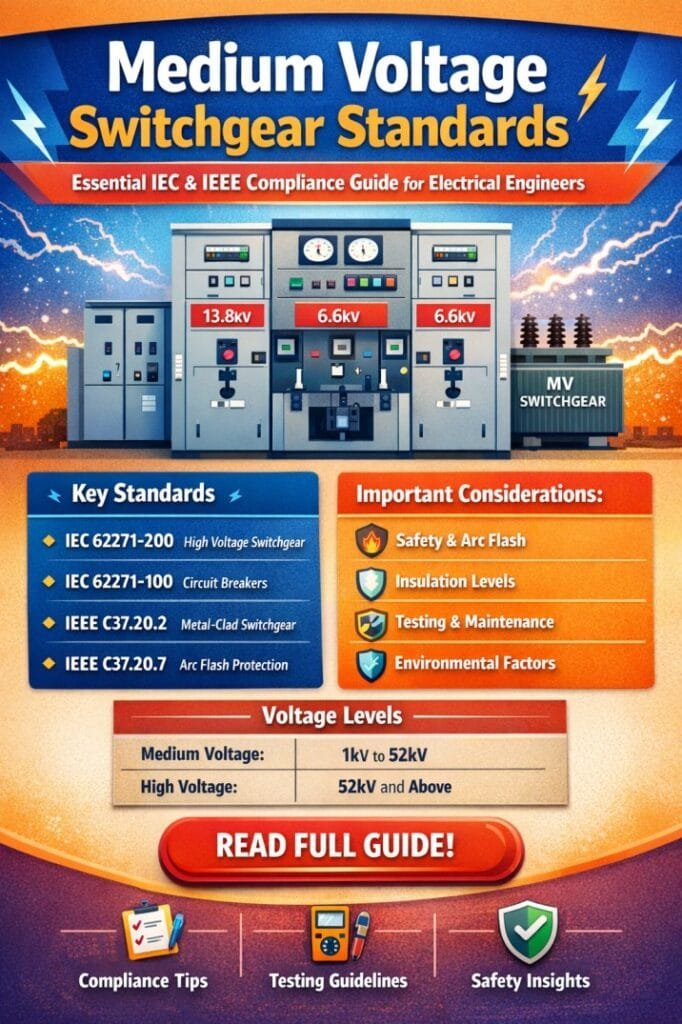
Table of Contents
Electrical engineers, designers, and maintenance professionals rely on medium voltage switchgear standards to guarantee equipment safety, interoperability, and operational reliability. These standards define testing procedures, design requirements, insulation coordination, short-circuit performance, and protection features.
This guide explains the most important IEC and IEEE standards governing medium voltage switchgear and provides practical insights for engineers involved in specification, design, procurement, and installation.
Know more about GIS vs AIS Switchgear: Best Key Differences Every Electrical Engineer Must Know
Understanding Medium Voltage Switchgear
Medium voltage switchgear refers to assemblies of switching and interrupting devices used to control, protect, and isolate electrical equipment in medium voltage power systems. These assemblies typically include circuit breakers, disconnect switches, busbars, protection relays, instrument transformers, and protective enclosures.
The purpose of medium voltage switchgear is to:
- Protect electrical equipment from faults
- Control power distribution in industrial networks
- Ensure safe isolation during maintenance
- Maintain system reliability and stability
Common applications include industrial plants, power generation facilities, data centers, mining operations, and electrical substations.
Typical voltage classifications for medium voltage systems are shown in the table below.
| Voltage Level | System Classification | Common Applications |
|---|---|---|
| 1 kV – 5 kV | Low Medium Voltage | Industrial motors and distribution |
| 5 kV – 15 kV | Standard Medium Voltage | Manufacturing plants and utilities |
| 15 kV – 36 kV | High Medium Voltage | Substations and large industrial facilities |
Compliance with medium voltage switchgear standards ensures these systems operate safely under normal and fault conditions.
Find more about Low Voltage Switchgear vs Medium Voltage Switchgear: Important Differences Every Engineer Must Know
Why Medium Voltage Switchgear Standards Are Important
Medium voltage equipment operates under high electrical stress. Fault currents can reach tens of kiloamps, and arc faults can cause severe equipment damage and safety hazards. Medium voltage switchgear standards provide a structured framework that ensures equipment can withstand these conditions.
The key benefits of following recognized standards include:
- Improved electrical safety for personnel
- Reliable fault interruption capability
- Standardized testing procedures
- Interoperability between equipment manufacturers
- Compliance with international engineering practices
- Long service life of electrical equipment
Engineers specifying electrical switchgear must ensure the selected equipment meets the required IEC or IEEE standards depending on project location and client requirements.
Major IEC Medium Voltage Switchgear Standards
The International Electrotechnical Commission (IEC) develops globally recognized standards for electrical equipment. Many countries adopt IEC-based standards for power distribution systems.
The IEC 62271 series is the primary framework governing medium voltage switchgear standards.
Find all about Top 15 Medium Voltage Switchgear Manufacturers in UAE: Ultimate Guide for Engineers & Buyers
Key IEC Standards for Medium Voltage Switchgear
| Standard | Description | Application |
|---|---|---|
| IEC 62271-1 | Common specifications for high-voltage switchgear | General design and testing |
| IEC 62271-100 | High-voltage AC circuit breakers | Circuit breaker performance |
| IEC 62271-200 | Metal-enclosed switchgear assemblies | MV switchgear design |
| IEC 62271-102 | High-voltage disconnectors and earthing switches | Isolation devices |
| IEC 62271-37 | Alternating current generator circuit breakers | Generator protection |
IEC 62271-200 is particularly important because it defines requirements for metal-enclosed medium voltage switchgear used in industrial and utility power systems.
IEC Switchgear Classification
IEC standards classify switchgears according to internal arc protection, accessibility, and compartment design.
| Classification | Meaning |
|---|---|
| LSC1 | Limited service continuity |
| LSC2A | Improved service continuity |
| LSC2B | Highest service continuity |
| PM | Partitioned with metal barriers |
| PI | Partitioned with insulating barriers |
This classification helps engineers select switchgear that meets operational reliability and safety requirements. Know more about Top 15 Electrical Switchgear Companies in UAE | Leading Power Distribution & MV/LV Manufacturers
IEEE Medium Voltage Switchgear Standards
In North America and several international projects, the Institute of Electrical and Electronics Engineers (IEEE) standards are widely used.
IEEE standards focus on performance testing, safety requirements, and operational reliability of medium voltage switchgear systems.
Important IEEE Standards
| Standard | Description | Voltage Range |
|---|---|---|
| IEEE C37.20.2 | Metal-clad switchgear | 5 kV – 38 kV |
| IEEE C37.20.3 | Metal-enclosed switchgear | Up to 38 kV |
| IEEE C37.04 | AC circuit breaker ratings | MV breaker ratings |
| IEEE C37.09 | Standard test procedures | Breaker testing |
| IEEE C37.06 | Preferred breaker ratings | Interrupting capacities |
IEEE C37.20.2 is one of the most commonly referenced medium voltage switchgear standards for metal-clad switchgear installations in utility and industrial power systems.
Key Design Requirements Defined in Medium Voltage Switchgear Standards
Medium voltage switchgear standards define detailed design requirements to ensure reliable performance during both normal operation and fault conditions.
Know more about Top 15 Electrical Switchgear Companies in UAE
Important design aspects include insulation levels, short-circuit withstand capability, temperature limits, mechanical endurance, and arc fault containment.
Basic Technical Requirements
| Parameter | Typical Requirement |
|---|---|
| Rated Voltage | Up to 36 kV (IEC) |
| Rated Current | 630 A – 4000 A |
| Short Circuit Current | Up to 63 kA |
| Power Frequency Withstand Voltage | Defined by insulation level |
| Impulse Withstand Voltage | Lightning impulse rating |
Switchgear assemblies must pass several type tests before they can be certified according to medium voltage switchgear standards.
Type Testing Requirements
Type testing verifies that switchgear assemblies meet the electrical, mechanical, and thermal requirements defined in international standards.
Common tests include dielectric tests, temperature rise tests, short-circuit tests, and mechanical endurance tests.
| Test Type | Purpose |
|---|---|
| Dielectric Test | Verify insulation strength |
| Temperature Rise Test | Ensure safe thermal performance |
| Short Circuit Test | Confirm fault current capability |
| Mechanical Operation Test | Validate switching endurance |
| Internal Arc Test | Evaluate arc fault containment |
Internal arc classification has become increasingly important because it protects personnel from dangerous arc flash incidents.
Find all about Top 15 Medium Voltage Switchgear Manufacturers in UAE
Internal Arc Classification in Modern Switchgear
Modern medium voltage switchgear standards emphasize internal arc protection to improve operator safety. Internal arc faults occur when insulation failure or equipment malfunction causes an electrical arc inside the switchgear enclosure.
IEC standards classify arc protection according to the following parameters:
| Parameter | Description |
|---|---|
| Accessibility Type | Front, side, or rear access |
| Test Duration | Arc fault duration in seconds |
| Fault Current | Maximum arc current level |
Switchgear that meets internal arc classification significantly reduces risk to maintenance personnel.
Differences Between IEC and IEEE Switchgear Standards
Although both IEC and IEEE frameworks regulate medium voltage switchgear, there are several technical and design differences.
| Feature | IEC Standards | IEEE Standards |
|---|---|---|
| Global Usage | Widely used worldwide | Common in North America |
| Switchgear Design | Compact and modular | Larger compartment design |
| Testing Philosophy | Performance-based | Prescriptive requirements |
| Voltage Classification | Up to 52 kV systems | Up to 38 kV systems |
Engineers working on international projects often need to understand both sets of medium voltage switchgear standards to ensure compliance with client specifications.
Know more about Top 12 Switchgear Training Courses in USA
Best Practices for Engineers When Selecting Switchgear
Selecting compliant switchgear requires careful evaluation of system parameters and project requirements.
Important factors include system voltage, fault current levels, environmental conditions, maintenance requirements, and future expansion capability.
Practical selection guidelines include:
- Verify compliance with IEC 62271 or IEEE C37 series standards
- Confirm short-circuit ratings exceed calculated fault levels
- Ensure adequate internal arc classification
- Check busbar current rating and temperature rise limits
- Evaluate accessibility and maintenance safety
- Consider insulation coordination with system voltage
Using equipment that follows established medium voltage switchgear standards helps engineers design reliable and safe electrical distribution systems.
Use our online tool for free Sub Panel Breaker Size Calculator – Find the Right Breaker for Your Electrical Sub Panel
Conclusion
Medium voltage switchgear standards provide the foundation for safe and reliable power distribution in modern electrical networks. By defining clear requirements for design, testing, and performance, these standards help engineers select equipment that can safely handle high fault currents and demanding operating conditions.
IEC and IEEE frameworks remain the most widely used references for medium voltage switchgear across the global power industry. Understanding these standards enables electrical engineers to design compliant systems, improve operational reliability, and enhance workplace safety.
For engineers involved in electrical design, procurement, or maintenance, a strong understanding of medium voltage switchgear standards is essential for ensuring long-term system performance and regulatory compliance. Use our online tool for free Wire Size Calculator for Subpanels and Feeders – NEC Guidelines Included
Follow Us on Social:
Subscribe our Newsletter on Electrical Insights for latest updates from Electrical Engineering Hub
MediumVoltageSwitchgear, #SwitchgearStandards, #ElectricalEngineering, #PowerDistribution, #IECStandards, #IEEEStandards, #MVSwitchgear, #ElectricalSafety, #SubstationEngineering, #PowerSystemDesign