
LiquidTight Flexible Nonmetallic Conduit Fill Chart – Profitable, Smart & Proven Guide (7 Insights)
Electrical installations fail most often due to small planning mistakes. Conduit fill is one of them. When conduit is overfilled, heat builds up, wire insulation degrades, and inspections fail. That is why every electrician, contractor, and site engineer relies on a LiquidTight Flexible Nonmetallic Conduit Fill Chart to make safe and profitable decisions. This guide explains the chart in simple terms, shows how to use it correctly, and highlights seven practical insights that improve safety, compliance, and project margins.
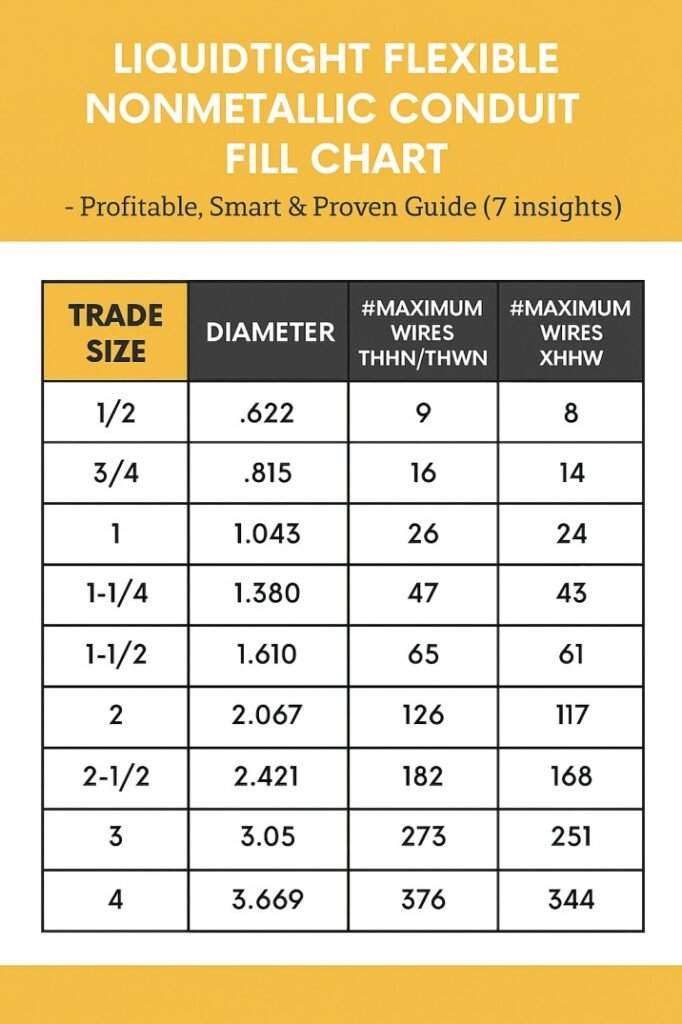
Table of Contents
Liquidtight flexible nonmetallic conduit is widely used in wet, corrosive, and vibration-prone locations. It protects conductors while remaining flexible. However, flexibility does not mean unlimited space. Using a LiquidTight Flexible Nonmetallic Conduit Fill Chart ensures the conduit is sized correctly for conductor count and type from the first day of design.
What liquidtight flexible nonmetallic conduit really is
Liquidtight flexible nonmetallic conduit, often called LFNC, is a plastic-based conduit with a smooth or corrugated exterior. It resists moisture, oils, sunlight, and mild chemicals. Electricians prefer it for HVAC units, outdoor equipment, pumps, and industrial machinery.
Unlike rigid PVC or EMT, LFNC bends easily. That saves labor time. But its internal diameter is smaller than many installers expect. This is where the LiquidTight Flexible Nonmetallic Conduit Fill Chart becomes essential. Without it, wire pulling becomes difficult and overheating risks increase.
Why conduit fill rules matter for safety and money
Conduit fill rules are not just code theory. They directly affect safety and long-term costs. Overfilled conduit traps heat. Heat shortens conductor life. It also increases voltage drop and nuisance tripping.
Use our online tool Conduit Fill Calculator CAT6: A Simple Guide for Safe Cable Installation
From a business point of view, code violations delay inspections. Delays mean extra labor and lost revenue. Following a LiquidTight Flexible Nonmetallic Conduit Fill Chart helps avoid rework and keeps projects profitable. It also protects your reputation with inspectors and clients.
NEC guidelines behind conduit fill charts
Most conduit fill charts are based on National Electrical Code rules. The NEC limits how much of a conduit’s internal area can be occupied by conductors.
The general rules are simple.
- For one conductor, the maximum fill is 53 percent.
- For two conductors, the maximum fill is 31 percent.
- For three or more conductors, the maximum fill is 40 percent.
A LiquidTight Flexible Nonmetallic Conduit Fill Chart converts these percentages into usable numbers. Instead of calculating cross-sectional areas, you read the chart and select the correct conduit size.
How to read a liquidtight conduit fill chart correctly
Many mistakes happen because charts are misread. A proper LiquidTight Flexible Nonmetallic Conduit Fill Chart lists conduit trade size on one side and conductor sizes across the top.
You must first identify the conductor type. THHN, THWN, and XHHW all have different diameters. Then match the wire gauge. Finally, check how many conductors fit within the allowed fill. Use our online tool for free Conduit Fill Calculator for Fire Alarm Cable: Best Tool for Engineers
Never mix conductor types unless the chart specifically allows it. Charts assume uniform wire insulation. Mixing can lead to incorrect sizing and inspection failure.
LiquidTight Flexible Nonmetallic Conduit Fill Chart reference table
The table below gives a practical reference for common installations. Always verify with manufacturer data and local code requirements.
| Conduit Trade Size | Max 14 AWG Conductors | Max 12 AWG Conductors | Max 10 AWG Conductors |
|---|---|---|---|
| 1/2 inch | 9 | 6 | 4 |
| 3/4 inch | 16 | 11 | 7 |
| 1 inch | 26 | 18 | 11 |
| 1-1/4 inch | 45 | 31 | 19 |
Using a LiquidTight Flexible Nonmetallic Conduit Fill Chart like this saves time during estimating and installation. It also reduces wire damage during pulling.
Seven proven insights electricians use on real jobs
Insight one: Always size up for long runs
Long conduit runs increase friction. Even if the chart allows a certain fill, choosing the next larger conduit size reduces pulling tension. Professionals still refer to the LiquidTight Flexible Nonmetallic Conduit Fill Chart, but they treat it as a minimum, not a target. Explore our professional online tool for quick calculations Conduit Fill Calculator for Fiber Optic Cable: Important Tool
Insight two: Heat matters more in flexible conduit
Flexible conduit traps more heat than rigid types. Installations near motors or compressors are especially sensitive. Staying comfortably below chart limits improves thermal performance and system reliability.
Insight three: Equipment whips need special attention
LFNC is commonly used for equipment whips. These short sections often carry multiple conductors. Installers sometimes guess sizes. Using a LiquidTight Flexible Nonmetallic Conduit Fill Chart avoids cramped whips and failed inspections.
Insight four: Manufacturer differences are real
Not all liquidtight conduit has the same internal diameter. Two brands with the same trade size can differ slightly. Always cross-check the chart with manufacturer specifications before final approval. Experience fast and accurate results using our online tool Conduit Fill Calculator for Multiple Wire Sizes: Best Tool
Insight five: Charts speed up bidding and estimating
Accurate conduit sizing improves cost estimates. Oversizing wastes material. Undersizing causes rework. Contractors who rely on a LiquidTight Flexible Nonmetallic Conduit Fill Chart produce tighter bids and better margins.
Insight six: Inspectors trust documented sizing
When inspectors ask why a certain conduit size was used, referencing the correct chart builds confidence. It shows professionalism and code awareness. That can speed up approvals and reduce site friction.
Insight seven: Proper fill improves wire lifespan
Conductors pulled through correctly sized conduit suffer less abrasion. Insulation lasts longer. Maintenance costs drop. The long-term benefit of using a LiquidTight Flexible Nonmetallic Conduit Fill Chart often outweighs the small upfront cost of larger conduit.
Common mistakes to avoid
Many installers assume flexible conduit can carry more because it bends. That is incorrect. Others ignore conductor insulation thickness. Some forget bonding and grounding conductors when counting total wires. Try our free online tool today Conduit Fill Calculator Canada: Accurate Electrical Planning Tool
Another mistake is copying charts meant for EMT or rigid PVC. Those charts do not apply here. Always use a LiquidTight Flexible Nonmetallic Conduit Fill Chart designed specifically for LFNC.
Practical applications across industries
In residential work, LFNC is common for outdoor air conditioners and heat pumps. Correct fill prevents nuisance breaker trips. In commercial settings, it protects wiring in kitchens and washdown areas. Industrial plants rely on it for vibration resistance near machinery.
In all cases, the LiquidTight Flexible Nonmetallic Conduit Fill Chart plays the same role. It balances flexibility, safety, and compliance.
Final thoughts on smarter conduit planning
Electrical work rewards accuracy. Guesswork leads to callbacks and lost profit. Smart professionals treat conduit fill as a design decision, not an afterthought. By using a LiquidTight Flexible Nonmetallic Conduit Fill Chart from the planning stage, projects run smoother and systems last longer.
Access our powerful online calculator now Conduit Fill Calculator (NEC Standard): Best Tool
This guide showed how charts work, why they matter, and how experienced electricians apply them in real conditions. When safety, compliance, and profitability matter, proper conduit fill is not optional. It is proven, practical, and essential.
Follow Us on Social:
Subscribe our Newsletter on Electrical Insights for latest updates from Electrical Engineering Hub
#LiquidTightConduitFillChart, #LiquidTightFlexibleConduit, #NonmetallicConduit, #ElectricalConduitGuide, #ConduitFillCalculator, #ElectricalInstallationTips, #NECConduitFill, #ElectricalSafetyStandards, #ElectricalContractor, #WiringSolutions