IEEE Standard for Insulation Resistance Test – Complete Guide for Accurate Electrical Testing & Compliance
The ieee standard for insulation resistance test plays a critical role in ensuring the safety, reliability, and long-term performance of electrical systems. Whether you are working with industrial equipment, power cables, transformers, or low-voltage installations, insulation resistance testing is one of the most fundamental diagnostic tools.
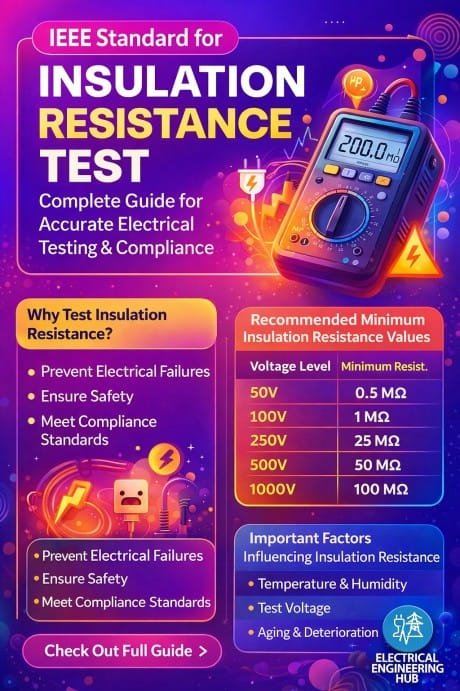
Table of Contents
Electrical insulation naturally degrades over time due to heat, moisture, contamination, and aging. Without proper testing, this degradation can lead to equipment failure, short circuits, or even catastrophic accidents. This is where the ieee standard for insulation resistance test provides a structured, reliable framework for accurate measurement and compliance.
Know more about HT Motor Tan Delta Testing – Best Guide for High Voltage Motor Insulation Diagnostic & Preventive Maintenance
Understanding Insulation Resistance Testing
Insulation resistance testing measures how well electrical insulation resists the flow of current. It is typically performed using a megohmmeter (Megger), which applies a DC voltage and measures leakage current.
A high resistance value indicates healthy insulation, while a low value suggests deterioration or contamination.
Key Objectives
- Detect insulation degradation early
- Prevent unexpected equipment failures
- Ensure personnel safety
- Maintain compliance with electrical standards
The ieee standard for insulation resistance test ensures that testing procedures are consistent, repeatable, and aligned with industry best practices.
Relevant IEEE Standards for Insulation Testing
Several IEEE standards guide insulation resistance testing depending on equipment type and application.
Commonly Referenced Standards
| IEEE Standard | Description |
|---|---|
| IEEE 43 | Recommended Practice for Testing Insulation Resistance of Rotating Machinery |
| IEEE 400 | Guide for Field Testing and Evaluation of Insulation of Shielded Power Cable Systems |
| IEEE 62 | Guide for Diagnostic Field Testing of Electric Power Apparatus |
| IEEE 95 | Insulation Testing of Large AC Rotating Machinery |
Each of these documents contributes to the broader framework of the ieee standard for insulation resistance test, ensuring accurate and reliable testing across various electrical systems.
Find all about VLF Tan Delta Testing of MV Cables: Ensure Reliable High-Voltage Cable Performance
Test Voltage Levels and Selection
Choosing the correct test voltage is essential for obtaining meaningful results. Applying too low voltage may not reveal insulation weaknesses, while excessive voltage can damage insulation.
Standard Test Voltage Guidelines
| Equipment Rating | Recommended Test Voltage |
|---|---|
| Up to 250 V | 250 V DC |
| 250 V – 600 V | 500 V DC |
| 600 V – 1 kV | 1000 V DC |
| 1 kV – 5 kV | 2500 V DC |
| Above 5 kV | 5000 V DC or higher |
The ieee standard for insulation resistance test emphasizes selecting voltage levels based on equipment rating and insulation class.
Factors Affecting Insulation Resistance
Insulation resistance readings are influenced by several environmental and operational factors. Understanding these helps in interpreting results correctly.
Explore all about Top 15 High Voltage Testing Services Indiana – Trusted Experts for Reliable Power Systems
Key Influencing Factors
- Temperature: Higher temperatures reduce resistance
- Humidity: Moisture lowers insulation resistance
- Surface contamination: Dust and oil create leakage paths
- Aging: Natural deterioration over time
- Mechanical stress: Vibration and wear
Temperature Correction Table
| Temperature (°C) | Correction Factor |
|---|---|
| 20 | 1.0 |
| 30 | 0.5 |
| 40 | 0.25 |
The ieee standard for insulation resistance test recommends correcting readings to a standard reference temperature, usually 40°C.
Step-by-Step Testing Procedure
Performing insulation resistance testing correctly is essential for reliable results.
Testing Procedure
- De-energize and isolate the equipment
- Discharge all stored energy
- Connect the megohmmeter properly
- Apply the test voltage
- Record resistance values over time
- Discharge the equipment after testing
Find all about Partial Discharge vs Tan Delta Cable Testing: Important Key Differences Every Engineer Must Know
The ieee standard for insulation resistance test also emphasizes safety precautions, including proper grounding and use of personal protective equipment.
Polarization Index (PI) and Dielectric Absorption Ratio (DAR)
Beyond basic resistance measurement, advanced diagnostic indicators provide deeper insights into insulation health.
Polarization Index (PI)
PI is the ratio of insulation resistance measured at 10 minutes to that at 1 minute.
| PI Value | Insulation Condition |
|---|---|
| < 1.0 | Poor |
| 1.0 – 2.0 | Questionable |
| 2.0 – 4.0 | Good |
| > 4.0 | Excellent |
Dielectric Absorption Ratio (DAR)
DAR is the ratio of resistance at 60 seconds to 30 seconds.
These metrics are integral to the ieee standard for insulation resistance test, especially for rotating machinery and high-voltage equipment.
Explore details on High Voltage Cable Testing Procedure: Step-by-Step Guide for Safe & Accurate HV Cable Testing
Minimum Acceptable Insulation Resistance Values
The IEEE guidelines provide general benchmarks for acceptable insulation resistance.
Rule of Thumb
Minimum insulation resistance (in Megaohms):
IR ≥ (Rated Voltage in kV + 1)
Example Table
| Equipment Voltage | Minimum IR Value |
|---|---|
| 1 kV | 2 MΩ |
| 5 kV | 6 MΩ |
| 11 kV | 12 MΩ |
However, the ieee standard for insulation resistance test advises comparing current readings with historical data for better accuracy.
Common Mistakes to Avoid
Even experienced professionals can make errors during insulation testing. Avoiding these mistakes ensures reliable results.
Explore all about vlf testing procedure
Frequent Errors
- Testing without proper isolation
- Ignoring temperature correction
- Using incorrect test voltage
- Not discharging equipment after testing
- Misinterpreting fluctuating readings
The ieee standard for insulation resistance test highlights the importance of consistency and proper documentation.
Safety Considerations During Testing
Safety is a top priority when performing insulation resistance testing, especially at high voltages.
Essential Safety Practices
- Always verify equipment is de-energized
- Use insulated gloves and tools
- Maintain safe distance during testing
- Properly ground equipment after testing
- Display warning signs in the test area
Following the ieee standard for insulation resistance test helps minimize risks to both personnel and equipment.
Applications Across Industries
Insulation resistance testing is widely used across multiple industries.
Key Applications
- Power generation plants
- Electrical substations
- Industrial manufacturing units
- Renewable energy systems (solar and wind)
- Commercial and residential installations
The ieee standard for insulation resistance test ensures consistent practices across all these sectors.
Find all about High Voltage Cable Testing Standards: Complete Guide for Engineers
Benefits of Following IEEE Standards
Adhering to IEEE standards provides both technical and operational advantages.
Key Benefits
- Improved equipment reliability
- Reduced maintenance costs
- Enhanced safety compliance
- Better fault detection
- Increased asset lifespan
Using the ieee standard for insulation resistance test also ensures alignment with international best practices.
Best Practices for Accurate Results
To achieve the most accurate and meaningful test results, follow these best practices.
Recommended Practices
- Maintain a testing schedule
- Record and compare historical data
- Perform tests under similar environmental conditions
- Use calibrated instruments
- Train personnel regularly
Know more about VLF Testing vs Hipot: Best Guide on Key Differences and Applications
The ieee standard for insulation resistance test strongly emphasizes consistency and documentation for trend analysis.
Conclusion
The ieee standard for insulation resistance test serves as a vital guideline for evaluating the condition of electrical insulation across a wide range of equipment. By following standardized procedures, selecting appropriate test voltages, and interpreting results correctly, professionals can detect insulation issues early and prevent costly failures.
From understanding basic resistance measurements to applying advanced diagnostics like PI and DAR, this standard provides a complete framework for accurate electrical testing. When combined with proper safety practices and regular maintenance, it ensures both compliance and long-term system reliability.
Know more about Insulation Resistance Testing: Step-by-Step Process
Follow Us on Social:
Subscribe our Newsletter on Electrical Insights for latest updates from Electrical Engineering Hub
IEEEStandard, #InsulationResistanceTest, #ElectricalTesting, #IRTest, #HighVoltageTesting, #ElectricalMaintenance, #TestingStandards, #PowerSystems, #EngineeringStandards, #ElectricalEngineering