IEC Standard for Vacuum Circuit Breaker – IEC 62271 Guidelines, Ratings & Testing Explained
Vacuum circuit breakers have become the backbone of modern electrical power systems. Their ability to interrupt high fault currents safely makes them ideal for medium-voltage networks. However, like all electrical equipment, vacuum circuit breakers must comply with strict international guidelines to ensure reliability, safety, and performance. These guidelines are defined under the IEC standard for vacuum circuit breaker, which sets the foundation for their design, testing, and operation.
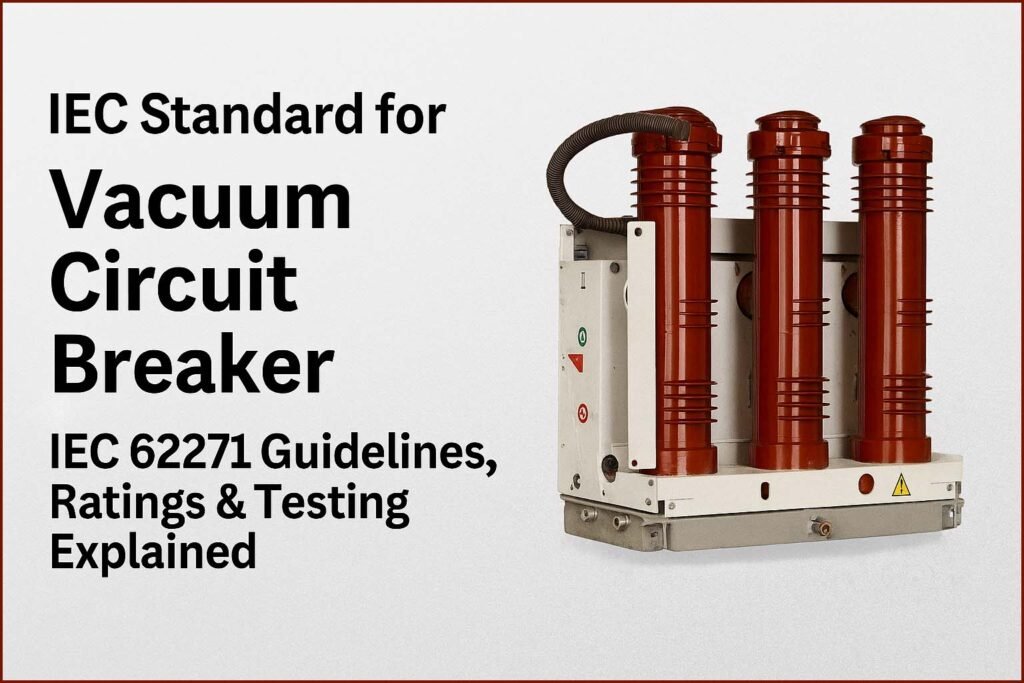
Table of Contents
What Is the IEC Standard for Vacuum Circuit Breaker
The IEC standard for vacuum circuit breaker refers to the set of international rules established by the International Electrotechnical Commission (IEC). These rules cover performance, construction, testing methods, and operational safety of circuit breakers that use vacuum as the arc-quenching medium.
The primary IEC document governing vacuum circuit breakers is IEC 62271-100. This standard applies to high-voltage and medium-voltage circuit breakers used in systems above 1 kV AC. It provides detailed specifications for testing procedures, dielectric properties, temperature rise limits, short-circuit performance, and mechanical endurance.
IEC standards aim to harmonize electrical equipment design worldwide. They make it easier for manufacturers to produce equipment that performs consistently under different environmental and operational conditions. For users, this means better interoperability, predictable performance, and higher safety levels.
Know more about IEC Standard for Voltage Drop Calculation: Best Guide
Key IEC Standards Related to Vacuum Circuit Breakers
The IEC standard for vacuum circuit breaker is not limited to a single document. It is supported by several related standards that address different aspects of design and testing.
| IEC Standard | Title | Scope |
|---|---|---|
| IEC 62271-100 | High-voltage switchgear and controlgear – Part 100 | Main performance and testing requirements for AC circuit breakers |
| IEC 62271-1 | Common specifications for high-voltage switchgear and controlgear | General construction, insulation, and mechanical design |
| IEC 62271-200 | AC metal-enclosed switchgear and controlgear for rated voltages above 1 kV and up to 52 kV | Specifies switchgear housing requirements |
| IEC 60694 (superseded) | Common specifications for high-voltage switchgear | Basis for IEC 62271-1 |
| IEC 62271-301 | Voltage presence indicating systems | Related to safety accessories in switchgear assemblies |
Together, these standards ensure that vacuum circuit breakers perform effectively in medium and high-voltage networks while maintaining operator and equipment safety.
Importance of IEC Standard for Vacuum Circuit Breaker
The IEC standard for vacuum circuit breaker plays a vital role in the power industry. Without these standards, the quality and reliability of circuit breakers would vary between manufacturers, increasing the risk of system failure or accidents.
The standards ensure that every breaker undergoes uniform testing procedures. This includes mechanical endurance, dielectric testing, temperature rise testing, and short-circuit performance evaluation. As a result, users can trust that any product certified under IEC 62271-100 will operate safely under defined conditions.
In addition, IEC compliance simplifies international trade. A vacuum circuit breaker designed according to IEC standards can be installed in different countries without the need for local re-certification. This standardization promotes global consistency and cost efficiency.
Know more about VLF Testing vs Hipot: Best Guide on Key Differences and Applications
Design Requirements Under IEC Standard for Vacuum Circuit Breaker
According to IEC 62271-100, every vacuum circuit breaker must meet specific design and construction criteria. These include:
Rated Voltage and Frequency:
The breaker must be designed for system voltages typically ranging from 1 kV to 52 kV, operating at standard power frequencies of 50 or 60 Hz.
Insulation Level:
The insulation strength must meet the rated power-frequency withstand voltage and lightning impulse withstand voltage.
Current-Carrying Capacity:
The circuit breaker must handle rated continuous current without exceeding temperature rise limits.
Short-Circuit Performance:
The breaker must safely interrupt fault currents up to its rated breaking capacity and withstand the thermal and dynamic stresses of such faults.
Mechanical Endurance:
IEC 62271-100 defines mechanical operation classes such as M1 and M2, where M2-rated breakers can perform at least 10,000 mechanical operations without failure.
Electrical Endurance:
Circuit breakers must demonstrate endurance under repetitive electrical load switching, ensuring long operational life.
Type Tests and Routine Tests
Testing is the backbone of the IEC standard for vacuum circuit breaker. It ensures that every unit performs safely and consistently under various conditions.
Type tests verify the breaker’s overall design and performance. They are carried out once per design type. Routine tests, on the other hand, are performed on each manufactured unit before delivery.
| Test Type | Description | Purpose |
|---|---|---|
| Dielectric Test | Applies high voltage across insulation | Ensures insulation integrity |
| Temperature Rise Test | Monitors heating at rated current | Prevents overheating under load |
| Short-Circuit Test | Simulates fault current interruption | Confirms breaking capacity |
| Mechanical Operation Test | Repeated opening and closing cycles | Checks mechanical reliability |
| Internal Arc Test | Tests enclosure strength during internal fault | Protects operator safety |
These tests guarantee that the breaker can handle real-world stresses without degradation in performance.
Know more about High Voltage Cable Testing Standards: Complete Guide for Engineers
Ratings and Parameters as per IEC Standard
The IEC standard defines specific rated parameters to describe a vacuum circuit breaker’s capability.
| Parameter | Description | Typical Range |
|---|---|---|
| Rated Voltage (Ur) | Maximum system voltage | 3.3 kV to 52 kV |
| Rated Current (Ir) | Maximum continuous current | 630 A to 4000 A |
| Rated Short-Circuit Breaking Current (Isc) | Maximum fault current it can interrupt | 16 kA to 50 kA |
| Rated Short-Time Withstand Current | Maximum current it can carry for 1 or 3 seconds | 16 kA to 50 kA |
| Power Frequency Withstand Voltage | Tests insulation strength | 28 kV to 95 kV (depending on rating) |
All these parameters must be verified through type and routine tests under IEC 62271-100 procedures.
Advantages of Following IEC Standard for Vacuum Circuit Breaker
Manufacturers and end-users both gain from strict compliance with IEC standards.
For manufacturers, it builds credibility, allowing their equipment to be marketed globally. For users, it ensures reliability, safety, and predictable operation in demanding environments.
Some key benefits include:
- Consistent performance across manufacturers
- Enhanced operational safety
- Reduced equipment failures
- Simplified global certification
- Compatibility with other IEC-compliant components
In industries like power distribution, oil and gas, and manufacturing, these advantages directly translate into higher uptime and lower maintenance costs.
Know more about Cable VLF Testing Procedure: Step-by-Step Guide for Safe High Voltage Cable Testing
Performance Requirements Under IEC 62271-100
The IEC standard defines clear performance benchmarks for circuit breakers under normal and abnormal conditions.
Under normal service conditions, the breaker must operate reliably within specified ambient temperature limits, typically -25°C to +40°C. It must also function correctly under humidity levels up to 95% and altitudes below 1000 meters.
For abnormal or severe conditions, the standard allows for derating or special design considerations. For example, in dusty, humid, or high-altitude environments, insulation clearances and contact materials may require modification.
Furthermore, the breaker must handle transient recovery voltages and dielectric stress during short-circuit interruption without restriking or re-ignition.
Comparison Between IEC and Other Standards
The IEC standard for vacuum circuit breaker is widely used in Europe, Asia, and most international markets. However, in North America, ANSI/IEEE standards are more common.
| Feature | IEC 62271-100 | ANSI C37 Standards |
|---|---|---|
| Voltage Range | 1 kV – 52 kV | 4.76 kV – 38 kV |
| Frequency | 50 or 60 Hz | 60 Hz |
| Short-Circuit Test Procedure | Symmetrical and asymmetrical current | Asymmetrical focus |
| Endurance Classification | M1/M2 for mechanical, E1/E2 for electrical | Standard test duty cycles |
| Global Acceptance | International | Primarily USA |
IEC standards are more universal, while ANSI standards are region-specific but often more conservative in test cycles.
Applications of IEC Standard Vacuum Circuit Breakers
Vacuum circuit breakers designed under IEC standards are used across several sectors.
They are common in:
- Medium-voltage distribution networks
- Industrial plants and refineries
- Renewable power systems (wind and solar)
- Smart grid substations
- Mining and railway traction systems
In all these cases, IEC compliance ensures that the breaker meets performance and safety expectations under both normal and fault conditions.
Know more about IEC Standard for VRLA Battery – Complete Guide to Design, Testing, and Performance
Future Trends in IEC Standards for Vacuum Circuit Breakers
The IEC constantly updates its standards to align with advancements in material science and digital monitoring. Modern vacuum interrupters are smaller, more efficient, and often integrated with sensors for condition monitoring.
Upcoming revisions of IEC 62271-100 focus on incorporating digital communication interfaces, predictive maintenance data, and eco-friendly materials. This ensures the continued relevance of the IEC standard for vacuum circuit breaker in future smart grids and renewable systems.
Conclusion
The IEC standard for vacuum circuit breaker ensures that every device meets globally accepted benchmarks for safety, reliability, and performance. By following IEC 62271-100 and related documents, manufacturers and users can trust the breaker’s ability to operate under demanding conditions.
In a world where electrical infrastructure continues to expand, adherence to IEC standards is not optional—it is essential. It provides a common language for design, testing, and operation, ensuring that vacuum circuit breakers remain the safest and most reliable choice for modern power systems.
Through these standards, the power industry achieves one key goal: consistent, safe, and efficient control of electrical energy across the globe.
Follow Us on Social:
Subscribe our Newsletter on Electrical Insights for latest updates from Electrical Engineering Hub
#IECSstandard, #VacuumCircuitBreaker, #VCSafety, #ElectricalEngineering, #Switchgear, #PowerDistribution, #IEC62271, #MediumVoltage, #ElectricalProtection, #CircuitBreakerTesting, #IndustrialSafety, #ElectricalStandards, #EnergySystems, #HighVoltageEquipment, #EngineeringDesign