Distribution Transformer Sizing – Accurate Load Calculation, kVA Selection & Design Guide
Distribution transformer sizing is one of the most critical steps in electrical power system design. Whether you are planning a residential colony, a commercial plaza, or an industrial facility, selecting the correct transformer rating ensures reliability, efficiency, and long service life. Oversizing increases capital cost and no-load losses, while undersizing leads to overheating, voltage drop, and premature failure.
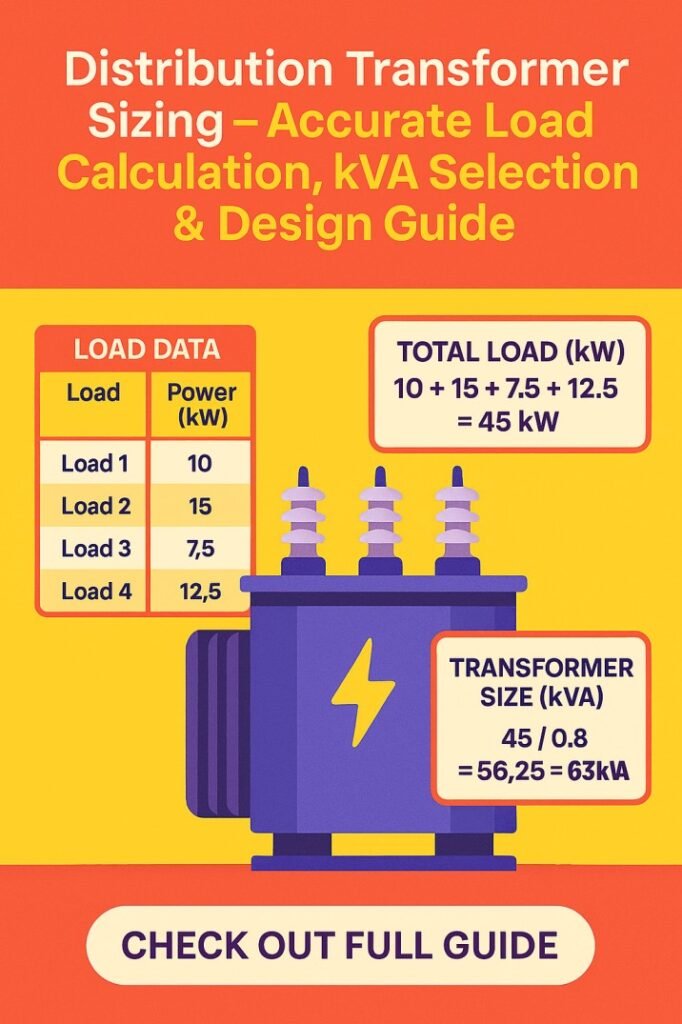
Table of Contents
This comprehensive guide explains distribution transformer sizing in a practical way, covering load calculation, demand estimation, kVA selection, voltage considerations, impedance, cooling, and installation design factors.
Why Distribution Transformer Sizing Matters
A distribution transformer connects the utility supply to end users at usable voltage levels such as 400/230V or 11kV/400V. Proper distribution transformer sizing ensures:
- Stable voltage regulation
- Adequate fault withstand capacity
- Improved energy efficiency
- Reduced copper and core losses
- Longer insulation life
- Compliance with grid standards
Inaccurate sizing can result in nuisance tripping, excessive temperature rise, high technical losses, and reduced power quality.
Start using our online tool today — it’s free Transformer Short Circuit Calculator – Accurate Fault Current & Transformer Protection Tool
Step 1: Accurate Load Calculation
The foundation of distribution transformer sizing is precise load calculation. The connected load is not equal to the actual operating load. Engineers must consider demand factor, diversity factor, and load growth.
1. Connected Load
Connected load is the total rated power of all electrical equipment connected to the system.
Formula:
Connected Load (kW) = Sum of all equipment ratings
Example:
| Equipment Type | Quantity | Rating (kW) | Total (kW) |
|---|---|---|---|
| Air Conditioners | 10 | 1.5 | 15 |
| Lighting Circuits | – | 8 | 8 |
| Motors | 5 | 3 | 15 |
| Miscellaneous Loads | – | 5 | 5 |
| Total Connected Load | 43 kW |
Connected load = 43 kW
However, not all equipment runs simultaneously.
Test our online tool for free Transformer Full Load Current Calculator – Accurate Load & Current Calculation Tool for Transformers
2. Demand Factor
Demand Factor = Maximum Demand / Connected Load
For residential buildings, demand factor typically ranges from 0.5 to 0.7.
If demand factor is 0.6:
Maximum Demand = 43 × 0.6 = 25.8 kW
3. Power Factor Consideration
Transformers are rated in kVA, not kW. Therefore, power factor must be included.
- kVA = kW / Power Factor
- Assuming power factor = 0.9:
- Required kVA = 25.8 / 0.9 = 28.67 kVA
This forms the base value for distribution transformer sizing.
Enjoy free access to our online tool Step-Down Transformer Calculator – Accurate Voltage & Power Conversion Tool
Step 2: Apply Future Load Growth
Every distribution system must consider expansion. A typical margin of 20% to 30% is recommended.
- Adjusted kVA = 28.67 × 1.25 = 35.8 kVA
- Next standard rating would be 50 kVA.
This approach ensures the transformer is not overloaded within a few years.
Standard Distribution Transformer Ratings
Distribution transformers are available in standard kVA sizes.
| Standard Ratings (kVA) |
|---|
| 25 |
| 50 |
| 100 |
| 160 |
| 200 |
| 250 |
| 315 |
| 400 |
| 500 |
| 630 |
| 800 |
| 1000 |
During distribution transformer sizing, always select the next higher standard rating.
Use our online tool without paying anything Transformer Impedance Calculation Tool – Accurate Transformer Impedance Calculator for Engineers
Voltage Level Selection
Primary and secondary voltage selection directly affects distribution transformer sizing.
Common combinations include:
- 11kV / 400V
- 33kV / 11kV
- 22kV / 400V
The choice depends on utility supply voltage and distribution network design. Higher primary voltage reduces current and copper losses.
Transformer full load current is calculated as:
For three-phase:
Current (A) = kVA × 1000 / (√3 × Voltage)
Example for 50 kVA, 400V:
Current = 50 × 1000 / (1.732 × 400)
Current ≈ 72 A
This helps in selecting LV cables and protective devices.
Access our online tool completely free Transformer Vector Group Calculation Tool | Easy & Accurate Vector Group Calculator
Impedance and Fault Level Consideration
During distribution transformer sizing, impedance percentage must match system fault levels.
Typical impedance values:
| Transformer Rating | Impedance % |
|---|---|
| Up to 200 kVA | 4% |
| 250–500 kVA | 5% |
| Above 500 kVA | 6%–8% |
Higher impedance reduces fault current but increases voltage drop.
Short circuit current:
Fault Current = Full Load Current / (Impedance % / 100)
For 50 kVA, 4% impedance:
Fault Current = 72 / 0.04 = 1800 A
Proper distribution transformer sizing ensures downstream breakers can interrupt this fault level safely.
Cooling Method Selection
Cooling plays a major role in transformer performance.
Common cooling types:
- ONAN (Oil Natural Air Natural)
- ONAF (Oil Natural Air Forced)
- Dry Type (Air Cooled)
Know more about Transformer Sizing for Residential Building
For outdoor pole-mounted transformers, ONAN oil-filled units are widely used. For indoor installations such as commercial buildings, dry-type cast resin transformers are preferred due to fire safety.
Cooling affects thermal rating, overload capacity, and maintenance requirements.
Efficiency and Loss Evaluation
Distribution transformer sizing must also consider efficiency at expected loading.
Losses include:
- Core Loss (No-load loss)
- Copper Loss (Load loss)
Efficiency is highest near 50% to 70% loading. Oversized transformers operate at low load, increasing relative core loss impact. Undersized transformers run hot, increasing copper losses.
Know more about Transformer Cooling Methods: ONAN, ONAF, OFAF & More
Typical efficiency levels:
| Rating (kVA) | Efficiency (%) |
|---|---|
| 100 | 98.0 |
| 250 | 98.5 |
| 500 | 99.0 |
Energy-efficient transformers reduce lifecycle cost significantly.
Location and Installation Factors
Environmental conditions affect distribution transformer sizing.
Consider:
- Ambient temperature
- Altitude
- Ventilation
- Harmonic content
- Space availability
High ambient temperature reduces transformer capacity. At 45°C ambient, derating may be required.
Explore all about Transformer Bond Sizing
If nonlinear loads such as VFDs and UPS systems are present, K-factor rated transformers may be necessary.
Harmonic and Nonlinear Load Impact
Modern facilities contain rectifiers, inverters, LED drivers, and data center loads. These create harmonics that increase heating.
During distribution transformer sizing, evaluate total harmonic distortion (THD).
If THD exceeds 15%, consider:
- K-rated transformer
- Oversizing by 10–15%
- Installing harmonic filters
This prevents insulation stress and overheating.
Step-by-Step Distribution Transformer Sizing Process
The following structured method simplifies the design process.
| Step | Description |
|---|---|
| 1 | List all connected loads |
| 2 | Calculate total connected kW |
| 3 | Apply demand factor |
| 4 | Convert kW to kVA using power factor |
| 5 | Add future growth margin |
| 6 | Select next standard rating |
| 7 | Verify voltage and current |
| 8 | Check impedance and fault level |
| 9 | Review cooling and environment |
| 10 | Confirm protection coordination |
Following this process ensures accurate distribution transformer sizing for any project.
Know all about Transformer Sizing for EV Charger
Practical Example for Industrial Facility
Suppose an industrial workshop has:
- Motors: 120 kW
- Lighting: 20 kW
- HVAC: 30 kW
- Miscellaneous: 10 kW
- Total connected load = 180 kW
- Demand factor = 0.8
- Maximum demand = 180 × 0.8 = 144 kW
- Power factor = 0.85
- Required kVA = 144 / 0.85 = 169.4 kVA
Add 25% margin:
169.4 × 1.25 = 211.75 kVA
Select 250 kVA transformer.
This ensures safe loading and future expansion capacity.
Protection and Coordination
Proper distribution transformer sizing also includes selecting:
- HV fuse or circuit breaker
- LV air circuit breaker
- Surge arresters
- Earthing system
Protection settings must coordinate with transformer rating and impedance to avoid nuisance trips.
Know more about Transformers Earthspark Size Chart
Economic Considerations
Capital cost, operating losses, and maintenance expenses influence transformer selection.
Undersized transformer:
- Lower purchase cost
- Higher failure risk
Oversized transformer:
- Higher capital investment
- Increased no-load losses
Optimal distribution transformer sizing balances technical performance and lifecycle cost.
Final Design Checklist
Before finalizing distribution transformer sizing, verify:
- Accurate load assessment
- Correct diversity assumption
- Adequate future margin
- Voltage compatibility
- Short circuit withstand rating
- Cooling adequacy
- Harmonic mitigation
- Protection coordination
- Utility approval requirements
A systematic approach ensures reliability and efficiency.
Find all about Transformer Disconnect Sizing
Conclusion
Distribution transformer sizing is not simply choosing a kVA rating from a catalog. It requires careful evaluation of connected load, maximum demand, power factor, voltage levels, impedance, cooling, fault current, harmonic distortion, and future expansion.
When done correctly, distribution transformer sizing improves voltage stability, reduces losses, extends equipment life, and ensures compliance with electrical standards. By following a structured load calculation method and selecting the appropriate standard rating with proper safety margin, engineers can design cost-effective and reliable distribution systems for residential, commercial, and industrial applications. Know more about Best Transformer Testing Companies in Canada | Trusted Electrical Testing Experts & Utility Service Providers
Follow Us on Social:
Subscribe our Newsletter on Electrical Insights for latest updates from Electrical Engineering Hub
#DistributionTransformerSizing, #TransformerSizingGuide, #ElectricalDesign, #PowerDistributionSystem, #LoadCalculation, #kVARating, #TransformerSelection, #ElectricalEngineering, #SubstationDesign, #PowerSystemPlanning