
Cable Tray Bending Radius: Minimum Bend Formula & Calculation Guide
Cable tray systems are a critical part of electrical installations in industrial plants, commercial buildings, substations, and infrastructure projects. One of the most important design considerations is the cable tray bending radius. If the bend is too sharp, it can affect cable pulling, create unnecessary stress, and even damage insulation.
Understanding the correct cable tray bending radius helps engineers, electricians, and installers maintain safe cable routing and comply with IEC, NEC, and manufacturer standards.
In this guide, you will learn the bend radius formula, how to calculate 90-degree bends, minimum bend radius requirements for different tray types, and practical examples.
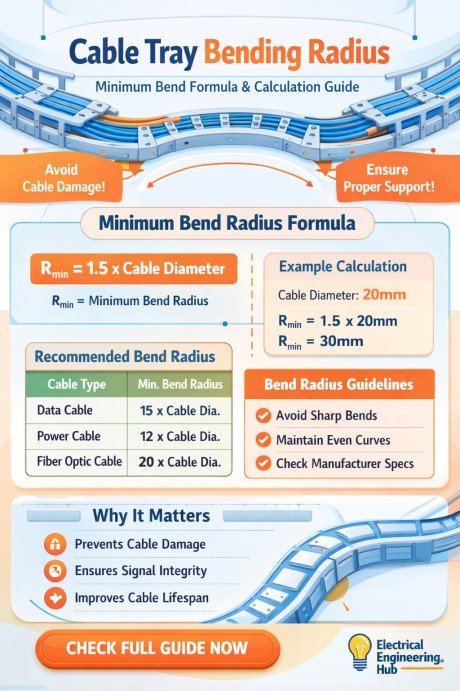
Table of Contents
Table of Contents
What Is Cable Tray Bending Radius?
Cable tray bending radius refers to the centerline radius of a tray fitting where the tray changes direction. It defines how smooth or sharp the bend is when routing cables through horizontal or vertical turns.
In simple terms, it is the curved path length that allows cables to pass through without excessive tension or deformation.
A proper bend radius ensures:
- Smooth cable installation
- Lower pulling tension
- Reduced cable insulation stress
- Better heat dissipation
- Longer cable lifespan
Cable trays commonly include bends such as:
| Bend Type | Description |
|---|---|
| Horizontal Bend | Changes direction left or right |
| Vertical Inside Bend | Routes cable downward |
| Vertical Outside Bend | Routes cable upward |
| Tee Fitting | Splits cable path into two directions |
| Cross Fitting | Routes cable in four directions |
Each of these requires a specific bending radius depending on cable size and tray type.
Why Cable Tray Bend Radius Matters
The cable tray bend radius directly affects installation quality and cable performance.
When a tray bend is too tight, cables may:
- Exceed their minimum bending limits
- Experience insulation cracking
- Develop conductor stress
- Face pulling difficulty
- Lose mechanical integrity
Proper bend radius improves cable management and supports future maintenance.
Here are the main reasons it matters:
Find all about Busbar Bending Calculation
1. Prevents Cable Damage
Power cables, control cables, and instrumentation cables have manufacturer-defined bending limits. Matching tray bends with these limits prevents damage.
2. Simplifies Cable Pulling
A larger radius reduces pulling friction and sidewall pressure.
3. Improves Cable Arrangement
Proper bends keep cables aligned and organized.
4. Ensures Standard Compliance
IEC 61537 and NEC Article 392 provide guidelines for tray systems and fittings.
5. Supports Heavy Cable Loads
Large MV and HV cables need wider bends because of their thicker insulation and armor.
Cable Tray Bend Formula
The standard formula used for cable tray bending radius is based on geometry.
The basic bend arc formula is:
Bend Length = (Angle × π × Radius) ÷ 180
Where:
| Parameter | Meaning |
|---|---|
| Angle | Bend angle in degrees |
| π | 3.1416 |
| Radius | Centerline bend radius |
For 90-degree bends:
Bend Length = (90 × π × Radius) ÷ 180
Simplified:
Bend Length = 1.57 × Radius
Example:
If the bend radius is 600 mm:
Bend Length = 1.57 × 600
Bend Length = 942 mm
This means the curved tray section length will be 942 mm.
Discover everything about cable bending radius iec standard
This formula is commonly used in tray fabrication and field installation.
Cable Tray 90-Degree Bend Calculation
A 90-degree cable tray bend is the most common tray fitting in electrical layouts.
To calculate it:
Step 1: Determine Cable Diameter
Assume the largest cable diameter is 50 mm.
Step 2: Find Minimum Cable Bend Radius
For power cable:
Minimum radius = 12 × cable diameter
Minimum radius = 12 × 50
Minimum radius = 600 mm
Step 3: Select Tray Radius
The tray radius must be equal to or greater than the cable radius.
Selected tray radius = 600 mm
Step 4: Calculate Bend Length
Using formula:
Bend Length = 1.57 × Radius
Bend Length = 1.57 × 600
Bend Length = 942 mm
Find all about 11kV Cable Bending Radius
Calculation Table
| Cable Diameter | Multiplier | Minimum Radius | Bend Length |
| 25 mm | 12 | 300 mm | 471 mm |
| 35 mm | 12 | 420 mm | 659 mm |
| 50 mm | 12 | 600 mm | 942 mm |
| 75 mm | 12 | 900 mm | 1413 mm |
This method helps in planning bends accurately.
Minimum Bend Radius by Tray Type
Different tray systems have different structural flexibility. The cable tray bending radius depends on the tray material and construction.
1. Ladder Tray
Ladder tray is widely used for power distribution because it offers strong support and excellent ventilation.
Typical bend radius:
| Tray Width | Standard Radius |
|---|---|
| 150 mm | 300 mm |
| 300 mm | 450 mm |
| 450 mm | 600 mm |
| 600 mm | 750 mm |
Best for:
- Power cables
- Heavy load applications
- Industrial cable runs
Use our online tool HV Cable Bending Radius Calculator
Advantages:
- Strong structure
- Easy cable pulling
- Better cooling
2. Solid Bottom / Perforated Tray
Solid bottom and perforated trays are common for control and communication cables.
Recommended bend radius:
| Tray Width | Standard Radius |
|---|---|
| 100 mm | 200 mm |
| 200 mm | 300 mm |
| 300 mm | 450 mm |
| 450 mm | 600 mm |
These trays offer better cable protection but less ventilation.
Applications:
- Data cables
- Control wiring
- Indoor installations
3. Wire Mesh Tray
Wire mesh trays are flexible and easier to bend on-site.
Standard bend radius:
| Tray Width | Recommended Radius |
|---|---|
| 50 mm | 100 mm |
| 100 mm | 200 mm |
| 200 mm | 300 mm |
| 300 mm | 450 mm |
Know more about Wire Bending Radius NEC
Wire mesh systems are ideal for:
- Lightweight cables
- IT cabling
- Fast installations
They can be cut and shaped easily using manual tools.
Cable Tray Bending Radius vs. Cable Bending Radius
Many people confuse these two terms, but they are different.
| Factor | Cable Tray Bending Radius | Cable Bending Radius |
|---|---|---|
| Definition | Radius of tray fitting | Radius cable can safely bend |
| Purpose | Supports routing | Protects cable integrity |
| Based On | Tray design | Cable construction |
| Standard | IEC 61537 | IEC 60287 / Manufacturer |
Important rule:
The cable tray bending radius should never be smaller than the largest cable bending radius inside it.
For example:
If a cable requires 500 mm bend radius, the tray should be at least 500 mm or larger.
This avoids installation stress.
Cable Tray Bend Radius Reference Table
Below is a quick reference for selecting standard bend radius.
| Largest Cable Diameter | Minimum Cable Radius | Recommended Tray Radius |
|---|---|---|
| 10 mm | 120 mm | 150 mm |
| 20 mm | 240 mm | 300 mm |
| 30 mm | 360 mm | 450 mm |
| 40 mm | 480 mm | 600 mm |
| 50 mm | 600 mm | 750 mm |
| 60 mm | 720 mm | 900 mm |
| 75 mm | 900 mm | 1050 mm |
This table is useful during cable tray layout design.
Selection tips:
- Always use the largest cable for calculation
- Add future expansion margin
- Consider pulling tension
- Follow manufacturer data
Use our online tool HV Cable Bending Radius Calculator
Cable Tray Bend Radius Calculator
A cable tray bending radius calculator makes the process faster and more accurate.
A typical calculator needs:
- Cable diameter
- Cable type
- Number of conductors
- Tray width
- Bend angle
The calculator automatically gives:
- Minimum bend radius
- Arc length
- Tray fitting size
- Cable pulling path
Benefits of using a calculator:
| Benefit | Description |
|---|---|
| Saves Time | Quick calculations |
| Reduces Errors | Accurate geometry |
| Improves Planning | Better material estimation |
| Enhances Safety | Prevents wrong bend selection |
For electrical engineers, using a calculator during design can improve installation quality and reduce site modifications.
Use our free online tool Cable Bending Radius Calculator
Frequently Asked Questions
How do you calculate cable tray bend radius?
To calculate cable tray bend radius, first identify the largest cable diameter in the tray. Multiply it by the recommended bend factor, usually 8 to 12 times depending on cable type. The tray bend radius should be equal to or greater than this value.
Formula:
Minimum Radius = Cable Diameter × Bend Factor
What is the formula for a 90-degree cable tray bend?
The formula for a 90-degree bend is:
Bend Length = 1.57 × Radius
This calculates the arc length of the curved tray section.
For example:
If radius is 500 mm:
Bend Length = 1.57 × 500
= 785 mm
How do you bend wire mesh cable tray?
Wire mesh cable trays can be bent by cutting selected wire sections and shaping the tray manually. Use bolt cutters or tray forming tools. Follow the required radius to avoid sharp edges.
Steps:
Mark bend location
Cut side wires
Shape the bend
Secure the tray
Check radius compliance
Is cable tray bend radius the same as cable bend radius?
No. Cable tray bend radius refers to the tray fitting curve, while cable bend radius refers to the minimum safe bending limit of the cable itself.
The tray radius must always match or exceed the cable radius to ensure safe installation.
Follow Us on Social:
Subscribe our Newsletter on Electrical Insights for latest updates from Electrical Engineering Hub
#CableTrayBendingRadius, #CableTrayDesign, #BendRadiusCalculation, #ElectricalEngineering, #CableManagement, #IECStandards, #CableInstallation, #ElectricalDesignGuide, #TrayBendFormula, #VoltageDropCalculation