Capacitor Dissipation Factor vs ESR: Complete Comparison Guide for Accurate Capacitor Testing
Capacitors are critical components in power supplies, motor drives, audio circuits, industrial electronics, and renewable energy systems. When a capacitor starts degrading, the entire circuit performance can suffer. This is why technicians and engineers often rely on electrical testing parameters to evaluate capacitor health accurately. Among the most discussed parameters are dissipation factor and ESR.
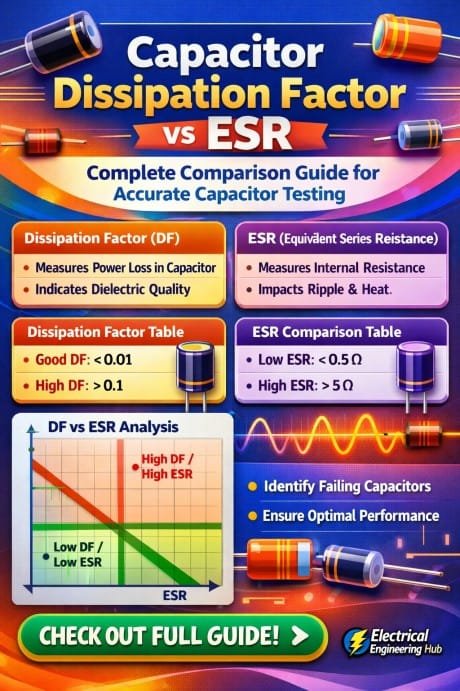
Table of Contents
Understanding Capacitor Dissipation Factor vs ESR is important because both values indicate internal losses inside a capacitor, yet they measure different electrical behaviors. Many beginners assume they are identical, but each parameter serves a unique role in capacitor diagnostics and predictive maintenance.
This guide explains the difference between dissipation factor and ESR, how they are measured, where they are used, and which one is more suitable for accurate capacitor testing.
What Is Capacitor Dissipation Factor?
Dissipation factor, often abbreviated as DF or tan δ, measures the energy loss inside a capacitor when AC voltage is applied. Ideally, a capacitor should store and release energy without losses. In real conditions, some energy converts into heat because of dielectric imperfections.
Dissipation factor represents the ratio of resistive power loss to reactive power in the capacitor.
A lower dissipation factor indicates better capacitor efficiency and healthier dielectric material. A higher value usually points toward aging, moisture contamination, insulation breakdown, or dielectric deterioration.
Know more about Power Factor vs Crest Factor: Important Differences & Comparison
Dissipation Factor Formula
| Parameter | Formula |
|---|---|
| Dissipation Factor | DF = ESR / XC |
| Capacitive Reactance | XC = 1 / (2πfC) |
Where:
- ESR = Equivalent Series Resistance
- XC = Capacitive Reactance
- f = Frequency
- C = Capacitance
Dissipation factor changes with frequency, temperature, and capacitor construction.
What Is ESR in Capacitors?
Equivalent Series Resistance, commonly known as ESR, is the internal resistance present in a capacitor. It reflects the resistive losses caused by leads, electrolyte, dielectric material, and internal connections.
Unlike ideal capacitors, practical capacitors behave as if a small resistor exists in series with the capacitance.
Find all about Capacitor Bank Sizing for Power Factor Correction – Step by Step
When ESR increases, capacitors generate more heat, reduce efficiency, and may fail under load conditions. High ESR is especially dangerous in switching power supplies and high-frequency electronic circuits.
ESR Unit
ESR is measured in ohms (Ω).
Lower ESR values are preferred for high-frequency and ripple-current applications.
Capacitor Dissipation Factor vs ESR
The comparison between these two parameters becomes easier when their practical roles are understood clearly. Both indicate capacitor losses, but the testing approach and interpretation differ.
Main Comparison Table
| Feature | Dissipation Factor | ESR |
|---|---|---|
| Full Form | Dissipation Factor | Equivalent Series Resistance |
| Unit | Ratio or Percentage | Ohms |
| Indicates | Dielectric losses | Internal resistive losses |
| Frequency Dependent | Yes | Yes |
| Main Use | Insulation and dielectric evaluation | Power and ripple performance |
| Common in | Power factor testing | SMPS and electronics repair |
| Test Equipment | LCR meter, tan delta tester | ESR meter |
| Ideal Value | Very low | Very low |
| Failure Indicator | Dielectric aging | Heat and resistance rise |
This table helps technicians quickly understand Capacitor Dissipation Factor vs ESR during troubleshooting and preventive maintenance.
Know more about Bus Bar Current Rating Calculation: Practical Method for Accurate Sizing and Load Capacity
How Dissipation Factor and ESR Are Related
Although dissipation factor and ESR are different parameters, they are mathematically connected.
Dissipation factor depends on ESR and capacitive reactance. If ESR rises while capacitance remains stable, the dissipation factor also increases.
At higher frequencies, capacitive reactance decreases, which affects the DF calculation. This is why test frequency selection is important during capacitor diagnostics.
In practical applications:
- High ESR usually means higher heat generation
- High dissipation factor usually means dielectric degradation
- Both together provide a more complete capacitor condition analysis
Importance of Accurate Capacitor Testing
Capacitor failure can lead to system shutdowns, unstable voltage, overheating, and equipment damage. Proper testing helps avoid costly breakdowns.
Accurate capacitor testing is essential in:
- Power distribution systems
- Industrial motors
- UPS systems
- Solar inverters
- Audio amplifiers
- HVAC equipment
- Electronic repair workshops
Understanding Capacitor Dissipation Factor vs ESR allows maintenance teams to identify hidden faults before catastrophic failure occurs.
How ESR Testing Works
An ESR meter injects a small AC signal into the capacitor and measures internal resistance. In many cases, ESR testing can be performed without removing the capacitor from the circuit.
Learn more about capacity factor formula
Advantages of ESR Testing
| Advantage | Description |
|---|---|
| Fast Testing | Quick diagnosis in electronic circuits |
| In-Circuit Measurement | Often no desoldering required |
| Detects Dry Capacitors | Useful for electrolytic capacitor failures |
| Practical for Repair | Widely used in TV and SMPS repair |
Limitations of ESR Testing
- Cannot fully evaluate dielectric quality
- Results vary with frequency
- May not detect all insulation defects
How Dissipation Factor Testing Works
Dissipation factor testing applies AC voltage at a specified frequency and measures dielectric losses. It is commonly used in medium-voltage and high-voltage capacitor banks.
Advantages of Dissipation Factor Testing
| Advantage | Description |
|---|---|
| Evaluates Dielectric Health | Detects insulation deterioration |
| Reliable for Predictive Maintenance | Useful in industrial systems |
| Detects Moisture Contamination | Important in power equipment |
| High Accuracy | Suitable for critical applications |
Learn more about Demand Factor as Per NEC
Limitations of Dissipation Factor Testing
- Requires specialized equipment
- Usually performed offline
- More time-consuming than ESR testing
Which Parameter Is More Important?
The answer depends on the application.
For Electronics Repair
ESR testing is usually more useful because switching power supplies and electronic circuits are sensitive to internal resistance rise.
Applications include:
- Motherboards
- LED drivers
- Televisions
- Audio amplifiers
- Computer power supplies
For Industrial and Power Systems
Dissipation factor testing provides better insight into insulation and dielectric condition.
Applications include:
- Capacitor banks
- Transformers
- High-voltage bushings
- Power factor correction systems
Using both measurements together gives the most reliable results.
Know more about load factor calculation formula
Typical Capacitor Failure Symptoms
Technicians often observe these warning signs before capacitor failure:
| Symptom | Possible Cause |
|---|---|
| Overheating | High ESR |
| Reduced capacitance | Aging |
| Leakage current | Dielectric breakdown |
| Bulging capacitor | Internal gas formation |
| Poor filtering | Increased ESR |
| Power loss | High dissipation factor |
These symptoms help identify whether further ESR or DF testing is required.
Factors Affecting ESR and Dissipation Factor
Several environmental and operational factors influence capacitor performance.
Temperature
High temperatures accelerate capacitor aging and increase internal losses.
Frequency
Both ESR and dissipation factor vary with test frequency.
Age
Older capacitors usually show increased ESR and dielectric deterioration.
Voltage Stress
Continuous overvoltage operation damages dielectric material.
Get complete information about power factor correction calculations
Moisture
Moisture contamination significantly increases dissipation factor.
Best Practices for Capacitor Testing
To obtain reliable results, technicians should follow proper testing methods.
Recommended Testing Practices
- Use calibrated instruments
- Compare readings with manufacturer specifications
- Test at standard frequencies
- Inspect for physical damage
- Measure capacitance alongside ESR and DF
- Perform periodic preventive maintenance
Combining multiple test methods improves fault detection accuracy.
Common Misconceptions About ESR and Dissipation Factor
Many people misunderstand the relationship between these two parameters.
Misconception 1: ESR and DF Are the Same
They are related but not identical. ESR measures resistance while dissipation factor measures energy loss ratio.
Misconception 2: Low Capacitance Always Means Failure
Some capacitors maintain capacitance values while ESR rises significantly.
Misconception 3: ESR Alone Is Enough
In high-voltage systems, dielectric testing through dissipation factor analysis is equally important.
Know more about Coincidence Factor vs Demand Factor
Final Thoughts
Understanding Capacitor Dissipation Factor vs ESR is essential for accurate capacitor testing and reliable equipment maintenance. ESR focuses mainly on internal resistance and heat-related losses, while dissipation factor evaluates dielectric efficiency and insulation quality.
For electronics troubleshooting, ESR testing offers speed and convenience. For industrial maintenance and high-voltage systems, dissipation factor testing provides deeper insight into capacitor health.
The best diagnostic approach combines capacitance measurement, ESR analysis, and dissipation factor testing together. This method improves reliability, prevents unexpected failures, and extends equipment lifespan.
Whether you work in industrial maintenance, electronics repair, or power system diagnostics, mastering Capacitor Dissipation Factor vs ESR will help you make more accurate testing decisions and improve system performance.
Know more about What is Demand Factor and Diversity Factor? Quick Concepts
Follow Us on Social:
Subscribe our Newsletter on Electrical Insights for latest updates from Electrical Engineering Hub
#CapacitorDissipationFactor,#CapacitorESR,#DissipationFactorVsESR,#ESRMeasurement,#CapacitorTesting,#ElectricalEngineering,#PowerElectronics,#CapacitorAnalysis,#ElectronicComponents,#CircuitDiagnostics