Step Down Transformer Sizing Calculator – Accurate kVA Rating & Load Calculation Tool
Introduction
The step down transformer sizing calculator helps determine the correct transformer capacity required to reduce voltage safely and efficiently for a specific load. In practical electrical work, step down transformers are widely used in industrial plants, commercial buildings, control panels, renewable energy systems, and utility installations where high distribution voltage must be converted to a lower usable level.
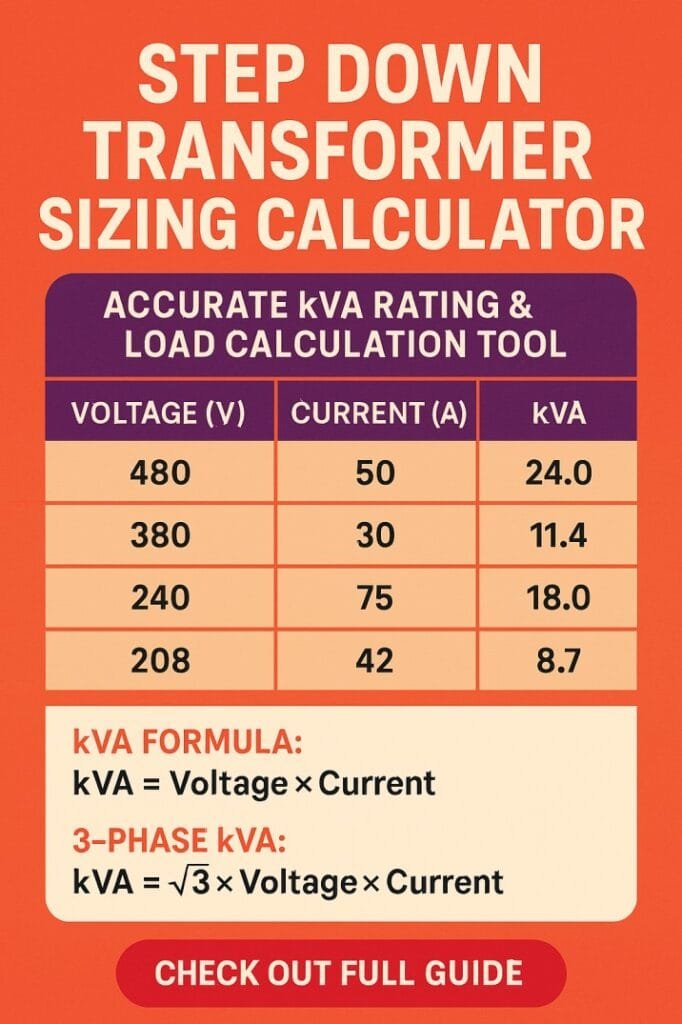
Table of Contents
Selecting the right transformer size is not simply a matter of matching voltage. Undersizing can lead to overheating, insulation failure, voltage drop, and nuisance tripping. Oversizing increases project cost, reduces efficiency at light load, and may complicate protection coordination. A reliable step down transformer sizing calculator ensures the selected transformer supports the connected load, power factor, and operating conditions without compromising safety or performance.
Use our online tool for free Transformer Neutral Current Calculator – Accurate Neutral Current Estimation
For engineers, electricians, contractors, and students, accurate transformer sizing is essential for compliance with electrical standards and long-term system reliability.
Step Down Transformer Sizing Calculator
Enter the required input values such as primary voltage, secondary voltage, load current or power, and power factor.
Click calculate to determine the recommended transformer kVA rating for your application.
Step-Down Transformer Sizing Calculator
How to Use
1. Enter the primary voltage (incoming supply).
2. Enter the required secondary voltage (output).
3. Select whether the system is single-phase or three-phase.
4. Choose whether you want to input load in kW or Amps.
5. Enter the load value and power factor.
6. Click “Calculate Transformer Size” to get the minimum kVA rating and the nearest standard transformer rating.
Always select a commercially available transformer size equal to or greater than the calculated kVA.
Find more Electrical Engineering Tools for easy electrical calculations and estimations.
How to Use Step Down Transformer Sizing Calculator(Step-by-Step)
- Identify the primary voltage.
This is the incoming supply voltage, such as 11 kV, 415 V, or 480 V. - Determine the required secondary voltage.
This is the voltage your equipment or distribution panel needs, such as 230 V or 208 V. - Enter the load power or current.
You may use total connected load in kilowatts (kW) or total current in amperes, depending on what the calculator requests. - Input the power factor if required.
For most industrial loads, power factor typically ranges between 0.8 and 0.95. - Review the calculated transformer rating.
The step down transformer sizing calculator will provide the minimum kVA capacity required. - Select the nearest standard transformer rating above the calculated value.
Always choose a commercially available size that meets or exceeds the result.
Try our free online tool Transformer Temperature Rise Calculator: Accurate and Easy Guide
How the Calculation Works
The step down transformer sizing calculator determines the apparent power required by the load. Transformers are rated in kVA because they supply both real power and reactive power.
When load power in kilowatts is entered, the calculator adjusts for power factor to determine the total apparent power. If load current is entered, it considers the operating voltage and calculates the total power demand accordingly.
The result represents the minimum transformer capacity needed to operate the load continuously without exceeding thermal limits. The logic ensures that the transformer can handle the electrical demand under normal operating conditions.
The calculator does not simply convert voltage levels. It ensures that the transformer core and windings can safely deliver the required output power at the desired secondary voltage.
Start using our online tool today — it’s free Transformer Short Circuit Calculator – Accurate Fault Current & Transformer Protection Tool
Practical Electrical Example
Consider a small manufacturing unit that receives a 415 V three-phase supply but needs 230 V single-phase power for lighting and office equipment.
Given values:
- Primary voltage: 415 V
- Secondary voltage: 230 V
- Total connected load: 18 kW
- Power factor: 0.9
Using the step down transformer sizing calculator, enter 18 kW and 0.9 power factor. The calculator determines the apparent power required, which will be higher than 18 kW due to the power factor.
The output may indicate a required transformer capacity of approximately 20 kVA. Since transformers are available in standard ratings such as 20 kVA, 25 kVA, and 30 kVA, selecting a 25 kVA unit would provide additional operational margin.
Enjoy free access to our online tool Step-Down Transformer Calculator – Accurate Voltage & Power Conversion Tool
This ensures stable voltage under varying load conditions and prevents overheating during peak usage.
Key Factors That Affect the Result
Several electrical parameters influence the outcome of the step down transformer sizing calculator:
- Voltage level
Higher voltage systems may require consideration of insulation class and clearance distances. - Load type
Inductive loads such as motors and compressors demand higher inrush current compared to resistive loads. - Power factor
Lower power factor increases apparent power requirement and affects transformer sizing. - Efficiency
Transformer efficiency impacts energy losses and long-term operating cost. - Environmental conditions
Ambient temperature, altitude, ventilation, and installation location influence thermal performance. - Duty cycle
Continuous operation requires more conservative sizing compared to intermittent loads.
Use our online tool without paying anything Transformer Impedance Calculation Tool – Accurate Transformer Impedance Calculator for Engineers
Understanding these factors ensures that the calculated transformer size aligns with real-world conditions.
Common Mistakes to Avoid
Even with a reliable step down transformer sizing calculator, incorrect inputs can lead to improper selection.
One common mistake is entering only connected load without considering actual operating load. If future expansion is planned, the transformer may become undersized.
Another frequent error is ignoring power factor. Assuming unity power factor for motor loads results in an underestimated kVA requirement.
Failing to consider starting current for motors is also problematic. Transformers must withstand temporary inrush without excessive voltage drop.
Selecting a transformer exactly equal to the calculated value without any margin can reduce service life. Standard practice usually includes a safety margin to accommodate minor variations.
Incorrect voltage input is a critical mistake. Always verify primary and secondary voltage ratings before finalizing the selection to prevent equipment damage.
Get started with our free online tool Transformer Efficiency Calculator – Calculate Power, Losses & Performance Instantly
Why Use Step Down Transformer Sizing Calculator
The step down transformer sizing calculator simplifies a technical decision that directly impacts safety and cost.
It improves accuracy by applying correct electrical relationships between voltage, current, power, and power factor. This reduces manual calculation errors.
It saves time during project design, estimation, and procurement stages. Contractors and engineers can quickly evaluate multiple load scenarios.
It supports reliable engineering decisions by presenting transformer capacity in standard industry units. This helps during equipment specification and tender documentation.
For students and junior engineers, it reinforces understanding of transformer rating principles while providing practical results.
Electrical Standards & Practical Considerations
Transformer sizing must align with national and international electrical standards. These standards define insulation levels, temperature rise limits, short-circuit withstand capability, and installation requirements.
Following recognized electrical codes ensures:
- Proper overcurrent protection coordination
- Adequate conductor sizing
- Safe earthing and bonding
- Compliance with utility interconnection rules
Access our online tool completely free Transformer Vector Group Calculation Tool | Easy & Accurate Vector Group Calculator
In industrial environments, additional considerations such as harmonic distortion and nonlinear loads may influence transformer selection. Certain applications may require special design features like K-rated transformers or isolation transformers.
Proper enclosure rating is also important for outdoor installations or dusty environments. Mechanical protection and ventilation must be evaluated during selection.
Using a structured approach with the step down transformer sizing calculator supports compliance and promotes long-term operational safety.
Use our tool online at no cost Transformer Losses Calculation Tool – Accurate & Easy Energy Loss Analysis
Frequently Asked Questions (FAQs)
How do I know what kVA transformer I need?
You need to calculate the total apparent power required by your load. The step down transformer sizing calculator converts load power and power factor into the correct kVA rating.
Can I use the calculator for single-phase and three-phase systems?
Yes. As long as you enter the correct voltage and load details, the calculator can determine the appropriate transformer capacity for both system types.
Should I add a safety margin to the calculated result?
In most practical applications, selecting the next standard rating above the calculated value is recommended to allow for future expansion and load variations.
What happens if the transformer is undersized?
An undersized transformer may overheat, experience excessive voltage drop, and have reduced insulation life. This can lead to premature failure and safety risks.
Does power factor affect transformer size?
Yes. Lower power factor increases apparent power demand, which directly increases the required kVA rating. Always enter a realistic power factor value for accurate results.
Follow Us on Social:
Subscribe our Newsletter on Electrical Insights for latest updates from Electrical Engineering Hub
#StepDownTransformer, #TransformerSizing, #ElectricalCalculator, #PowerEngineering, #TransformerDesign, #ElectricalTools, #LoadCalculation, #KVARating, #VoltageConversion, #ElectricalEngineering