Top 30 UK G99 Grid Connection Interview Questions: Master Your Power System Job Prep
If you are preparing for a power systems role in the UK, understanding the G99 grid connection standard is essential. Grid engineers, protection specialists, and design professionals often face rigorous interviews focused on UK G99 grid connection. Whether you are entering a design consultancy, a utility company, or a renewable energy firm, being ready for these questions can set you apart.
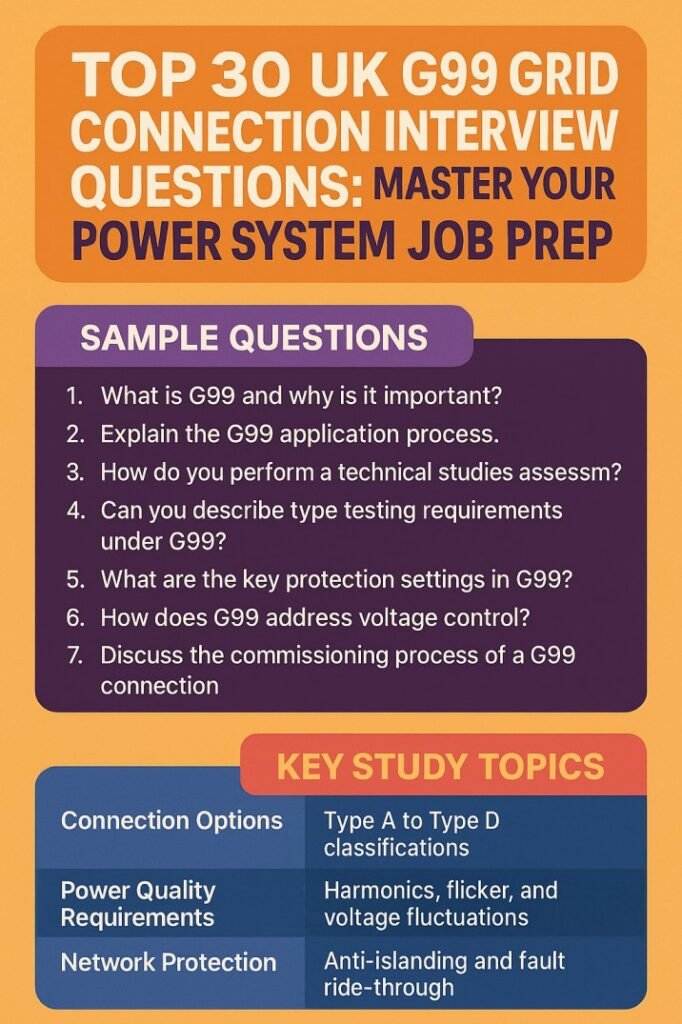
Table of Contents
In this guide, we present the top 30 UK G99 grid connection interview questions to help you master your preparation. These questions cover technical, practical, and scenario-based topics to give you a comprehensive edge.
What is UK G99 Grid Connection?
UK G99 grid connection is the standard that governs the connection of generation equipment, including renewable energy sources, to the UK distribution network. It replaced the older G83 standard for generation above 16A per phase. Engineers working with distributed generation must understand voltage control, protection requirements, and fault ride-through capabilities to comply with G99.
Why UK G99 Grid Connection Knowledge is Crucial
Employers value candidates who can interpret G99 standards correctly because improper implementation can lead to network instability, non-compliance fines, and equipment damage. Interviewers typically focus on your knowledge of protection settings, compliance procedures, and real-world application of the G99 standard.
Know more about G99 Grid Connection Standard: Guide to Compliance, Safety & Efficient Integration
Top 30 UK G99 Grid Connection Interview Questions
Below is a structured list of the most commonly asked questions in UK G99 grid connection interviews, along with brief guidance on how to approach answers.
| Question Number | UK G99 Grid Connection Interview Questions | Guidance/Notes |
|---|---|---|
| 1 | What is the scope of G99 in the UK distribution network? | Explain that it covers generation >16A per phase and defines connection, protection, and operational requirements. |
| 2 | How does G99 differ from G83? | Focus on higher capacity, fault ride-through, and reactive power requirements. |
| 3 | What is Low Voltage Ride Through (LVRT)? | Discuss the requirement for generation to remain connected during voltage dips. |
| 4 | What is High Voltage Ride Through (HVRT)? | Explain how generators must handle temporary overvoltage without tripping. |
| 5 | Explain reactive power requirements under G99. | Include the necessity for power factor control and voltage support. |
| 6 | What are the protection requirements in G99? | Discuss overcurrent, under/overvoltage, frequency, and islanding protection. |
| 7 | How is fault level assessed for G99 compliance? | Explain short circuit calculations and network studies. |
| 8 | Define the term “inverter-based generation” in G99 context. | Cover PV, wind, and battery systems using inverters. |
| 9 | What are the key documentation requirements for G99? | Include design approval, commissioning records, and compliance certificates. |
| 10 | Explain anti-islanding and its importance. | Emphasize safety, network stability, and regulatory compliance. |
| 11 | How do you perform voltage control for G99-connected generators? | Discuss tap-changing transformers, reactive support, and droop control. |
| 12 | What is frequency protection under G99? | Cover underfrequency and overfrequency trip settings. |
| 13 | How do you test G99 protection devices? | Explain simulation, relay testing, and commissioning checks. |
| 14 | What is the significance of power factor in G99? | Discuss reactive power compensation and network impact. |
| 15 | Describe the commissioning process for a G99 generator. | Include pre-connection tests, witness testing, and documentation. |
| 16 | Explain the impact of harmonics from G99-connected equipment. | Discuss mitigation techniques and standards compliance. |
| 17 | How are distribution network studies performed for G99? | Include load flow, fault analysis, and voltage profile assessments. |
| 18 | What is the role of SCADA in monitoring G99 compliance? | Explain real-time monitoring, alarms, and data logging. |
| 19 | How do you calculate short-circuit current for a G99 connection? | Discuss per-unit system, impedance, and network modeling. |
| 20 | What are the operational challenges of high penetration G99 generators? | Include voltage regulation, frequency control, and protection coordination. |
| 21 | Explain the difference between Type A, B, and C generation under G99. | Discuss categorization by size, inverter type, and connection requirements. |
| 22 | How is harmonic emission measured for compliance? | Explain IEEE 519 standard relevance and measurement procedures. |
| 23 | Describe a practical scenario where G99 protection failed. | Prepare an example showing cause, effect, and mitigation. |
| 24 | How do you coordinate relay settings for multiple G99 generators? | Discuss selectivity, backup protection, and zone coordination. |
| 25 | What is the role of automatic disconnection devices? | Explain compliance with voltage and frequency thresholds. |
| 26 | How do network upgrades affect G99 compliance? | Discuss capacity, fault level, and connection agreement changes. |
| 27 | Explain the influence of distributed generation on grid stability. | Cover voltage fluctuations, frequency deviations, and harmonics. |
| 28 | How do you handle reactive power export limitations? | Discuss inverter settings, dynamic voltage support, and network agreements. |
| 29 | What commissioning tests are mandatory before energization? | Include LVRT/HVRT, protection relay, and metering tests. |
| 30 | How do you maintain ongoing compliance with G99? | Mention periodic testing, monitoring, and reporting. |
Practical Tips for Answering UK G99 Grid Connection Interview Questions
Preparation is not just about memorizing answers. Here are strategies to excel:
- Understand the standard deeply: Read the latest ENA G99 documentation and focus on voltage, frequency, and fault ride-through requirements.
- Use real-world examples: When asked about protection or voltage control, refer to scenarios you have experienced or studied.
- Be ready for calculations: Some interviews involve short-circuit, load flow, or fault level calculations. Practice step-by-step methods.
- Keep documentation knowledge handy: Interviewers often check your familiarity with commissioning forms, test reports, and compliance certificates.
- Explain clearly: Use medium-length, structured sentences to ensure clarity and confidence.
Use our online tool for free Sub Panel Breaker Size Calculator – Find the Right Breaker for Your Electrical Sub Panel
Common Calculation Questions You Might Face
Power system interviews often include practical calculation questions. Here is a table of typical calculations:
| Calculation Type | Example | Notes |
|---|---|---|
| Short-circuit current | Determine Isc at point of connection for 5 MW PV | Include transformer impedance and network impedance |
| Reactive power support | Calculate Q needed to maintain 0.95 power factor at 11 kV | Use P and PF formulas |
| LVRT performance | Simulate voltage dip to 80% for 150 ms | Verify generator remains connected |
| Fault ride-through | Assess overvoltage tolerance for a wind turbine | Include control system response |
| Harmonics | Measure THD for inverter output | Must comply with standards limits |
Use our online tool for free Wire Size Calculator for Subpanels and Feeders – NEC Guidelines Included
Key Skills Interviewers Test
In addition to technical knowledge, interviewers evaluate skills that are critical for G99-related roles:
- Analytical thinking: Ability to assess network impact and protection coordination.
- Problem-solving: Handling real-life grid connection challenges.
- Communication: Explaining technical solutions to non-technical stakeholders.
- Attention to standards: Strict compliance with ENA G99 and IEC norms.
Conclusion
Mastering UK G99 grid connection interview questions is crucial for landing a power system role in the UK. By familiarizing yourself with protection requirements, ride-through standards, reactive power management, and practical calculations, you can demonstrate expertise and confidence.
Use the tables in this guide as quick references for preparation, and always complement your study with real-world scenarios. With thorough preparation, understanding the top 30 UK G99 grid connection interview questions will give you a competitive edge in the power systems industry.
Use our online tool Electrical Feeder Size Calculator: Best Tool for Accurate Feeder & Load Calculations
Follow Us on Social:
Subscribe our Newsletter on Electrical Insights for latest updates from Electrical Engineering Hub
#UKG99, #GridConnection, #G99Interview, #RenewableEnergyJobs, #ElectricalEngineering, #PowerSystemEngineer, #GridCompliance, #UKEnergy, #SmartGrid, #EngineeringCareer