HVDC Transformer Working Principle Explained – How Converter Transformers Handle Extreme DC Power
The hvdc transformer working principle is a critical topic for anyone involved in modern power transmission systems. As global power demand rises and renewable energy sources are connected over long distances, High Voltage Direct Current transmission has become essential. At the heart of every HVDC system lies the converter transformer, a highly specialized machine designed to operate under extreme electrical, thermal, and mechanical stresses. Understanding how it works provides valuable insight into the reliability and efficiency of HVDC links used worldwide.
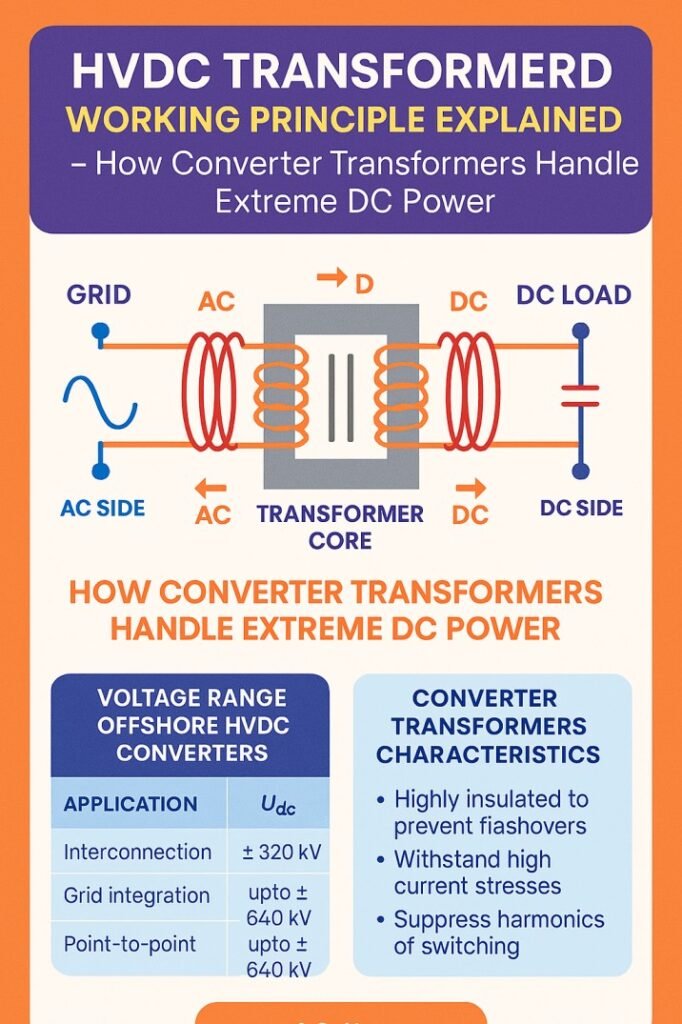
Table of Contents
HVDC transformers are not ordinary power transformers. They are engineered to interface directly with power electronic converters, manage high harmonic content, withstand DC voltage stress, and ensure precise voltage matching between AC networks and converter stations. The hvdc transformer working principle explains how these complex requirements are achieved in a single piece of equipment.
What Is an HVDC Transformer and Why It Is Unique
An HVDC transformer, often called a converter transformer, connects the AC grid to the HVDC converter valves. Its primary role is to step up or step down voltage and provide electrical isolation while feeding the converter bridge. Unlike conventional transformers, it must handle non-sinusoidal currents, DC bias, and rapid changes in operating conditions.
The hvdc transformer working principle is built around three key requirements:
- Voltage adaptation between AC system and converter
- Electrical isolation for safety and control
- Harmonic and DC stress management
Because of these requirements, HVDC transformers are usually custom-designed for each project and are among the most expensive components in an HVDC station.
Know more about Difference Between 11kV and 33kV Substation: Best Guide on Design, Cost, Capacity & Applications
Basic Construction of an HVDC Converter Transformer
To understand the hvdc transformer working principle, it is important to look at its construction. The core, windings, insulation system, and cooling arrangement are all designed differently from conventional transformers.
Key construction features include:
- Laminated magnetic core designed to limit DC flux
- Multiple winding arrangements for 12-pulse or 24-pulse converters
- High-grade oil-paper insulation system
- Robust tank and cooling system to manage losses
The windings are often divided into valve-side windings and line-side windings. The valve-side winding is exposed to high harmonic content and must be insulated accordingly.
HVDC Transformer Working Principle in Simple Terms
The hvdc transformer working principle can be explained as the controlled transfer of AC power into a form suitable for DC conversion. The transformer itself does not convert AC to DC. Instead, it supplies the correct voltage level and phase shift to the converter valves, which perform the actual rectification or inversion.
In rectifier mode, AC power flows from the grid through the transformer to the converter, where it is converted to DC. In inverter mode, DC power is converted back to AC and passed through the transformer to the receiving grid. Throughout both modes, the transformer ensures stable operation and protects the AC network from DC-side disturbances.
Know more about HVDC Converter: Best Guide to HVDC Transmission System
Role of Phase Shifting in HVDC Transformers
Phase shifting is a vital part of the hvdc transformer working principle. HVDC systems typically use 12-pulse or higher pulse converters to reduce harmonic distortion. This is achieved by using transformers with different phase shifts.
Common phase shift arrangements include:
- Star-delta connections
- Star-star connections with phase displacement
- Combination of multiple transformer units
By introducing a phase shift, certain harmonic orders cancel each other, improving power quality and reducing the need for extensive filtering.
How HVDC Transformers Handle DC Stress
One of the biggest challenges explained by the hvdc transformer working principle is DC stress. Due to asymmetrical converter operation and valve behavior, a small DC component can appear in the transformer windings. This DC component can saturate the core if not properly managed.
To handle this, HVDC transformers are designed with:
- Larger core cross-sections
- Special magnetic materials
- Air gaps or flux control techniques
These measures prevent excessive saturation, reduce losses, and avoid overheating.
Know more about HVDC Converter Efficiency: 3 Important Formulas
Insulation System and Dielectric Design
The insulation system is central to the hvdc transformer working principle. Converter transformers experience complex voltage waveforms that include harmonics, steep voltage gradients, and transient overvoltages.
The insulation design focuses on:
- High impulse withstand capability
- Resistance to partial discharge
- Long-term thermal aging performance
Oil-impregnated paper insulation is commonly used, supported by carefully designed oil ducts to ensure uniform cooling and dielectric strength.
Cooling and Thermal Performance
Thermal management is another area where the hvdc transformer working principle differs from conventional designs. Harmonic currents and higher losses generate additional heat, which must be removed efficiently.
Common cooling methods include:
- Oil Natural Air Natural
- Oil Forced Air Forced
- Oil Forced Water Forced
The choice depends on transformer rating, site conditions, and reliability requirements.
Know more about hvdc transmission
Comparison Between HVDC and Conventional Power Transformers
The table below highlights key differences that further clarify the hvdc transformer working principle.
| Feature | HVDC Transformer | Conventional Power Transformer |
|---|---|---|
| Application | AC to DC conversion interface | AC voltage transformation |
| Current waveform | Highly non-sinusoidal | Nearly sinusoidal |
| DC stress handling | Required | Not required |
| Insulation complexity | Very high | Moderate |
| Cost per MVA | Very high | Lower |
Importance of HVDC Transformers in Modern Power Systems
The hvdc transformer working principle underpins the success of long-distance power transmission, offshore wind integration, and interconnection of asynchronous grids. Without reliable converter transformers, HVDC systems would not be feasible at high voltage and power levels.
Know more about 7 Important HVDC Operating Modes
They enable:
- Reduced transmission losses over long distances
- Efficient integration of renewable energy
- Improved grid stability and controllability
Common Operational Challenges and Solutions
HVDC transformers operate under demanding conditions, and understanding the hvdc transformer working principle helps address common challenges.
Typical challenges include:
- Harmonic heating of windings
- Insulation aging due to voltage stress
- Mechanical stress during faults
These are managed through advanced design, continuous monitoring, and condition-based maintenance.
Key Parameters Considered During Design
The table below summarizes important parameters linked to the hvdc transformer working principle.
| Parameter | Design Consideration |
|---|---|
| Voltage rating | AC and DC stress coordination |
| Insulation level | Impulse and harmonic withstand |
| Core design | DC flux tolerance |
| Cooling system | Harmonic loss dissipation |
| Phase shift | Harmonic reduction |
Know more about Applications of HVDC Transmission: Where High-Voltage DC Outperforms AC in Modern Power Grids
Final Thoughts on HVDC Transformer Operation
The hvdc transformer working principle reflects decades of engineering development aimed at handling extreme electrical conditions with high reliability. These transformers are not passive components but active enablers of efficient and stable HVDC transmission.
By managing voltage transformation, isolation, phase shifting, harmonic mitigation, and DC stress, HVDC transformers ensure that massive amounts of power can be transmitted safely across continents and seas. As power systems continue to evolve, the importance of understanding and applying the hvdc transformer working principle will only continue to grow.
Follow Us on Social:
Subscribe our Newsletter on Electrical Insights for latest updates from Electrical Engineering Hub
#HVDCTransformer, #HVDCWorkingPrinciple, #ConverterTransformer, #DCTransmission, #HighVoltageEngineering, #PowerElectronics, #GridInterconnection, #HVDCSystems, #ElectricalEngineering, #PowerTransmission