
Load Flow Analysis Methods: Newton-Raphson vs Gauss-Seidel vs Fast Decoupled
Compare Load Flow Analysis Methods including Newton-Raphson, Gauss-Seidel, and Fast Decoupled methods, with equations, accuracy, speed, and applications.
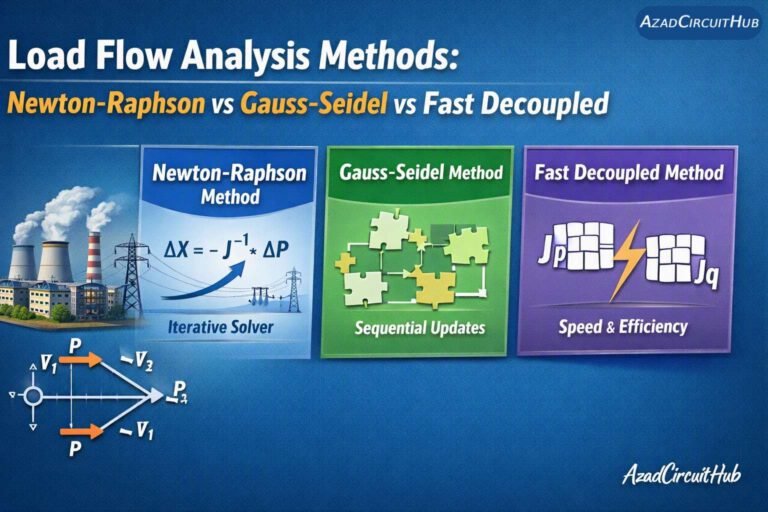
Compare Load Flow Analysis Methods including Newton-Raphson, Gauss-Seidel, and Fast Decoupled methods, with equations, accuracy, speed, and applications.
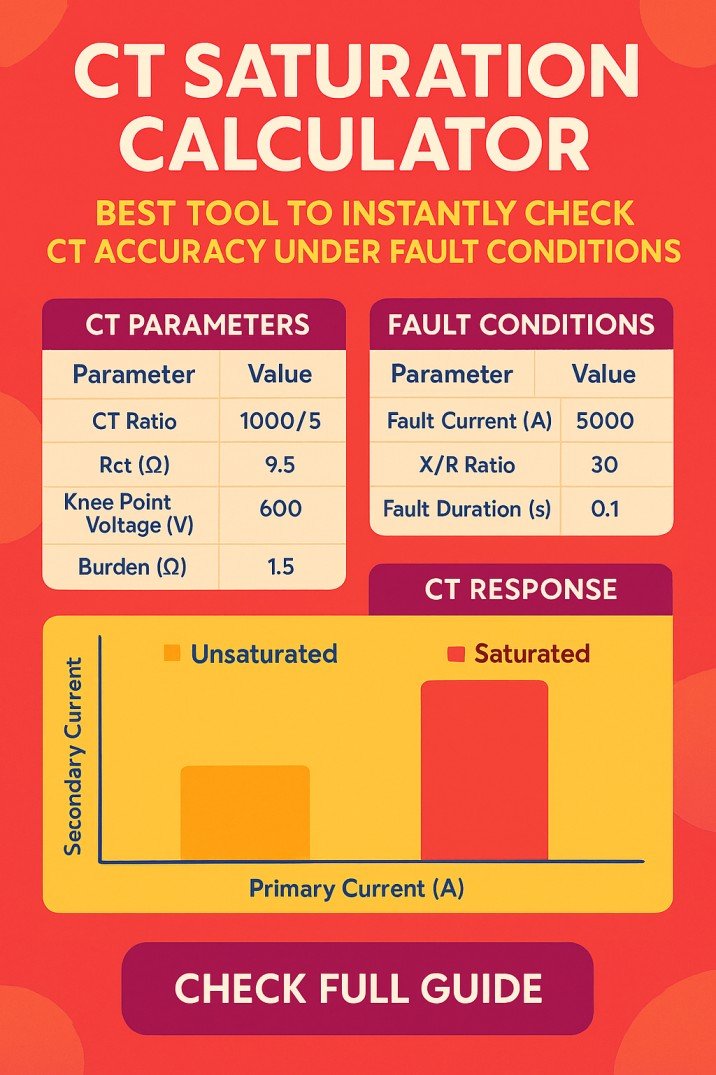
Use this CT saturation calculator to quickly determine current transformer saturation during fault conditions. Ideal for protection engineers verifying CT accuracy, knee point voltage, and reliable relay performance.
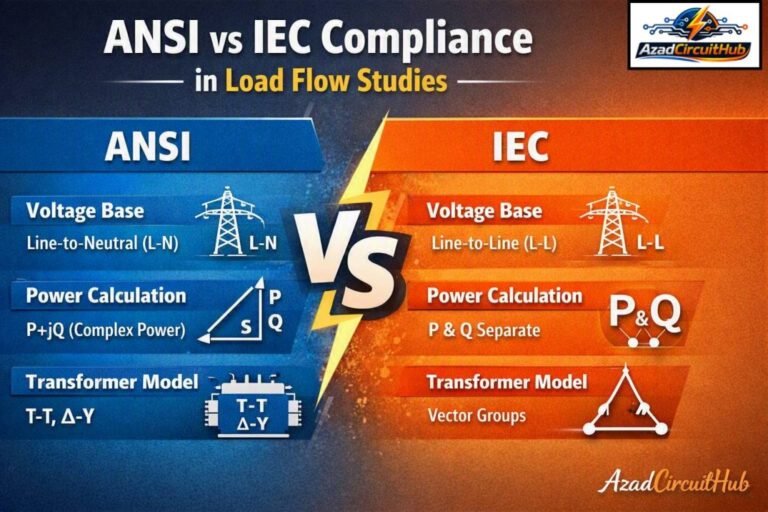
ANSI vs IEC Compliance in Load Flow Studies: Compare standards, methods, voltage limits, modeling practices, and key differences for accurate power system analysis.

Use our Transformer Neutral Current Calculator to quickly determine neutral current under unbalanced loading conditions. Improve transformer safety, enhance system reliability, and streamline power system analysis with fast and accurate calculations.

Understanding short circuit calculation methods is essential for engineers working in…

Understanding the types of faults in a power system is crucial…

Alternators are critical components in power systems. They are responsible for…

The fault current division factor is a key concept in electrical…
Understanding Current Imbalance Current imbalance occurs when the three-phase currents in…

Circuit breakers are essential components in electrical systems, designed to protect…

Fault Current Calculation made simple with practical formulas, examples, and an easy-to-use calculator. Learn how to determine short circuit current for proper equipment selection, relay coordination, and electrical system protection.