EU Low Voltage Directive 2014/35/EU Explained: CE Marking, Safety Rules & Compliance Guide for Electrical Products
The EU low voltage directive 2014/35/EU is one of the most important European laws governing electrical product safety. It applies to a vast range of electrical equipment sold within the European Economic Area. Whether you manufacture power supplies, lighting systems, industrial control panels, or household appliances, understanding the EU low voltage directive 2014/35/EU is essential for legal market access and consumer safety.
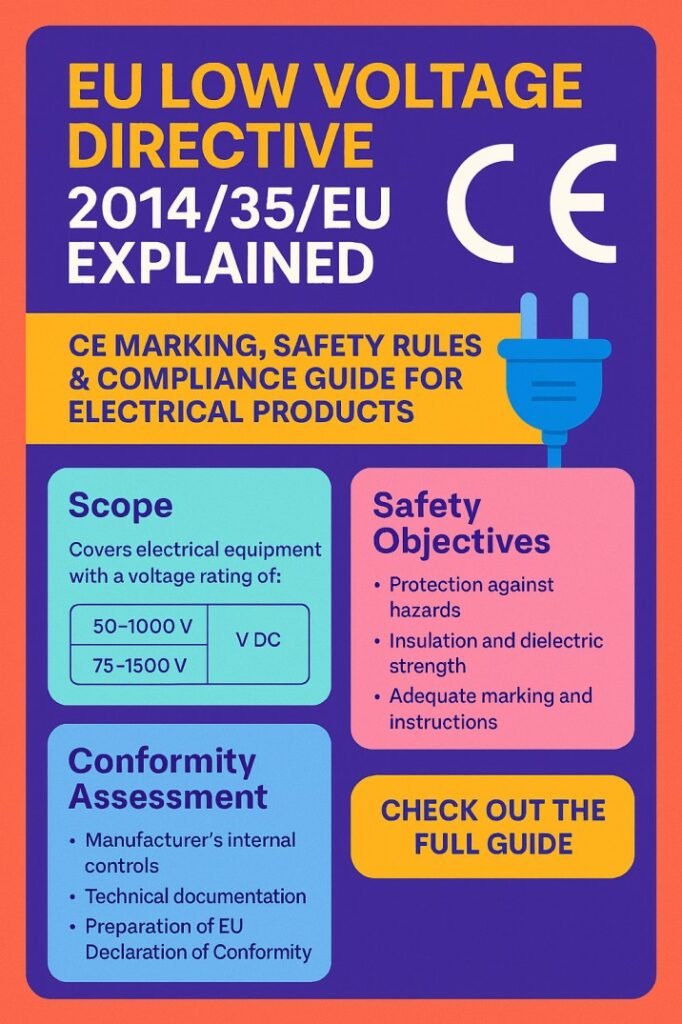
Table of Contents
This directive focuses on protecting users from electrical hazards while ensuring fair trade across EU member states. It sets clear safety objectives rather than prescribing specific technical solutions. Manufacturers must prove their products are safe before placing them on the market, and this proof is demonstrated through CE marking and proper documentation.
Know all about ieee and iec standards
What Is the Scope of the Directive
The EU low voltage directive 2014/35/EU applies to electrical equipment operating with a voltage rating between 50 and 1000 V AC, and 75 and 1500 V DC. This includes a broad spectrum of products used in homes, offices, factories, and commercial installations.
However, certain categories are excluded. These include electrical equipment for explosive atmospheres, medical devices, lifts, electricity meters, and railway equipment. Those fall under other specialized directives.
The table below summarizes the coverage.
| Category | Covered Under LVD | Notes |
|---|---|---|
| Household appliances | Yes | Includes kitchen and cleaning devices |
| Industrial electrical equipment | Yes | Control panels, machinery components |
| Power supplies and adapters | Yes | External and internal PSUs |
| Medical electrical equipment | No | Covered by Medical Devices Regulation |
| ATEX equipment | No | Governed by ATEX Directive |
| Electrical parts for elevators | No | Covered under Lift Directive |
Know more about OSHA Electrical Safety Standard 1910 – Workplace Electrical Safety | Safety Experts
Safety Objectives and Essential Requirements
Instead of giving detailed design instructions, the EU low voltage directive 2014/35/EU defines essential safety objectives. These requirements ensure electrical equipment does not endanger people, animals, or property when properly installed and maintained.
Key safety areas include protection against electric shock, overheating, fire hazards, mechanical risks, and radiation dangers. Insulation, grounding, clearances, creepage distances, and temperature rise limits all play a role in compliance.
Manufacturers usually demonstrate conformity by applying harmonised European standards such as EN 60335 for household appliances or EN 60950/62368 for IT and audio-visual equipment. Using these standards gives a “presumption of conformity,” meaning authorities accept that the essential requirements are met.
Know more about G99 Grid Connection Standard: Guide to Compliance, Safety & Efficient Integration
Role of CE Marking
CE marking is the visible proof that a product complies with the EU low voltage directive 2014/35/EU and other applicable EU legislation. It is not a quality mark or certification logo. Instead, it is a legal declaration by the manufacturer.
Before affixing the CE mark, the manufacturer must carry out a conformity assessment. For most products under this directive, self-declaration is allowed. A Notified Body is not typically required unless another directive demands it.
The CE mark must be affixed visibly, legibly, and indelibly to the product or its nameplate. If this is not possible, it may appear on packaging and accompanying documents.
Explore Top 30 UK G99 Grid Connection Interview Questions: Master Your Power System Job Prep
Conformity Assessment Process
Compliance with the EU low voltage directive 2014/35/EU follows a structured process. This ensures that safety is built into the product from the design stage.
| Step | Action Required | Purpose |
|---|---|---|
| 1 | Identify applicable directives and standards | Defines legal framework |
| 2 | Perform risk assessment | Identifies potential hazards |
| 3 | Design and test product | Ensures electrical safety |
| 4 | Compile technical documentation | Evidence of compliance |
| 5 | Prepare EU Declaration of Conformity | Legal declaration |
| 6 | Affix CE marking | Market access requirement |
The risk assessment should consider electrical, mechanical, thermal, and environmental risks. Testing may include dielectric strength, insulation resistance, leakage current, and abnormal operation scenarios.
Know more about Electrical Standards USA – National Electrical Code | Electrical Safety Foundation
Technical Documentation Requirements
A technical file is mandatory under the EU low voltage directive 2014/35/EU. This documentation must be available to market surveillance authorities upon request, usually for ten years after the last product is placed on the market.
Typical contents of a technical file include product design drawings, circuit diagrams, bill of materials, risk assessment reports, test results, standards applied, and copies of labeling and instructions. Clear documentation shows that safety was considered at every stage of product development.
Poor or incomplete documentation is one of the most common reasons products fail compliance checks.
EU Declaration of Conformity
The EU Declaration of Conformity is a legal statement that the product complies with the EU low voltage directive 2014/35/EU. It must include the manufacturer’s name and address, product identification, applied standards, and references to relevant directives.
This declaration must be signed by an authorized person within the company. It does not need to accompany every product physically, but it must be available to authorities when requested.
Learn more in detail on NEMA 250 Enclosures – Electrical Enclosure Standards | Best Manufacturing Companies in USA
Responsibilities of Economic Operators
The directive does not apply only to manufacturers. Importers and distributors also have legal duties when dealing with products covered by the EU low voltage directive 2014/35/EU.
| Operator | Key Responsibilities |
|---|---|
| Manufacturer | Ensure design compliance, prepare documentation, affix CE mark |
| Importer | Verify CE marking and documentation before placing product on EU market |
| Distributor | Check labeling, instructions, and traceability information |
| Authorized Representative | Act on behalf of non-EU manufacturer if appointed |
Traceability is crucial. Products must include type, batch, or serial numbers along with manufacturer and importer contact details.
Labeling and User Instructions
Clear labeling is part of compliance with the EU low voltage directive 2014/35/EU. Electrical ratings, warnings, and safe installation instructions must be provided in a language easily understood in the destination country.
Instructions should cover safe use, maintenance, and foreseeable misuse. If improper installation could create hazards, the documentation must clearly explain the correct procedure.
Learn more about NFPA 70 National Electrical Code | Electrical Safety Experts
Market Surveillance and Enforcement
EU member states conduct market surveillance to ensure only safe products circulate. Authorities may request technical files, test products, or inspect manufacturing facilities. Non-compliant products can be withdrawn, recalled, or banned from sale.
Penalties may include fines and legal action, especially if unsafe equipment causes injury or property damage. Proper adherence to the EU low voltage directive 2014/35/EU significantly reduces these risks.
Common Compliance Mistakes
Manufacturers often underestimate documentation requirements. Missing risk assessments, outdated standards, or incomplete test reports can lead to non-compliance findings.
Another frequent issue is applying CE marking without verifying all applicable directives. Many electrical products also fall under the EMC Directive or RoHS Directive. Overlooking these linked regulations can invalidate the conformity claim related to the EU low voltage directive 2014/35/EU.
Know more about 7 Common Mistakes in Electrical Outlet Height
Why Compliance Matters for Global Trade
Following the EU low voltage directive 2014/35/EU does more than satisfy legal obligations. It builds customer trust, reduces product liability risks, and simplifies entry into one of the world’s largest markets.
Because EU safety standards are widely respected, compliant products often find it easier to access other international markets. Many countries recognize or align with European safety principles, making compliance a strong competitive advantage.
Final Thoughts
The EU low voltage directive 2014/35/EU plays a central role in ensuring electrical equipment sold in Europe is safe and reliable. It focuses on essential safety objectives, supported by harmonised standards, proper testing, and strong documentation. CE marking, technical files, and the Declaration of Conformity form the backbone of compliance.
Manufacturers that integrate safety and compliance early in product design avoid costly redesigns, delays, and legal issues. Understanding and correctly applying the EU low voltage directive 2014/35/EU is not just a regulatory task. It is a fundamental part of responsible electrical product engineering and successful access to the European market.
Know more about Transformer Oil Testing: 9 Important Tests for Healthiness
Follow Us on Social:
Subscribe our Newsletter on Electrical Insights for latest updates from Electrical Engineering Hub
#EULowVoltageDirective, #CECompliance, #ElectricalSafetyEU, #LVDCertification, #ElectricalStandards, #ProductCompliance, #EURegulations, #ElectricalEngineering, #ConformityAssessment, #CE Marking
