G99 Grid Connection Standard: Guide to Compliance, Safety & Efficient Integration
The G99 grid connection standard is a cornerstone regulation in the United Kingdom for ensuring that renewable energy generators connect safely and efficiently to the electricity distribution network. As the push for low-carbon energy sources grows, understanding and complying with G99 is essential for developers, engineers, and network operators alike. This guide provides a practical overview of the standard, highlighting compliance requirements, safety protocols, technical specifications, and integration strategies.
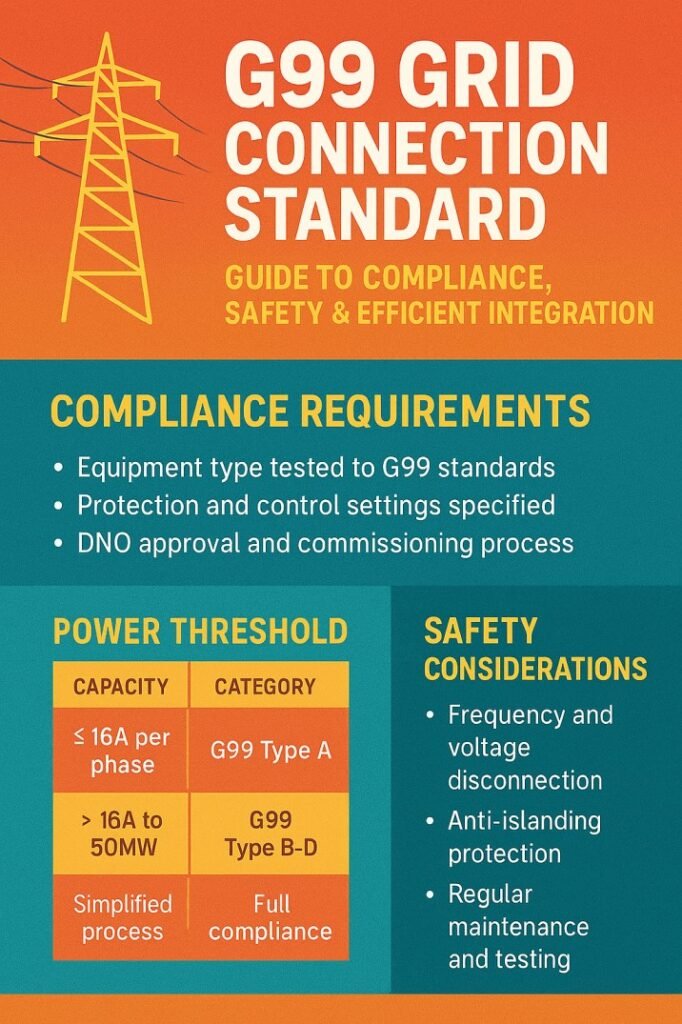
Table of Contents
Understanding the G99 Grid Connection Standard
The G99 grid connection standard replaced the older G59 regulation in 2019, reflecting the evolution of the UK’s energy landscape and the increasing prevalence of distributed generation. G99 applies to all new generation plants connecting to the distribution network with a capacity exceeding 16A per phase, including solar farms, wind turbines, battery storage, and other renewable systems.
At its core, G99 aims to ensure that generators operate safely, maintain network stability, and do not negatively impact existing customers. It defines technical and procedural requirements for protection systems, voltage and frequency limits, and testing before connection. Compliance with G99 is not only a regulatory necessity but also a pathway to long-term operational efficiency and network reliability.
Experience fast and accurate results using our online tool cable size calculator uk
Key Compliance Requirements of G99
The G99 grid connection standard outlines several critical compliance elements. These are structured to ensure that any new generator integrates smoothly with the distribution network without causing instability or safety risks.
- Voltage and Frequency Protection:
Generators must disconnect automatically in the event of abnormal voltage or frequency. This protects both the generator and the broader network. - Power Factor Management:
The standard mandates that generators operate within specified reactive power limits to maintain network voltage stability. - Fault Ride-Through (FRT) Capability:
Generators must remain connected during short-term disturbances, supporting network stability instead of disconnecting immediately. - Harmonics Control:
Electrical equipment must limit harmonic emissions to prevent interference with other devices connected to the network. - Protection Settings:
All protection devices must be coordinated with the Distribution Network Operator (DNO) to avoid nuisance tripping or delayed operation during faults.
These requirements ensure that generators contribute positively to network performance while safeguarding safety and equipment integrity.
Use our online tool Heat Pump KWh Calculator UK Free – Instantly Estimate Running Costs & Savings
G99 Connection Process
Connecting a generator under the G99 grid connection standard involves several stages, each requiring detailed technical and administrative steps.
| Stage | Description | Key Considerations |
|---|---|---|
| Pre-Application | Initial contact with the DNO to discuss feasibility | Understand network capacity, initial studies, and project constraints |
| Application | Submission of detailed design and protection plans | Ensure compliance with G99 protection, voltage, and frequency requirements |
| Design Review | Technical assessment by DNO | May include short-circuit studies, harmonic analysis, and FRT verification |
| Installation & Testing | Physical installation and pre-commissioning tests | Verification of protective devices, relay settings, and communication systems |
| Commissioning | Final approval and energization | DNO issues permission to operate once all standards are met |
This structured process ensures that generators are not only compliant with the G99 grid connection standard but also optimized for reliable operation.
Technical Considerations for Efficient Integration
Efficiency and stability are crucial when connecting generators under G99. Engineers must consider multiple technical factors to ensure seamless integration.
- Transformer and Cable Sizing: Correct sizing prevents overheating, voltage drops, and losses.
- Protection Coordination: Proper coordination avoids unnecessary tripping during network disturbances.
- Communication Interfaces: Modern G99-compliant systems often require SCADA or remote monitoring integration to provide real-time operational data to the DNO.
- Reactive Power Control: Active management of reactive power helps maintain voltage levels and avoids penalties for poor power factor.
- Energy Storage Integration: Battery systems can enhance compliance with FRT and voltage support requirements, providing both stability and flexibility.
By addressing these factors, developers can maximize generator efficiency while adhering strictly to the G99 grid connection standard.
Use our online tool Watts to KWh Cost Calculator UK: Instantly Check & Slash Your Electricity Bills
Safety Considerations Under G99
Safety is a central element of the G99 grid connection standard. Failure to comply can result in hazards for personnel, equipment, and the wider network. Key safety measures include:
- Automatic Disconnection: Prevents damage during overvoltage or fault conditions.
- Earthing and Bonding: Ensures that exposed conductive parts are safely earthed.
- Isolation Protocols: Provides safe working conditions during maintenance or emergencies.
- Fault Monitoring: Real-time fault detection reduces the risk of prolonged exposure to dangerous electrical conditions.
These measures not only protect individuals but also enhance network resilience.
Testing and Documentation
A crucial aspect of G99 compliance is rigorous testing and documentation. Before connection, the generator must undergo:
| Test Type | Purpose | Typical Methods |
|---|---|---|
| Protection Relay Testing | Verify correct tripping during abnormal conditions | Primary injection, secondary injection, software simulation |
| Voltage & Frequency Tests | Confirm compliance with operational limits | Steady-state and dynamic simulation |
| Harmonics Measurement | Ensure compliance with harmonic limits | Spectrum analysis, on-site measurement |
| FRT Testing | Confirm generator stays connected during short disturbances | Hardware-in-loop or field testing |
Comprehensive documentation must accompany each test, forming part of the application for DNO approval. Accurate records demonstrate compliance and can prevent costly delays.
Use our online tool Fish Tank Electricity Cost Calculator UK – Find Out Your Aquarium Energy Bills Instantly
Practical Tips for G99 Compliance
Achieving seamless compliance with the G99 grid connection standard requires careful planning and execution. Some practical tips include:
- Engage early with the DNO to identify potential network constraints.
- Use simulation software to model voltage, frequency, and fault scenarios.
- Maintain detailed records of all protection settings, tests, and commissioning procedures.
- Incorporate modern monitoring solutions to track generator performance and network interactions.
- Regularly review G99 updates and guidance to stay aligned with regulatory changes.
These proactive measures reduce the risk of non-compliance and improve operational efficiency.
Future-Proofing with G99
As the energy landscape evolves, adherence to the G99 grid connection standard ensures that generators remain compatible with emerging technologies such as smart grids, advanced energy storage, and distributed generation systems. Compliance today can simplify future expansions, reduce retrofit costs, and improve grid resilience.
Use our online tool for free Solar Panels kWh Calculator UK: Instantly Estimate Output, Savings & Payback
In addition, integrating renewable generation efficiently under G99 supports the UK’s low-carbon energy targets. Well-planned G99-compliant systems contribute to network stability, minimize losses, and enhance overall power quality.
Conclusion
The G99 grid connection standard is more than a regulatory requirement; it is a framework for safe, efficient, and reliable integration of generation into the distribution network. From initial design through testing, commissioning, and ongoing operation, understanding and following G99 ensures that renewable energy projects operate safely, contribute positively to the grid, and remain future-ready.
By paying attention to compliance requirements, technical considerations, and safety protocols, developers and engineers can achieve successful integration while avoiding costly delays or penalties. The standard provides a roadmap for optimizing performance, protecting equipment and personnel, and supporting the UK’s transition to a sustainable energy future.
Learn more about Top 15 Best Electrical Courses in UK: Industrial Trainings Which Pay More
Follow Us on Social:
Subscribe our Newsletter on Electrical Insights for latest updates from Electrical Engineering Hub
#g99gridconnection, #gridstandards, #renewableintegration, #solarpvconnection, #electricityregulations, #distributionnetwork, #smartgridcompliance, #energyengineering, #gridcode, #powerengineering
